The Maintenance Problem in Round-the-Clock Warehousing
Warehouse robotics operates under conditions that would punish any mechanical component. Dust, debris, temperature fluctuations, and relentless 24/7 duty cycles create an environment where traditional metal bearings with grease lubrication face constant degradation. The lubrication itself becomes a liability — grease attracts and traps airborne particles, accelerating wear rather than preventing it. Maintenance schedules built around re-lubrication add labor costs and create downtime that undermines the very efficiency gains the robots are supposed to deliver.
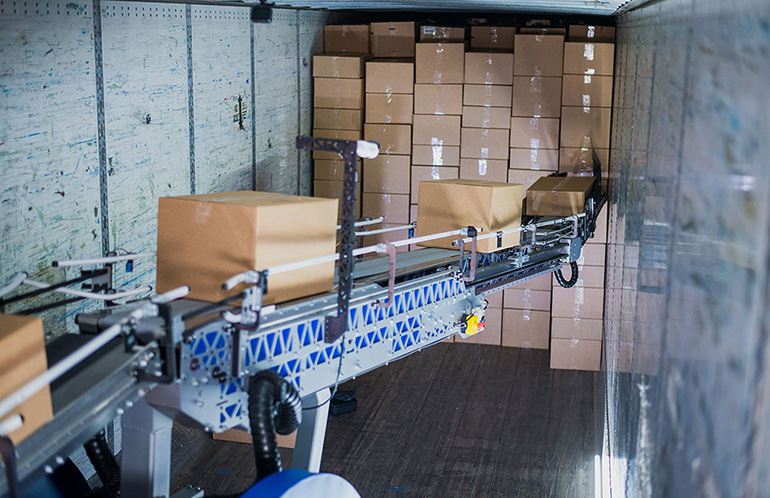
Bastian Solutions, a Toyota Advanced Logistics company that develops automated material handling systems, confronted this problem directly when engineering its ULTRA BLUE autonomous truck-loading robot. The system is designed to replace manual box loading in warehouse shipping operations, handling over 1,000 cases per hour in continuous operation. With a retractable mast, six-degree-of-freedom end-of-arm tooling, and articulating conveyors guided by lidar navigation, the ULTRA BLUE is a mechanically complex platform with numerous points of rotational and linear motion — each one a potential maintenance headache.
The Switch to Self-Lubricating Polymers
Rather than accepting the conventional approach of metal bearings and regular lubrication, Bastian Solutions turned to igus, a German manufacturer specializing in high-performance polymer motion components that require no external lubrication. The collaboration resulted in the integration of four distinct igus product types across the ULTRA BLUE platform, each addressing a specific motion requirement.
Plain bearings were installed in a four-bar linkage mechanism — one of the most mechanically stressed subsystems on the robot. This linkage translates motor rotation into the complex articulation patterns needed to position conveyor sections during the loading process. Traditional bearings in this location required frequent attention; the igus polymer bearings eliminated that maintenance entirely while doubling the system's operational lifespan and cutting bearing costs in half.
Linear guides were deployed to support both the linkage mechanism and the conveyor sections. These guides must provide smooth, quiet operation in busy warehouse environments where noise levels are already a concern. The polymer material's inherent damping properties contribute to quieter operation compared to metal-on-metal alternatives, a benefit that compounds across facilities running dozens of robotic systems simultaneously.
Solving the Spherical Joint Challenge
One of the more elegant engineering solutions involved the pivoting conveyor sections that allow the ULTRA BLUE to articulate its loading path into different truck configurations. These pivot points require spherical ball joints that accommodate multi-axis rotation while supporting significant dynamic loads as cases travel along the conveyor at high speed.
Traditional spherical joints in dusty warehouse environments typically require dust boots — protective covers that seal the joint against contamination. These boots add cost, create additional failure points, and must be inspected and replaced periodically. The igus spherical ball joints, made from self-lubricating polymer compounds, eliminated the need for dust boots entirely. The material is inherently resistant to particle ingress, and even when exposed to dust and debris, it continues to function without the accelerated wear that would destroy a lubricated metal joint.
At the rear conveyor pivot, plain slewing bearings handle the rotational loads that allow the conveyor system to track and align with the truck's loading area. These bearings must support both radial and axial loads simultaneously while maintaining smooth rotation under varying load conditions as cases of different weights pass through the system.
The Technical Case for Motion Plastics
The advantages of self-lubricating polymer components in warehouse robotics extend beyond the elimination of grease. Temperature resilience is a significant factor — warehouses can experience wide temperature swings between seasons, and traditional grease lubricants change viscosity with temperature, becoming too thick in cold conditions and too thin in heat. Polymer bearings maintain consistent performance across a broad temperature range without any adjustment or seasonal maintenance.
Weight reduction is another benefit. Polymer components are significantly lighter than their metal counterparts, reducing the overall mass of moving subsystems. In a robot that must accelerate and decelerate its conveyor sections thousands of times per day, lower moving mass translates directly into reduced motor loads, lower energy consumption, and less stress on structural components.
Chemical resistance rounds out the technical case. Warehouse environments may expose equipment to cleaning agents, hydraulic fluid leaks from other machinery, or product spills. Igus polymer materials are resistant to a wide range of chemicals that would attack conventional lubricants or corrode metal bearing surfaces.
Broader Implications for Warehouse Automation
The Bastian Solutions case study illustrates a broader trend in warehouse robotics: the migration away from maintenance-intensive mechanical designs toward components and materials that support true deploy-and-forget operation. As warehouses deploy larger fleets of robots, the cumulative maintenance burden of traditional components becomes a scaling bottleneck. A facility with ten robots might manage regular lubrication schedules; a facility with a hundred robots cannot afford the labor and downtime.
Lubrication-free motion plastics address this scaling challenge directly. Each component that eliminates a maintenance task reduces the total cost of ownership for the robot fleet and increases the effective uptime of every unit. For warehouse operators already facing labor shortages, shifting maintenance hours from robot servicing to other value-adding activities is an immediate productivity gain.
The partnership between Bastian Solutions and igus also demonstrates how component-level innovation can have system-level impact. The ULTRA BLUE's doubled lifespan and halved bearing costs were not achieved through a radical redesign of the robot's architecture but through thoughtful material substitution at specific high-wear points. This approach is replicable across the warehouse robotics industry, suggesting that many existing robotic platforms could benefit from similar polymer component upgrades without requiring fundamental engineering changes.
This article is based on reporting by The Robot Report. Read the original article.
Originally published on therobotreport.com