Google’s telepresence platform is now targeting a more specific meeting problem
Video conferencing solved availability, not presence. That has been the core weakness of remote work tools for years: people can join, but they often do not feel equally situated in the room. Google’s latest experiment for Google Beam is aimed squarely at that gap.
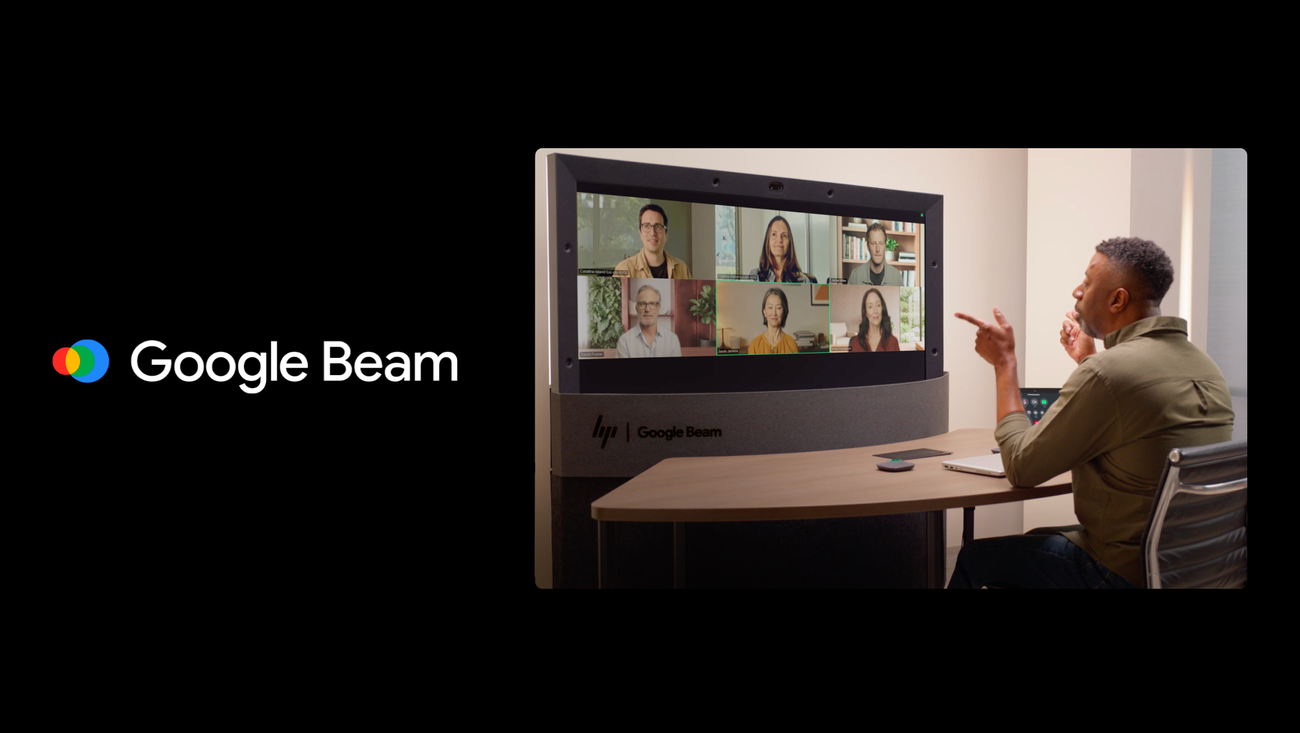
According to the company, Beam can now present participants joining from non-Beam devices in true-to-life size on HP Dimension’s immersive display, positioning them as if they were seated around a shared table. Spatial audio then anchors each voice to the apparent location of the speaker.
The goal is to make hybrid group meetings feel less like a wall of floating faces and more like a physically coherent conversation.
Why group meetings are harder than one-to-one calls
Standard video meetings work tolerably well when one person speaks at a time and everyone has equal screen real estate. They break down when the social dynamics become more complex. Side glances, turn-taking, interruptions, and subtle emotional cues are harder to interpret when participants are compressed into small boxes and remote voices emerge from a single undifferentiated speaker.
That is where the so-called inclusion gap comes from. People dialing in from elsewhere may technically be present while still feeling peripheral. The friction shows up in missed openings to speak, weaker rapport, and a lower sense that the meeting is genuinely shared.
Google is positioning Beam as a fix for that problem by restoring scale and directional cues that ordinary conferencing strips away.
What the experiment changes
The company says Beam’s new optimization works automatically for participants joining from home or the office, even if they are not using Beam hardware themselves. On the immersive display, those participants are rendered at life size and placed as though they are seated at the same table as Beam users in the room.
Spatial audio is the other half of the effect. Instead of hearing all remote participants from a single point, listeners hear voices tied to where each person appears visually. That alignment reduces the mental work required to match speech to speaker and can make multi-person discussion feel more natural.
This is not just a graphics trick. It is an attempt to reconstruct the social geometry of a meeting.
Google’s own results suggest a measurable effect
Google says its research indicates approaches like this can produce a 50% stronger sense of social connection and a 21% increase in participants’ reported ability to contribute to conversations. Those are company-reported figures, so they should be interpreted as directional rather than definitive, but they point to the metric Beam is optimized for.
The product is not trying to be another generic meeting client. It is trying to improve subjective meeting quality, especially for mixed in-room and remote groups where standard setups tend to favor the people physically present.
In that sense, Beam reflects a broader shift in enterprise communication design: from simple connectivity toward behavioral outcomes such as participation, inclusion, and engagement.
Where Beam fits in Google’s strategy
The source material says Google is continuing to work with both Google Workspace and Zoom to elevate standard meetings on Beam. That is important because enterprise adoption usually depends on compatibility with existing software habits, not just hardware novelty.
Beam has always been more ambitious than a normal conferencing system. Its premise is that better sensing, rendering, and audio can create a more convincing experience of co-presence. The challenge is turning that promise into something organizations can deploy without rebuilding their collaboration stack from scratch.
By improving group meetings across more devices rather than only between dedicated Beam endpoints, Google is signaling that practical interoperability matters if the platform is to move beyond showcase demos.
The business case for “better presence” is getting clearer
Hybrid work is no longer a temporary adjustment. It is an operating condition. That means the quality of mediated interaction now affects productivity, management, hiring, and culture in durable ways. If remote participants consistently feel less able to enter discussions, organizations absorb that cost over time.
Technologies that reduce that asymmetry can therefore justify themselves not just as premium AV upgrades, but as tools for collaboration quality. The more companies accept distributed teams as normal, the more attention will move from whether meetings are possible to whether they are equitable and effective.
Beam’s value proposition is strongest in that second frame.
What remains to be proven
Google’s experiment is promising, but enterprise telepresence has a history of looking impressive in controlled environments while struggling on cost, complexity, or deployment scale. The source text does not describe broad rollout details, and the success of Beam will depend on whether organizations see enough benefit to justify specialized hardware experiences.
There is also a user adaptation question. Even a more immersive setup has to fit into real meeting behaviors, office room constraints, and remote work patterns. Better rendering and audio can help, but they do not automatically fix poor facilitation or overloaded meeting culture.
Still, the product is targeting a real pain point with a technically coherent approach. In a market crowded with AI note takers and summary tools, Beam stands out by trying to improve the meeting itself rather than merely documenting it afterward.
If hybrid work is here to stay, the next competition in communication software may be less about joining calls and more about making them feel worth joining. Beam is an early and unusually concrete bet on that future.
This article is based on reporting by Google AI Blog. Read the original article.
Originally published on blog.google