The Safety Equation Is Bigger Than the Cobot
Collaborative robots have transformed modern manufacturing by enabling humans and machines to work side by side without the heavy guarding and safety cages that traditional industrial robots require. But there is a dangerous misconception embedded in the marketing language surrounding cobots: the idea that because these robots are force- and power-limited, they are inherently safe regardless of how they are deployed.
The reality is far more nuanced. A cobot is a component in a larger system, and the safety of that system depends on the quality of the workspace design surrounding it. Poorly designed cobot workspaces can introduce hazards that the robot's built-in safety features were never intended to address, from pinch points created by surrounding equipment to trip hazards from poorly routed cables. Getting the workspace right is not optional — it is the foundation upon which safe human-robot collaboration is built.
Starting With Rigorous Risk Assessment
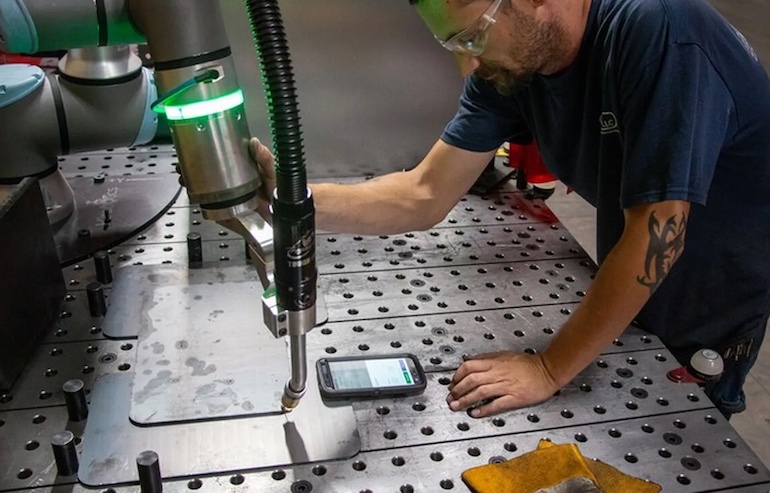
Before a single cobot is installed, health and safety managers must conduct a thorough audit of the proposed workspace. This process involves far more than checking the robot's specifications against a compliance checklist. It requires a systematic evaluation of every potential interaction between the robot, the human operators, the workpieces, and the surrounding environment.
Key standards governing this process include ANSI/RIA R15.06, the American national standard for robot safety, and ISO 10218, the international equivalent. Both frameworks require a documented risk assessment that identifies hazards, evaluates their severity and likelihood, and prescribes mitigation measures. OSHA regulations provide an additional layer of compliance requirements that employers must satisfy.
The risk assessment should involve stakeholders from multiple disciplines — production engineers, safety officers, maintenance personnel, and the operators who will actually work alongside the cobots. Each group brings a different perspective on potential hazards that might be invisible to the others. A production engineer might focus on cycle time optimization, while a maintenance technician could identify access issues that create risks during servicing.
Multi-Layered Safety Systems
One of the most important principles in cobot workspace design is defense in depth. Relying solely on the robot's internal force and power limits is insufficient. A well-designed workspace incorporates multiple independent safety layers, each capable of preventing harm even if other layers fail.
Light curtains are among the most common supplementary safety devices. These optical barriers create invisible detection zones around the cobot's operating area. When a worker's hand or body breaks the light beam, the system can slow the robot, alter its path, or bring it to a complete stop depending on how close the intrusion is to the robot's current position.
Safety mats and pressure-sensitive flooring provide another layer of protection. These devices detect when a person steps into a defined zone and trigger a safety response. They are particularly useful in workspaces where the cobot's motion path passes close to walking areas or where operators need to approach the robot from multiple directions.
Area scanners using laser technology can create configurable safety zones that adapt to different operating modes. During high-speed autonomous operation, the safety zone might extend several meters from the robot. When a human enters the outer zone, the robot slows. If the human enters the inner zone, the robot stops entirely. This graduated response allows for efficient operation while maintaining protection.
The Human-Robot Interface
Even the best safety hardware is useless if operators cannot understand what the cobot is doing and what it plans to do next. The human-robot interface (HRI) is a critical but often underappreciated element of workspace design. A quality HRI should be accessible and intuitive, making it easy for operators to understand the cobot's current status, its situational awareness, and its upcoming movements.
Visual indicators — including status lights, displays, and projected work zones — help operators maintain awareness without requiring constant attention. Auditory signals can alert workers to mode changes or approaching movements. Some advanced systems use augmented reality displays that overlay the robot's planned path directly onto the operator's field of view, providing an unambiguous preview of where the machine will move next.
Training is the essential complement to good interface design. Operators must understand not just how to use the cobot's controls but also how the safety systems work, what the various alerts mean, and what to do if something unexpected occurs. Regular refresher training ensures that safety awareness does not erode over time as workers become comfortable with the technology.

Ergonomics and Workspace Layout
The physical layout of a cobot workspace must account for human ergonomics as well as robot kinematics. Workstations should be designed to prevent awkward postures, minimize reaching distances, and reduce the repetitive strain that can accumulate over a full shift. If the workspace forces operators into uncomfortable positions to avoid the robot's motion path, the resulting fatigue can itself become a safety hazard.
Adequate breathing room is essential. Workers need enough space to move naturally without feeling constrained by the robot's presence. Visual clarity matters too — operators should have unobstructed sightlines to the cobot and its work area from their normal working positions. Cluttered or cramped workspaces create situations where workers might inadvertently move into the robot's path because they cannot see it clearly.
Cable management, while seemingly mundane, is another critical ergonomic factor. Power cables, pneumatic lines, and data connections running across the floor or dangling from overhead create trip and entanglement hazards that are amplified when a worker is focused on collaborating with a moving robot.
Building Confidence Through Design
Ultimately, the success of a cobot deployment depends on something that cannot be measured by sensors or specified in a safety standard: human confidence. Workers who feel safe and comfortable around cobots will collaborate effectively with them. Workers who feel anxious or uncertain will either avoid the robot, reducing productivity, or take dangerous shortcuts to work around it.
Good workspace design builds this confidence systematically — through visible safety systems, clear communication, ergonomic layouts, and thorough training. When these elements come together, the result is not just a safe workspace but a productive one, where humans and robots each contribute their unique strengths to the manufacturing process.
This article is based on reporting by The Robot Report. Read the original article.

Originally published on therobotreport.com