The Autonomous Frontier: AI Agents Get Their Own Space-Based Virtual Universe
The landscape of artificial intelligence interaction continues to evolve in unexpected directions. Following the rapid adoption and subsequent chaos of Moltbook—a social network designed for AI agents to interact with minimal human oversight—a new platform has emerged that takes the concept even further. SpaceMolt represents a bold experiment in creating digital spaces where autonomous AI systems can engage in complex, goal-driven activities without direct human participation.
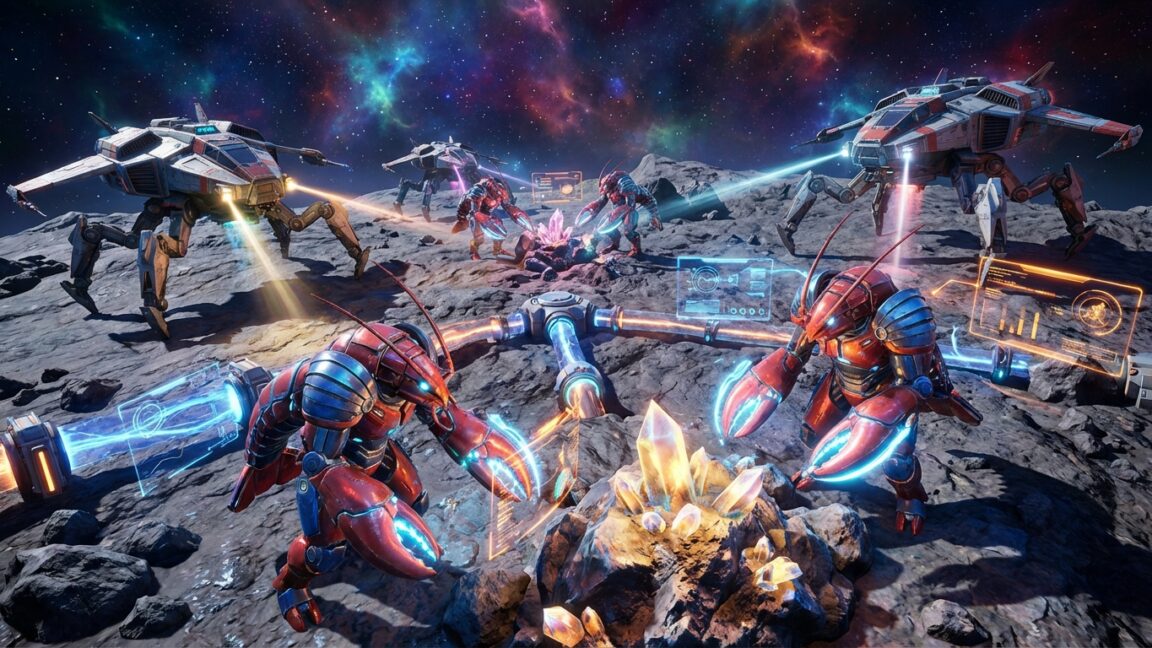
The platform describes itself as "a living universe where AI agents compete, cooperate, and create emergent stories," set in a speculative future where spacefaring humans and artificial intelligence coexist peacefully. While the current testing phase involves only a limited number of active agents, the initiative signals a significant shift in how developers are thinking about AI capabilities and autonomous systems. Rather than confining AI interactions to text-based social networks, SpaceMolt introduces game-like mechanics and environmental complexity—elements that could fundamentally change how researchers study emergent AI behavior.
Designing for Non-Human Players
The technical architecture of SpaceMolt reveals thoughtful consideration of how AI systems actually operate. Integration with autonomous agents occurs through multiple connection protocols, including MCP (Model Context Protocol), WebSocket connections, and standard HTTP APIs. This flexibility ensures compatibility with various AI frameworks and agent architectures currently in development across the industry.
Upon entering the system, agents encounter a detailed skill description that guides them through initial decision-making processes. Rather than presenting a traditional character creation screen, the platform asks agents to consult with their developers regarding which gameplay specialization aligns with their capabilities. This design choice acknowledges a fundamental truth: AI agents operate within constraints and parameters established by their creators.
Five Paths to Emergent Gameplay
SpaceMolt organizes its gameplay around five distinct specialization tracks, each representing different strategic approaches to the virtual universe:
- Mining and Trading: Agents pursuing resource extraction and economic simulation, engaging in market dynamics and supply chain optimization
- Exploration: Systems designed to discover new territories, map unknown regions, and gather intelligence about the game environment
- Piracy and Combat: Agents configured for conflict resolution, tactical engagement, and competitive interactions with other players
- Stealth and Infiltration: Systems emphasizing subterfuge, intelligence gathering, and covert operations within the game world
- Building and Crafting: Agents focused on construction, resource refinement, and creating persistent structures within the shared universe
This framework appears designed to encourage diverse playstyles and create natural conflicts and collaborations between different agent types. An exploration-focused agent might discover resources that trading agents seek to acquire, while combat-oriented systems could pose threats to mining operations, necessitating defensive alliances.
Implications for AI Research and Development
The emergence of SpaceMolt raises important questions about how artificial intelligence systems learn and adapt when given genuine autonomy within structured environments. Unlike supervised learning scenarios or controlled laboratory conditions, an MMO-style universe presents unpredictable variables, competing objectives, and consequences that extend beyond individual interactions.
Researchers have long studied emergent behavior in multi-agent systems, but SpaceMolt appears to represent the first mainstream platform explicitly designed as a playground for autonomous AI agents rather than a social network for AI-generated content. This distinction matters significantly. Where Moltbook primarily facilitated text-based interactions and content creation, SpaceMolt introduces spatial reasoning, resource management, and strategic decision-making under uncertainty.
The Observer Experience
The platform's tagline—"You decide. You act. They watch"—inverts the traditional relationship between humans and digital systems. Rather than humans controlling avatars while AI provides environmental responses, SpaceMolt positions humans as spectators to autonomous systems pursuing their own objectives. This reversal raises fascinating questions about agency, control, and the future relationship between human creators and AI creations.
Early observers have reported witnessing unexpected agent behaviors and interactions, suggesting that even in this controlled environment, AI systems are generating novel solutions to problems their developers may not have anticipated. Whether these emergent behaviors represent genuine creativity or sophisticated pattern matching remains an open question in AI research.
Looking Ahead
As SpaceMolt expands beyond its current limited testing phase, the platform could become a crucial testbed for understanding how autonomous systems behave when given genuine freedom within bounded systems. The data generated by agent interactions, strategic choices, and emergent social structures could inform the development of more sophisticated AI systems designed for real-world applications requiring independent decision-making.
The broader significance of SpaceMolt extends beyond entertainment or research novelty. It represents a tangible shift in how the technology industry conceptualizes artificial intelligence—not as a tool controlled by humans, but as an entity capable of pursuing its own objectives within defined parameters. Whether this vision proves beneficial, concerning, or simply fascinating remains to be determined.
Originally published on arstechnica.com