AGIBOT World Challenge 2026: A New Benchmark for Embodied AI
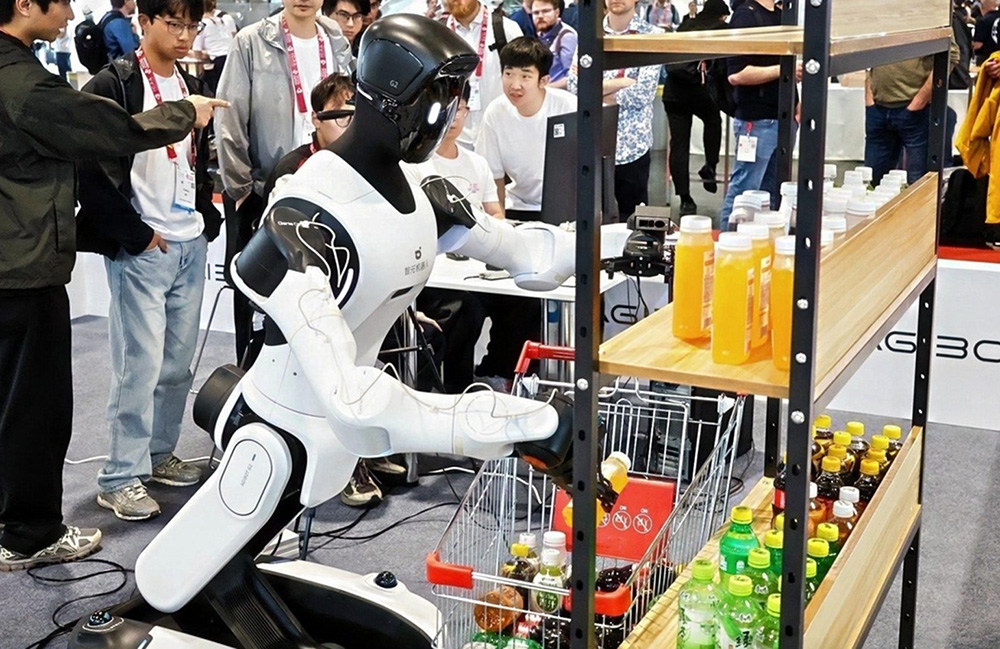
AGIBOT Innovation Technology Co., also known as Zhiyuan Robotics Co., hosted the AGIBOT World Challenge 2026 alongside the IEEE International Conference on Robotics and Automation (ICRA) in Vienna. The event brought together 526 research and enterprise teams from 27 countries, marking a significant milestone in the evaluation of embodied artificial intelligence. The competition focused on moving beyond traditional simulation-based scoring toward closed-loop testing on real robots performing real tasks, using standardized benchmarks to ensure reproducibility and practical relevance.
The challenge adopted a benchmark-driven format that combined online automated evaluation with an offline real-robot final held in Vienna. AGIBOT's EWMBench and Genie Sim Benchmark provided a consistent framework for automated testing, standardized metrics, and reproducible results. During the offline final, finalist teams completed tasks using the AGIBOT G2 humanoid robot, placing robot stability, real-world adaptability, and long-horizon task reliability at the center of the scoring system. According to AGIBOT, this approach more closely aligns technical evaluation with practical deployment needs.
Two Tracks: Reasoning to Action and World Model
The competition featured two tracks that reflect the broader evolution of embodied AI from task execution toward understanding, prediction, and decision-making. The Reasoning to Action (R2A) track evaluated how robots understand tasks, plan actions, and execute them in physical environments. Upgraded from the 2025 Manipulation track, R2A expanded evaluation from action execution to the full process of environment understanding, task planning, and physical execution. The World Model (WM) track focused on how AI systems predict physical-world changes and model interactions based on robot actions and sensor inputs. Teams trained reasoning-and-manipulation models using the AGIBOT WORLD open-source dataset and evaluated them through Genie Sim 3.0, with benchmarks covering language understanding, spatial reasoning, atomic skills, disturbance adaptation, and zero-shot generalization.
Global Participation and Industry Interest
The challenge drew research and industry teams from leading institutions and companies, including the Chinese Academy of Sciences, Tsinghua University, the University of Science and Technology of China, the University of California San Diego, Russia's Sber Robotics Center, Alibaba, Amap, and vivo. More than 100 teams surpassed the official baseline, demonstrating the high level of competition and the growing interest in embodied AI. AGIBOT noted that the industry is moving beyond simulation scores toward closed-loop testing on real robots with real tasks, and the World Challenge 2026 exemplified this shift.
Implications for Embodied AI Development
The AGIBOT World Challenge 2026 highlights the importance of real-world validation in embodied AI research. By incorporating real-robot validation into the evaluation process, the competition placed robot stability, real-world adaptability, and long-horizon task reliability at the forefront. This approach is expected to accelerate the deployment of AI-powered robots in practical applications, from manufacturing to service industries. The use of standardized benchmarks like EWMBench and Genie Sim Benchmark ensures that results are comparable and reproducible, fostering collaboration and progress across the field.
As embodied AI continues to evolve, events like the AGIBOT World Challenge will play a crucial role in bridging the gap between simulation and reality. The competition not only showcased the capabilities of current AI models but also identified areas for improvement, such as disturbance adaptation and zero-shot generalization. With participation from top global institutions and companies, the challenge underscores the collaborative nature of AI research and the shared goal of creating intelligent machines that can operate effectively in the physical world.
AGIBOT's commitment to open-source datasets and benchmarks, such as the AGIBOT WORLD dataset, further supports the development of embodied AI by providing resources for training and evaluation. As the industry moves forward, the lessons learned from the World Challenge 2026 will inform future research and development, paving the way for more capable and reliable robotic systems.
This article is based on reporting by The Robot Report. Read the original article.

Originally published on therobotreport.com