Ship 40’s unusual splashdown has become a recovery opportunity
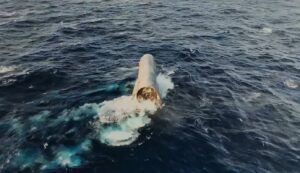
SpaceX has returned Starship second stage Ship 40 to its Starbase facility near Brownsville, Texas, after the vehicle unexpectedly survived a July splashdown in the Indian Ocean. The vehicle flew on Integrated Flight Test-13, or IFT-13, and is the only Starship reported to have remained intact after reaching the water and tipping over.
That outcome stands apart from earlier Starship splashdowns described by Space Policy Online, in which residual fuel usually led to an explosion after the vehicle tipped over. Ship 40 instead stayed intact, creating an opportunity for SpaceX engineers to inspect hardware that had traveled through space, reentered Earth’s atmosphere and then survived at sea.
SpaceX said the returned vehicle will provide first-of-its-kind data on a flown Starship heatshield, Raptor engines, avionics and more. The recovery therefore has value beyond the fact that a large vehicle made it back to Texas: it gives the company physical flight hardware to examine after an operational sequence that is normally far too destructive to preserve.
A flight that changed in its final moments
IFT-13 launched from Starbase on July 25 at 6:51 pm Eastern time. The Super Heavy booster separated about two and a half minutes after liftoff, while Ship 40 ignited its engines for a journey of roughly 65 minutes to the Indian Ocean.
According to the report, the booster made a hard landing rather than a soft landing in the Gulf. The rest of the mission went as planned until the final moments, when Ship 40 settled onto the ocean waves. In prior cases, a Starship that reached the water tipped over and exploded. Ship 40 did not follow that pattern.
Its survival was especially valuable because the company could potentially study how the vehicle endured both the trip through space and atmospheric reentry. Heatshield performance is a central part of that question. A reusable spacecraft must protect its structure and internal systems during reentry, then return in a condition that can be assessed, repaired or eventually flown again. Ship 40 offers a rare example of hardware available for direct post-flight inspection.

Recovery required a long maritime operation
Keeping a floating Starship intact was only the first challenge. SpaceX still had to move Ship 40 to a location where it could be loaded onto a barge and sent back to Texas. The company documented the recovery effort in a video titled Holy Grail of Rocketry, which showed the work involved in bringing the vehicle to Christmas Island.
Space Policy Online reported that the trip from splashdown to Christmas Island took 26 days. From there, Ship 40 still needed to cross back to Starbase. It arrived at the Texas site on October 12 and was placed in one of the facility’s Megabays.

The logistics underline a practical limit of ocean recovery. A vehicle can survive splashdown but still be far from a suitable port, exposed to marine conditions and difficult to secure for transport. Yet the successful return shows that SpaceX was willing to undertake a lengthy recovery process because the potential engineering information was worth preserving.
Data from a vehicle that flew through reentry
SpaceX’s stated focus includes the heatshield, Raptor engines and avionics. Those systems cover several of the vehicle’s most consequential technical areas. The heatshield faces the thermal demands of reentry. Engines are essential to powered flight and future landing operations. Avionics coordinate the vehicle’s sensing, control and communications functions.
Ship 40’s return does not by itself demonstrate a fully reusable Starship. The vehicle splashed down in the ocean rather than returning to a launch site, and the report does not say it will fly again. But it does give SpaceX an unusual physical record of a mission, rather than relying only on telemetry, imagery or debris from a destructive end state.
That distinction matters for a development program pursuing reusability. Hardware inspection can reveal conditions that are hard to infer from remote data alone. SpaceX described the recovered vehicle’s data as first-of-its-kind, suggesting it sees the inspection as a distinct source of information for its design and test work.

Starship recovery remains a work in progress
Starship is the name commonly applied to both the Super Heavy first stage and the Ship second stage. SpaceX’s broader objective is to recover both stages at their launch sites. The company has already recovered three Super Heavy boosters at Starbase, although the most recent of those recoveries was IFT-8 in March 2025.
The first attempt to catch a Ship could occur on the next mission, IFT-15, according to the report. A catch would differ significantly from Ship 40’s recovery: instead of floating in an ocean for later transport, a vehicle would return directly to the launch site. Ship 40’s voyage nevertheless supplies information about a key part of that future goal—the condition of a vehicle after flight and reentry.
Starbase is currently the only operational Starship launch site, though SpaceX is close to activating a second site at Kennedy Space Center’s Launch Complex 39-A in Florida. Meanwhile, the Federal Aviation Administration is opening a public comment period on SpaceX’s request to significantly increase launches and landings at Starbase.
For now, Ship 40 is a recovered test article rather than an operationally recovered spacecraft. Its significance lies in the chance event that it survived the water and in the effort required to bring it home. That combination has turned a final-stage splashdown into a rare opportunity to inspect a flown Starship in detail.
This article is based on reporting by spacepolicyonline.com. Read the original article.
Originally published on spacepolicyonline.com