The Information Hiding in Darkness
At first glance, an eclipse is simply an absence of light — the Moon blocking the Sun, a planet crossing a star's disk, a moon slipping into the shadow of its parent planet. But in science, absences are often as revealing as presences, and the careful analysis of how light disappears and returns during celestial alignments has unlocked some of the most important discoveries in the history of astronomy. From the size of the Earth to the composition of exoplanet atmospheres billions of miles away, the information encoded in shadows has proven to be extraordinarily rich.
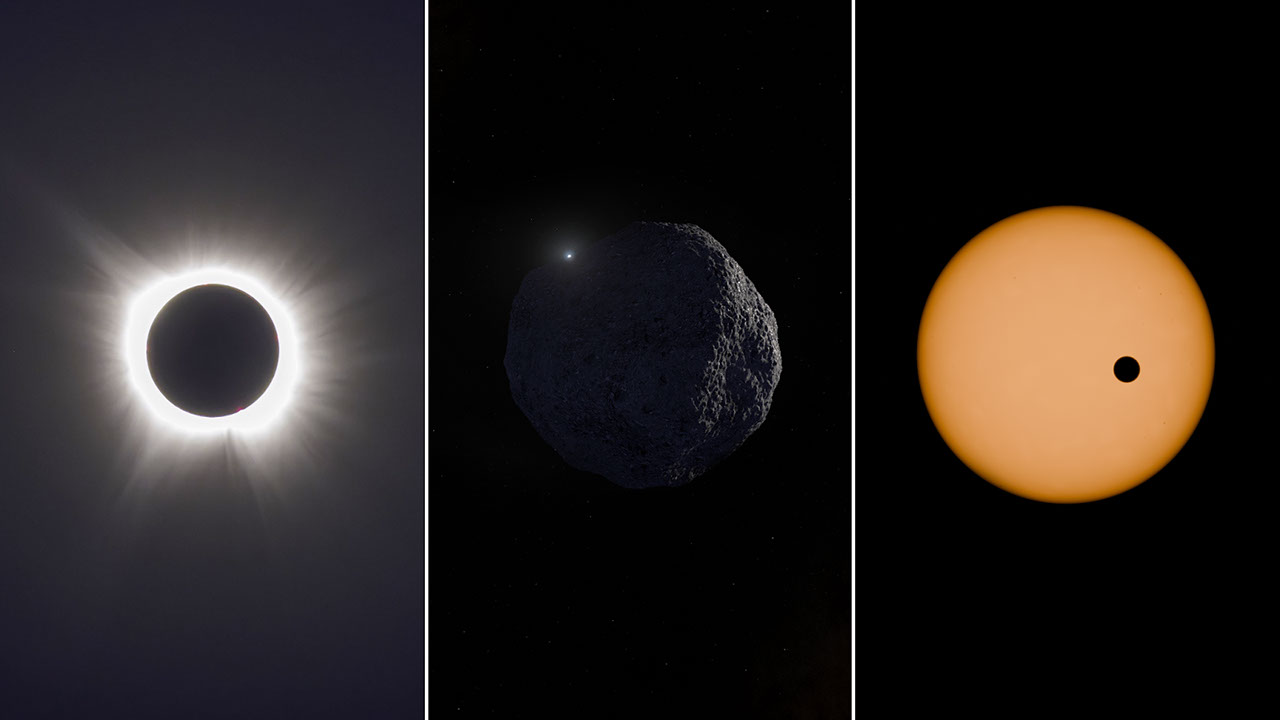
Solar eclipses are perhaps the most spectacular and historically significant example. The ability to observe the Sun's corona — the tenuous, extraordinarily hot outer atmosphere that is ordinarily overwhelmed by the solar disk's brightness — depends entirely on the Moon's fortuitous apparent size in Earth's sky. The Moon is 400 times smaller than the Sun but also approximately 400 times closer, a coincidence that means both objects appear nearly identical in angular size as seen from Earth's surface. This alignment allows total solar eclipses to completely obscure the photosphere while leaving the corona visible — and it was during a total solar eclipse in 1919 that Arthur Eddington famously confirmed Einstein's prediction that massive objects bend light, observing the shifted positions of stars near the occulted Sun.
Occultations: Probing the Universe's Fine Structure
A stellar occultation occurs when a solar system object — a planet, moon, asteroid, or Kuiper Belt body — passes in front of a background star as seen from Earth. The precise timing of how the star's light dims and recovers as the occulting object's edge crosses it reveals the object's size, shape, and, in cases where an atmosphere is present, its atmospheric structure with extraordinary precision.
Pluto's atmosphere was first detected through stellar occultation measurements in 1988, years before any spacecraft visited the distant dwarf planet. The gradual dimming of the background star's light — rather than the sharp cutoff that a body without an atmosphere would produce — revealed the presence of a tenuous nitrogen atmosphere and provided the first measurements of its pressure profile. When NASA's New Horizons spacecraft finally flew past Pluto in 2015, the atmospheric models built from decades of occultation observations proved to be remarkably accurate.
Stellar occultations have also been used to characterize the shapes of Trojan asteroids, measure the rings of Uranus and Neptune (discovered through occultation profiles before any spacecraft imaged them directly), and probe the outermost edge of the solar system where Kuiper Belt objects too faint for direct imaging can be studied through their shadows on background stars.
Transits: The Exoplanet Revolution
The transit method — in which a planet crossing the disk of its host star as seen from Earth causes a measurable, periodic dimming of the star's light — has been the most transformative application of the science of shadows in recent decades. NASA's Kepler Space Telescope, operating from 2009 to 2018, monitored more than 150,000 stars for the telltale light curves of planetary transits and catalogued thousands of exoplanet candidates, transforming exoplanetary science from a field with a handful of known worlds to one with thousands of confirmed planets.
The transit method does more than detect planets. The precise shape of a transit light curve — how the star's brightness decreases as the planet's disk begins to overlap it, reaches full transit depth, and then recovers — encodes information about the planet's radius, orbital period, orbital inclination, and the ratio of the planet's size to its host star. Combined with radial velocity measurements of how the planet's gravity tugs the star, transit observations yield the planet's mass, enabling calculation of its density and inferences about its bulk composition.
Transmission Spectroscopy: Reading Atmospheres in the Light
The most powerful recent extension of transit science is transmission spectroscopy — the analysis of how a planet's atmosphere filters the star's light during a transit. As a transiting planet's disk crosses the star, light from the star passes through the thin annulus of the planet's atmosphere at the planet's limb. Different molecules in the atmosphere absorb specific wavelengths of light, leaving characteristic fingerprints in the spectrum of the star's light that reaches the telescope. By comparing the transit depth at different wavelengths, astronomers can identify the molecules present in the planet's atmosphere.
The James Webb Space Telescope has dramatically advanced this technique. JWST's infrared sensitivity and spectral resolution allow detection of water vapor, carbon dioxide, methane, sulfur dioxide, and other molecules in the atmospheres of planets ranging from hot Jupiters to sub-Neptunes. In 2023, JWST detected carbon dioxide in the atmosphere of a super-Earth for the first time. The search for biosignatures — molecular evidence of biological processes, such as the simultaneous presence of oxygen and methane in a rocky planet's atmosphere — in the atmospheres of Earth-like planets in habitable zones is now a technically realistic goal rather than a distant aspiration.
From Ancient Tools to Space-Age Applications
The use of celestial alignments as scientific instruments stretches back to antiquity. Eratosthenes used the angle of the Sun's shadow at two locations to calculate the Earth's circumference with remarkable accuracy in the third century BCE. Edmond Halley proposed in 1716 that simultaneous observations of the transit of Venus from widely separated points on Earth could provide a measurement of the astronomical unit — the Earth-Sun distance — using parallax, a proposal successfully executed during the 1761 and 1769 Venus transits by an international network of observers at the furthest reaches of the known world.
What connects these ancient and modern applications is a common principle: when light is precisely interrupted, the interruption carries information. The universe is full of shadows, and each one, carefully analyzed, tells a story about the objects that cast and receive them. NASA's continuing investment in education and public engagement around eclipse and transit science reflects a recognition that this principle — accessible, visual, and connecting human observers to the largest scales of cosmic structure — is one of the most effective bridges between professional science and the public imagination.
This article is based on reporting by science.nasa.gov. Read the original article.