Introduction: The Need for In-Situ Asteroid Exploration
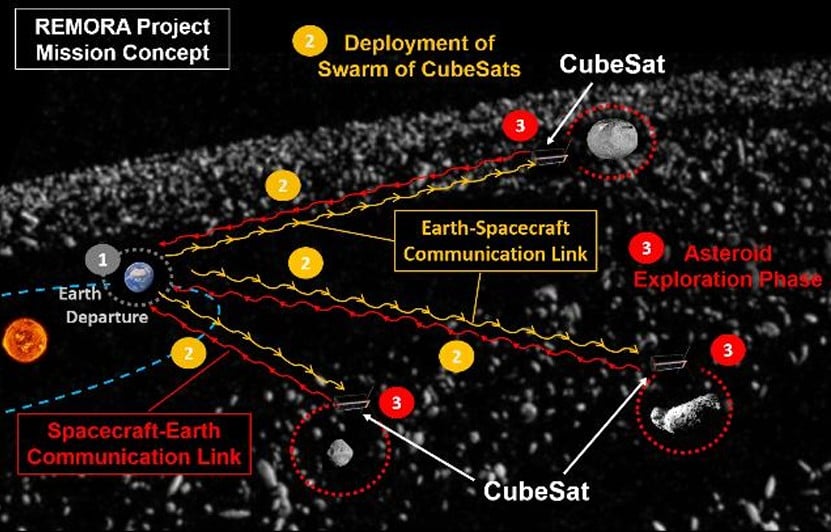
Remote sensing from ground-based telescopes and orbiting observatories can only reveal so much about the composition and structure of asteroids. To truly understand what an asteroid is made of, we need to send a probe directly to it. A new white paper submitted to the UK Space Agency’s 2035 Space Frontiers programme proposes a novel mission architecture called REMORA — the REndezvous Mission for Orbital Reconstruction of Asteroids. The plan calls for a swarm of autonomous CubeSats to tag, track, and characterize multiple near-Earth asteroids (NEAs) at a fraction of the cost of traditional missions.
What is REMORA?
REMORA stands for REndezvous Mission for Orbital Reconstruction of Asteroids. The concept, detailed in a white paper led by Dr. Stefania Soldini of the University of Liverpool, envisions a fleet of six CubeSats that would hitch a ride to known near-Earth asteroids. Each CubeSat would attach to or closely orbit an individual asteroid, studying it in far greater detail than remote sensing alone can provide. The mission is named after the remora fish, which famously attaches itself to sharks in a symbiotic relationship — a fitting analogy for the CubeSats latching onto asteroids.
Addressing the UK's Gap in Asteroid Science
The United Kingdom has some of the world’s best asteroid researchers, who have contributed to major missions like NASA’s Double Asteroid Redirection Test (DART) and OSIRIS-REx’s sample return from Bennu. However, the UK lacks a dedicated domestic funding stream to launch its own asteroid exploration missions. The REMORA white paper aims to change that by proposing a low-cost, high-return mission that could be developed entirely within the UK. With a budget of just €50 million — classified as a Mini-F class mission — REMORA would be extremely affordable compared to traditional asteroid missions.
Technical Architecture: Swarm of CubeSats
The REMORA mission would consist of six CubeSats, each designed to rendezvous with a different near-Earth asteroid. The CubeSats would use autonomous navigation software to approach and either attach to the asteroid’s surface or maintain a close orbit. This swarm approach allows multiple asteroids to be characterized in a single mission, vastly increasing the scientific return. The small size and low cost of CubeSats make them ideal for such a distributed architecture.

Autonomous Navigation with NEAR Software
Managing a fleet of spacecraft typically requires a large team of operators on Earth, which would blow the modest budget. To overcome this, the REMORA team is developing a software suite called Near-Earth Asteroid Regions (NEAR). NEAR is designed to calculate fuel-minimal trajectories on the fly, enabling the CubeSats to navigate near asteroids without direct operator input. The suite includes components such as dynNEAR for dynamic modeling and goNEAR for pathfinding. This autonomy is critical for keeping costs low and enabling the mission to operate efficiently.
Testing at the Zero-G Astrolab
The white paper highlights a unique UK asset: the Zero-G Astrolab at the University of Liverpool. This lab boasts the “flattest floor in the UK,” featuring an epoxy air bearing system that allows physical prototypes to float with minimal friction. The facility enables hardware-in-the-loop testing, where engineers can simulate the microgravity environment of space and test the CubeSats’ navigation and attachment mechanisms. This capability is essential for validating the REMORA concept before launch.
Scientific Goals and Impact
The primary goal of REMORA is to characterize the composition, structure, and orbital dynamics of multiple near-Earth asteroids. Understanding asteroid composition is crucial for planetary defense, resource utilization, and unraveling the early history of the solar system. By tagging and tracking these objects up close, REMORA could provide data that remote sensing cannot, such as detailed surface properties, internal structure, and precise mass estimates. The mission could also identify potential targets for future sample return or mining.
Comparison to Other Missions
While missions like DART and OSIRIS-REx have demonstrated the value of asteroid rendezvous, they are large, expensive, and target only one or two objects. REMORA’s swarm approach offers a complementary capability: surveying multiple asteroids at a fraction of the cost. This aligns with the growing trend toward small, distributed spacecraft for deep space exploration. If successful, REMORA could pave the way for future low-cost asteroid missions by other nations or commercial entities.
Challenges and Next Steps
The REMORA concept faces several challenges. The CubeSats must be robust enough to survive deep space travel and the harsh environment near asteroids. The autonomous navigation software must be reliable and capable of handling unexpected situations. Additionally, the mission requires a ride-share opportunity to reach its target asteroids, which may limit launch windows. The white paper is currently under review by the UK Space Agency as part of the 2035 Space Frontiers programme. If selected, the mission could move into detailed design and development phases.
Conclusion
REMORA represents an innovative, cost-effective approach to asteroid exploration. By leveraging CubeSat technology and autonomous navigation, the mission could unlock new insights into near-Earth asteroids while establishing a domestic asteroid science capability for the UK. As the white paper awaits a decision, the concept highlights the potential of small, smart spacecraft to tackle big scientific questions.
This article is based on reporting by Universe Today. Read the original article.
Originally published on universetoday.com