Beyond the Rocket Equation
Every spacecraft that has ever left Earth has been shackled by the tyranny of the rocket equation. To go faster, you need more fuel. But more fuel means more weight, which means you need even more fuel to accelerate that extra mass. This vicious cycle places fundamental limits on how fast chemical rockets can travel, making interstellar journeys effectively impossible with current propulsion technology.
Solar sails offer an elegant escape from this constraint. By using the pressure of photons — from sunlight or a powerful ground-based laser — to push a large reflective surface, a spacecraft can accelerate continuously without carrying any fuel at all. In principle, a solar sail pushed by a sufficiently powerful laser could reach a significant fraction of the speed of light, making interstellar travel feasible within a human lifetime.
There is, however, a critical problem: the sail melts. The intense laser beams needed to accelerate a sail to interstellar speeds would heat the reflective material to thousands of degrees, destroying it long before it reached its target velocity. Now, researchers at Tuskegee University have published a paper in the Journal of Nanophotonics describing a nanoengineered light sail that solves this thermal challenge.
The Thermal Barrier
The Breakthrough Starshot initiative, announced in 2016 with backing from the late Stephen Hawking and investor Yuri Milner, proposed sending gram-scale spacecraft to Alpha Centauri at 20 percent the speed of light using a ground-based laser array. The concept requires focusing roughly 100 gigawatts of laser power onto a sail just meters across for several minutes — enough energy to heat most materials well past their melting point.
Previous sail designs used thin films of aluminum or other reflective metals, but even the most reflective metals absorb a small fraction of incident light, converting it to heat. At the power densities required for interstellar acceleration, even one percent absorption is catastrophic. The sail would vaporize in seconds.
Various solutions have been proposed, including making the sail from exotic materials like diamond or silicon nitride, or using multi-layer dielectric mirrors that achieve higher reflectivity than metals. But all previous designs struggled to simultaneously achieve the high reflectivity, low mass, and structural integrity needed for a practical interstellar sail.
The Nanophotonic Solution
Dimitar Dimitrov and Elijah Taylor Harris of Tuskegee University approached the problem using nanophotonic engineering — designing materials at the nanometer scale to control how they interact with light. Their sail design uses a thin film of silicon nitride patterned with a periodic array of nanoscale features that create a photonic crystal structure.
This photonic crystal is engineered to reflect the specific wavelength of the pushing laser with extraordinary efficiency — greater than 99.9 percent — while simultaneously radiating absorbed heat away from the sail through carefully designed thermal emission channels. The nanostructure acts as both a near-perfect mirror and an efficient radiator, solving both halves of the thermal problem.
The researchers used computational electromagnetic simulations to optimize the geometry of the nanostructure, finding a configuration that maintains its optical properties even as the sail heats up. This thermal stability is critical because the optical properties of most materials change with temperature, potentially creating a runaway heating effect where absorption increases as the sail warms, causing it to heat up even faster.
Mass and Structural Considerations
A light sail for interstellar travel must be extraordinarily lightweight. The Breakthrough Starshot concept calls for a sail with an areal density of less than one gram per square meter — comparable to a few layers of atoms. The Tuskegee design achieves this by using a single layer of patterned silicon nitride just a few hundred nanometers thick, with the photonic crystal features etched directly into the film.
Structural integrity presents a separate challenge. During the acceleration phase, the sail experiences significant radiation pressure — that is the entire point — but this pressure is not perfectly uniform across the sail surface. Small variations in laser intensity or sail reflectivity create differential forces that can cause the sail to buckle, tear, or spin out of control. The researchers incorporated structural stiffening features into their nanopattern design that provide mechanical rigidity without adding significant mass.

From Theory to the Stars
The Tuskegee team's design remains theoretical for now, but it addresses what has been widely recognized as one of the most critical engineering bottlenecks for laser-propelled interstellar travel. Manufacturing a sail with the required nanoscale precision over areas of several square meters is beyond current production capabilities, but advances in nanolithography and roll-to-roll nanopatterning are steadily closing this gap.
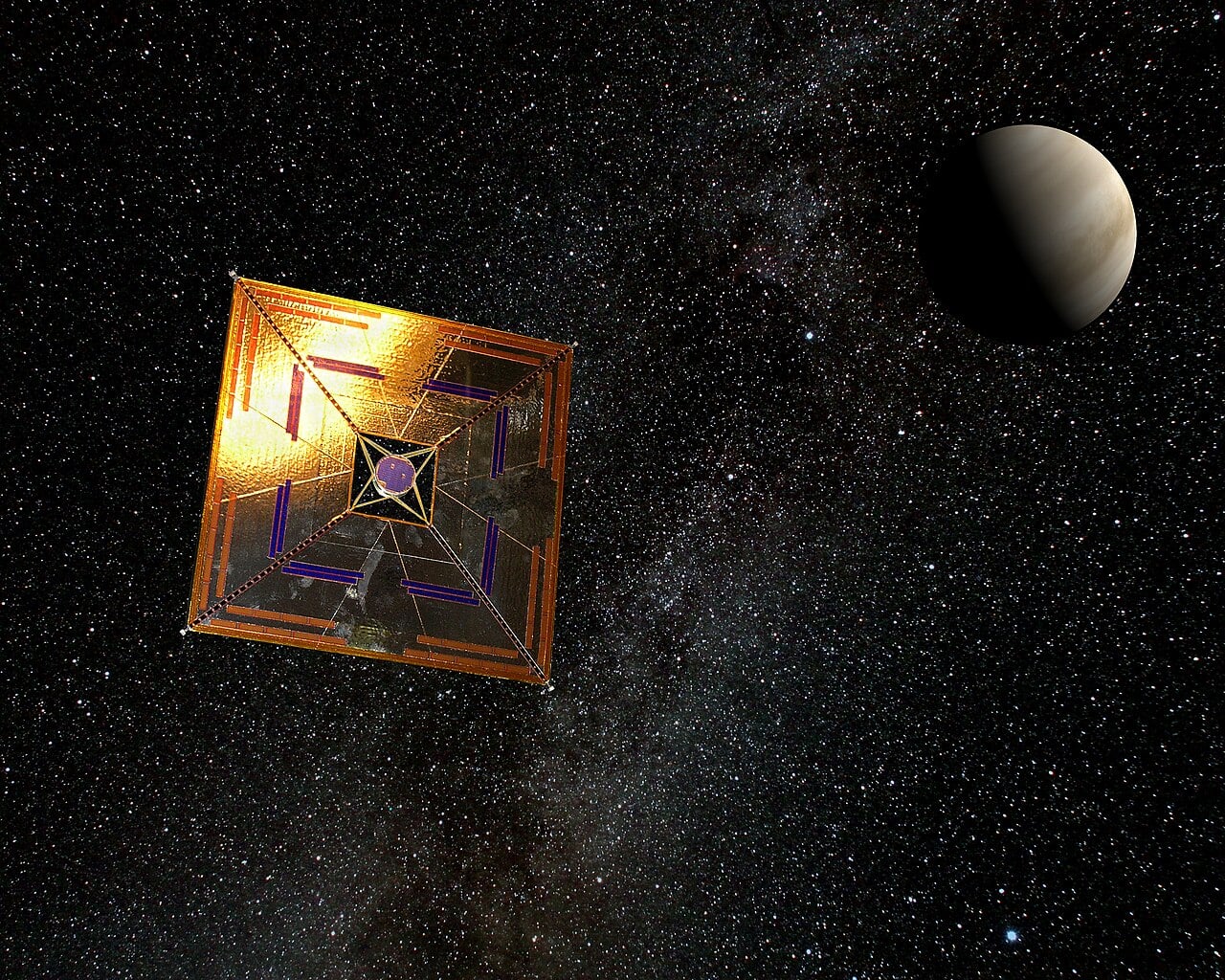
Japan's IKAROS mission demonstrated solar sail propulsion in space in 2010, and NASA's Advanced Composite Solar Sail System launched in 2024 to test new sail materials in Earth orbit. These missions used sunlight rather than lasers and traveled at modest speeds, but they proved the basic concept works. The nanoengineered design from Tuskegee could bridge the gap between these early demonstrations and the far more ambitious goal of interstellar flight.
For a technology that promises to carry humanity's first probes to other star systems, solving the melting problem is no small achievement.
This article is based on reporting by Universe Today. Read the original article.
Originally published on universetoday.com