A Rocky Exoplanet Comes Into Sharper Focus
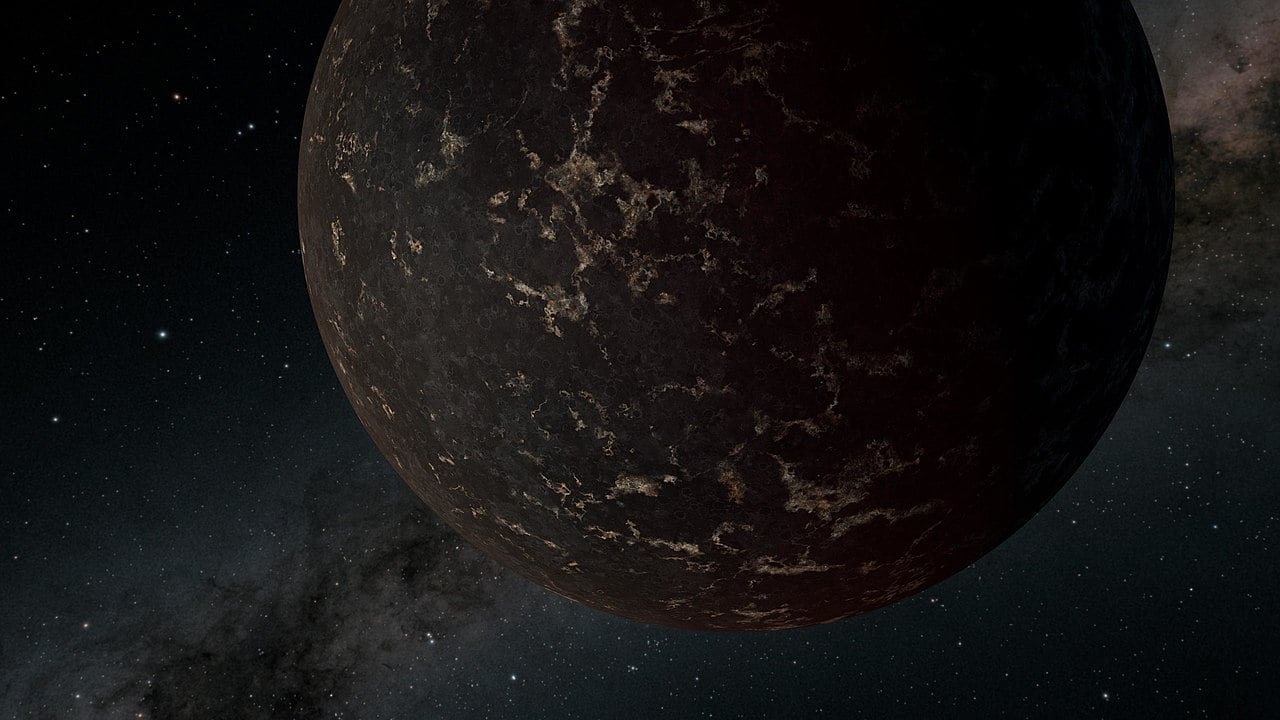
The James Webb Space Telescope has delivered a closer look at one of the more unforgiving rocky worlds yet studied: LHS 3844 b, a super-Earth orbiting about 48 light-years away. The planet, informally known as Kua'kua, appears to be dark, hot, rocky, and devoid of an atmosphere. That conclusion alone is important, but the deeper significance is methodological. Researchers used JWST not simply to infer broad planetary properties. They detected light from the surface directly and used it to examine what that surface may be made of.
LHS 3844 b was first found by TESS in 2018 as it transited its host star. It is about 30 percent bigger than Earth and circles a red dwarf every 11 hours in a tidally locked orbit, meaning one side permanently faces the star. The dayside reaches around 1000 Kelvin, creating an environment more comparable to a superheated Mercury than anything remotely Earth-like. That harshness, paradoxically, makes it easier to study. A searing, airless dayside radiates strongly enough in infrared light for JWST to extract a usable signal.
From Atmospheres to Bare Rock
Much of exoplanet science has focused on atmospheres. Those gaseous envelopes can reveal composition, temperature structure, and, in some cases, tantalizing clues about habitability. But rocky planets without atmospheres are scientifically valuable too. They offer a path toward understanding planetary surfaces directly, something far more difficult than reading gases above them.
That is where JWST’s Mid-Infrared Instrument, or MIRI, becomes especially powerful. A team led by Sebastian Zieba and Laura Kreidberg used MIRI to analyze the infrared radiation from the planet’s dayside. They then compared the resulting spectrum against libraries of rocks and minerals known from Earth, the Moon, and Mars. The result, as described in the report, rules out a surface similar to Earth’s crust, which is typically rich in silicate rocks such as granite.
Instead, the data are more consistent with mantle-type material or lava rock. In simple terms, Kua'kua does not look like a rocky planet covered in crustal material familiar from Earth’s continents. It looks more like a stripped, dark, heavily heated world whose surface composition may reflect deeper planetary layers or widespread volcanic rock.

No Atmosphere, No Buffer
The absence of an atmosphere is central to the interpretation. An atmosphere redistributes heat, softens temperature contrasts, and can imprint strong signatures on the infrared spectrum. Without one, the dayside bakes continuously and the emitted light more directly reflects the properties of the surface itself. Laura Kreidberg’s summary is blunt: a dark, hot, barren rock, devoid of any atmosphere.
That conclusion adds to the growing realization that many close-in rocky planets around red dwarfs may be extreme places. Red dwarfs are the most common stars in the galaxy, which makes their planets frequent targets of study. But abundance does not imply habitability. Worlds that orbit extremely close to these stars can become tidally locked, heavily irradiated, and geologically or atmospherically transformed beyond easy comparison with Earth.
Even so, those planets remain valuable laboratories. If astronomers can learn to distinguish crustal surfaces from mantle-like material or cooled lava using infrared spectra, they move closer to a richer classification system for rocky exoplanets. That matters for the long term because future discoveries will include many worlds where atmosphere, surface, and geology are all intertwined.
Why Direct Surface Detection Matters
Detecting light from the surface of a distant rocky planet is a substantial step for the field. Exoplanets are faint and typically overwhelmed by the glare of their stars. Pulling out a dayside signal precise enough to compare against mineral templates demonstrates both the sensitivity of JWST and the maturity of current analysis methods. It turns an exoplanet from a point on a discovery chart into a geophysical object with a more legible identity.
That identity is still incomplete, of course. Scientists are working with models and comparisons rather than physical samples. There is room for uncertainty in exactly which materials dominate the surface. But the ability to rule out an Earth-crust analogue is already informative. It narrows the possibilities and shows that even relatively small rocky planets can yield surprisingly detailed clues if the observational geometry is favorable.
The study also hints at the future of comparative planetology beyond the solar system. For decades, planetary geology was something astronomers could do in detail only for nearby worlds like the Moon, Mars, Venus, and Mercury. Webb is beginning to expand that frontier. If surface composition can be estimated for exoplanets, then the taxonomy of distant rocky worlds becomes much richer than simple size and temperature categories.
A Super-Earth, But Not an Earth Twin
“Super-Earth” can be a misleading label because it refers mainly to size, not habitability. LHS 3844 b is only about 30 percent larger than Earth, but nearly everything else about it points in the opposite direction from an Earth twin. It orbits its star in just 11 hours. It is tidally locked. Its dayside is roasting. And its surface appears barren and atmosphere-free.
That contrast is useful. It reminds astronomers and the public alike that rocky planets come in many forms, and that Earth-like size does not imply Earth-like conditions. Kua'kua may be closer in spirit to a scaled-up Mercury, with the added intrigue of surface material exposed under relentless stellar heating.
JWST’s observation of this world will not settle every question about rocky exoplanets, but it does mark a shift in what can be measured. Astronomers are no longer limited to asking whether a small planet exists. They are beginning to ask what its surface is like. For a barren world 48 light-years away, that is a remarkable leap.
- JWST studied the hot dayside of LHS 3844 b using its MIRI instrument.
- The super-Earth appears to be a dark, barren rocky world with no atmosphere.
- The spectrum rules out a surface similar to Earth’s crust and points toward mantle or lava rock.
This article is based on reporting by Universe Today. Read the original article.
Originally published on universetoday.com