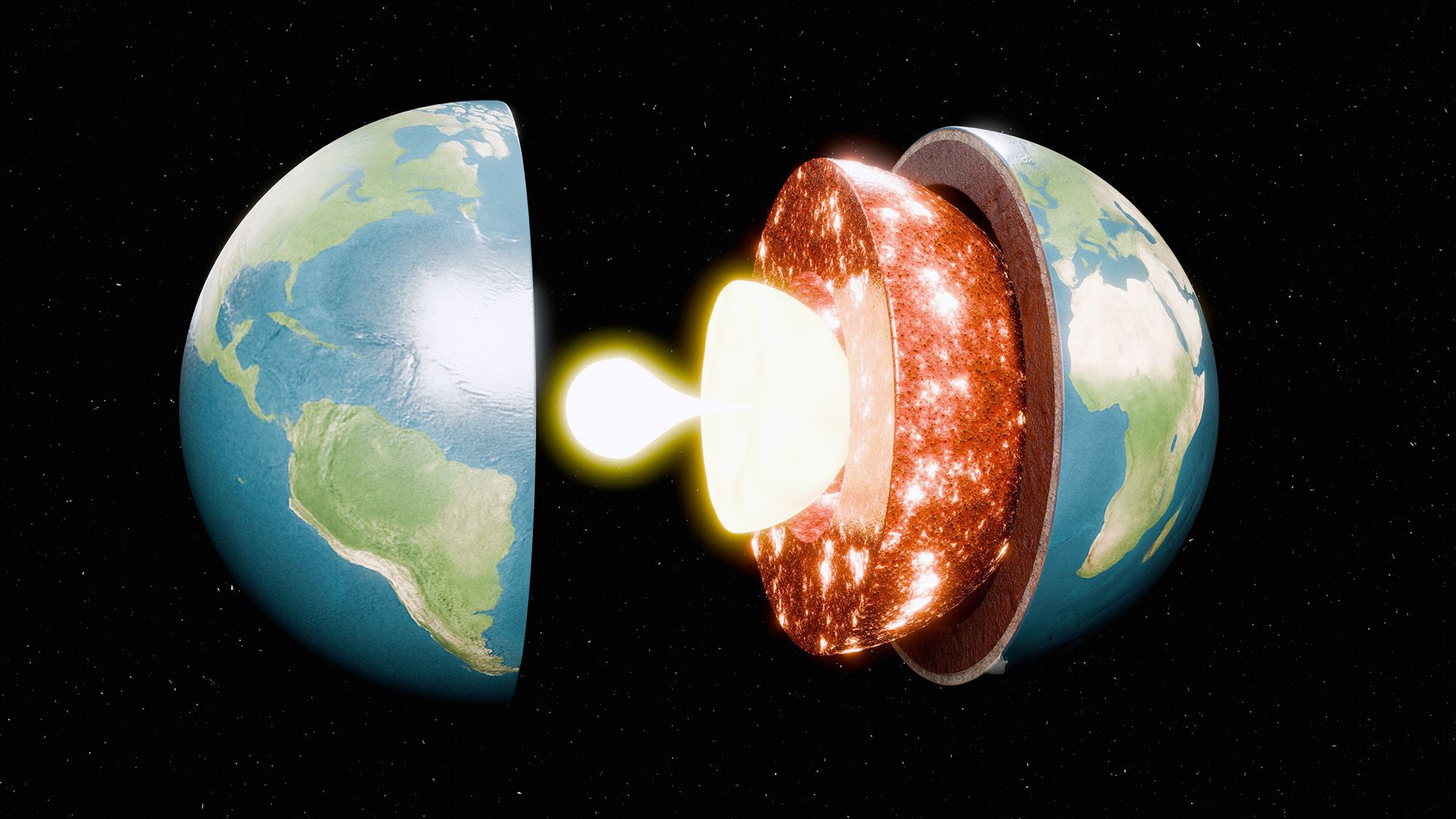
A hidden furnace deep below the planet
Earth’s core remains one of the least accessible places in science, but researchers have built a surprisingly detailed picture of it. According to Live Science, scientists estimate that the core reaches roughly 9,000 to just over 10,000 degrees Fahrenheit, or about 5,000 to more than 5,500 degrees Celsius, making it about as hot as the surface of the sun.
The estimate refers to the boundary between the inner and outer core, which scientists regard as the hottest part of the core. That temperature is not the result of a direct measurement. No instrument has reached anywhere close to those depths. Instead, it is a carefully assembled inference based on what the core is made of, how materials behave under extreme pressure and how seismic waves move through the planet.
Two cores, one liquid and one solid
Earth does not have a single uniform core. It has a liquid outer core and a solid inner core. The outer core begins around 1,800 miles, or 2,900 kilometers, below the surface and extends for about 1,400 miles, or 2,200 kilometers. The inner core begins at about 3,200 miles, or 5,150 kilometers, below ground and has a radius of roughly 758 miles, or 1,220 kilometers.
That structure is central to the temperature estimate. Scientists believe the core is composed primarily of iron, about 85%, together with nickel and lighter elements. In the outer core, that iron-rich material is liquid. In the inner core, it is solid. The transition between those states gives researchers a crucial clue: if the outer core is molten iron, its temperature must exceed iron’s melting point under the enormous pressures present at that depth.

How scientists know without going there
The modern estimate is the product of several lines of evidence. One is laboratory work on iron alloys subjected to extreme pressures. Another is the study of meteorites, which can offer insight into the materials that helped form the early solar system and, by extension, the Earth. A third is seismology, which tracks how earthquake waves travel through the planet.
Seismic waves are especially important because they do not move through all materials in the same way. Some waves bend, slow or disappear as they encounter changes in density or state. Those patterns helped scientists infer that Earth has a liquid outer core and a solid inner core. Once the structure and likely composition are known, researchers can combine that information with high-pressure experiments to estimate the temperature needed for those conditions to exist.
The result is not a thermometer reading but a constrained scientific estimate. It is one of the clearest examples of how planetary science often works at the edge of direct observation: researchers cannot sample the core itself, so they recreate parts of its environment and test what would have to be true.
Why the core is still hot
Earth formed around 4.5 billion years ago as a ball of molten rock. Over time, heavy elements such as iron and nickel sank toward the center and formed the early core. The fact that the core remains intensely hot today reflects both that violent origin and the extreme conditions under which heat is stored and transferred deep inside the planet.
Even though the planet’s surface has long since cooled enough to support oceans, continents and life, the deep interior remains a different environment entirely. The outer core is still liquid, while the inner core remains solid under immense pressure despite its extraordinary temperature.

A temperature that reshapes perspective
The comparison with the sun’s surface is striking because it collapses the perceived distance between everyday geology and stellar physics. Earth may feel stable underfoot, but the planet still contains a region hot enough to rival a star’s visible outer layer.
That does not mean the core behaves like the sun. The comparison is about temperature, not composition or physical process. Even so, it highlights how energetic the planet’s interior remains billions of years after formation.
The larger lesson is methodological. Earth’s core is a place humans cannot directly inspect, yet science can still say meaningful things about it by combining indirect evidence from multiple fields. The estimate of 5,000 to 5,500 degrees Celsius is therefore not a guess in the casual sense. It is a conclusion built from experiments, materials science and the seismic signatures of a world that still carries its primordial heat.
This article is based on reporting by Live Science. Read the original article.
Originally published on livescience.com