A rare public glimpse of a secret aircraft
Images published in Greece on March 18 have pushed one of the Pentagon's most secretive aircraft back into view. The aircraft, commonly and unofficially referred to as the RQ-180, was photographed landing at Larissa Air Base, a Greek installation that is also known to host U.S. Air Force MQ-9 Reaper drones. The sighting immediately raised a basic question: why would a very stealthy, very high-altitude, long-endurance intelligence, surveillance, and reconnaissance platform be operating from that location now?
The War Zone's reporting argues that the answer may be tied directly to the current conflict with Iran. The publication notes that such a drone would be an especially relevant fit for a mission set centered on penetrating defended airspace, staying aloft for long periods, and finding hard-to-track targets. In that framing, the aircraft's appearance near the eastern Mediterranean is not just a curiosity. It is a clue about the kind of surveillance demand the United States may be facing right now.
Why Iran changes the equation
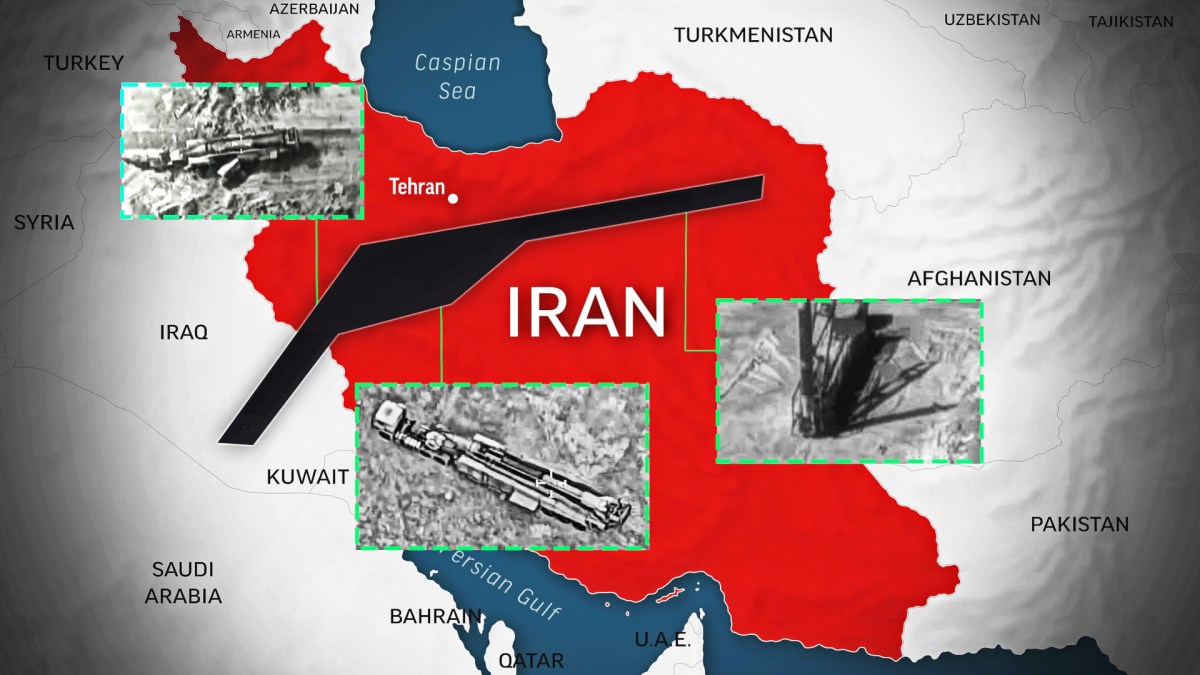
The article ties the aircraft's apparent presence in Greece to what it describes as the highest-priority standing mission for Operation Epic Fury: finding and destroying Iranian launchers. That mission is unusually difficult. Mobile launchers are built to hide, move, and fire on short notice. Tracking them requires persistence, access, and survivability. A conventional crewed aircraft may struggle to provide all three at once in a heavily defended environment. A stealthy uncrewed aircraft designed for endurance is far better matched to that job.
That is the strategic logic behind renewed attention to the RQ-180. Even though many details about the aircraft remain officially undisclosed, the broad outline presented here is consistent: a large flying-wing drone meant to gather intelligence where lower-end platforms would be too vulnerable and where satellites alone would not provide the needed persistence.
A mission with Cold War roots
One of the most revealing aspects of the report is not the aircraft sighting itself, but the historical comparison it draws. The War Zone points to Quartz, a secret late Cold War drone program intended to monitor mobile nuclear-tipped ballistic missiles deep inside the Soviet Union. That mission required the same core attributes now associated with the RQ-180 concept: low observability, long endurance, and the ability to persist over wide areas while hunting highly mobile strategic targets.
In that sense, the article suggests Quartz was less a historical footnote than a precursor. The United States spent large sums decades ago trying to build a platform for an extraordinarily specific surveillance problem. Today's operational demand in the Middle East, as described in the story, looks similar enough that Quartz provides a useful window into why the RQ-180 may exist in the first place.
The comparison also matters because it moves the discussion away from aircraft mystique and toward mission design. Secret aircraft programs often attract attention because they are hidden. What matters more is the operational problem they were built to solve. Here, the problem is persistent surveillance against mobile missile forces in dangerous airspace, and that is a problem that has existed for generations.
What the Greece sighting really signals
Larissa's geography gives the sighting extra weight. A forward location in Greece offers reach into parts of the Middle East while avoiding some of the constraints of more distant basing. If the aircraft seen there is indeed the RQ-180 or an evolution of it, the deployment would suggest that the platform is not simply a strategic reserve asset. It would indicate active demand for its capabilities in an ongoing theater.
The report is careful about what remains unknown. Questions persist about the exact configuration of the aircraft, the reason it was visible at all, and the full scope of its operations. But the bigger takeaway is clear enough. The combination of fresh imagery, a live regional conflict, and a mission requirement focused on locating Iranian launchers makes the sighting more than aviation gossip.
It is also a reminder that programs developed in deep secrecy tend to surface first at the edges: in a photograph, in a transit stop, in a base visit, in an unexplained deployment pattern. The public rarely gets a full unveiling. Instead, capabilities become legible when events create a reason for them to matter. That appears to be what is happening now.
Why this story matters beyond one aircraft
The RQ-180 discussion points to a broader shift in military operations. In conflicts shaped by distributed missile forces and contested airspace, survivable sensing can be as decisive as strike capacity. A stealthy intelligence aircraft may not generate headlines like a bomber or fighter, but it can become indispensable when commanders need to find elusive targets before those targets can move or fire again.
That makes the Greece sighting important even without official confirmation of every detail. It suggests that the United States may be leaning on exactly the kind of niche, high-end surveillance capability that was imagined decades ago for a different rivalry. The geopolitical map has changed. The operational logic has not.
This article is based on reporting by twz.com. Read the original article.