Air Force shifts collaborative combat aircraft testing toward field operations

The U.S. Air Force’s Collaborative Combat Aircraft program has reached a new operational milestone, with Anduril’s YFQ-44 Fury arriving at Creech Air Force Base in Nevada for an exercise focused on austere deployment and lean sustainment. According to reporting by The War Zone, the pilotless aircraft departed the Southern California Logistics Airport in Victorville and recovered at Creech, a major center for U.S. uncrewed aircraft operations.

The move matters because it pushes the CCA effort beyond design and production decisions into a more practical question: how these aircraft might actually be operated in demanding conditions. The Air Force told The War Zone that from July 20 to July 24, 2026, its CCA Experimental Operations Unit is conducting an Agile Combat Employment exercise at Creech involving both the YFQ-44 and General Atomics’ YFQ-42 Dark Merlin.

In the Air Force’s description, military operators are leading end-to-end ground and flight operations for both aircraft in order to build tactical concepts, test lean sustainment, and refine Air Force-led human-machine teaming. Observers from the Royal Netherlands Air Force are also present, according to the statement cited in the report.

Why Creech matters

Creech is best known as a hub for remotely operated and uncrewed platforms, including the MQ-9 Reaper and RQ-170 Sentinel. Hosting the YFQ-44 there is notable in itself. The War Zone said it was the first known time Fury had been hosted at the base. That gives the exercise significance beyond a simple relocation flight: it places one of the Air Force’s new collaborative aircraft inside a real operational ecosystem built around uncrewed systems.

The broader setting is the Air Force’s Agile Combat Employment doctrine, often shortened to ACE. The concept emphasizes the ability to disperse forces, operate with minimal support, and keep moving between locations rather than relying on large, fixed bases with heavy logistical footprints. For aircraft designed to team with crewed fighters and other assets, this kind of flexibility is not a side issue. It is part of the operational logic behind the program.

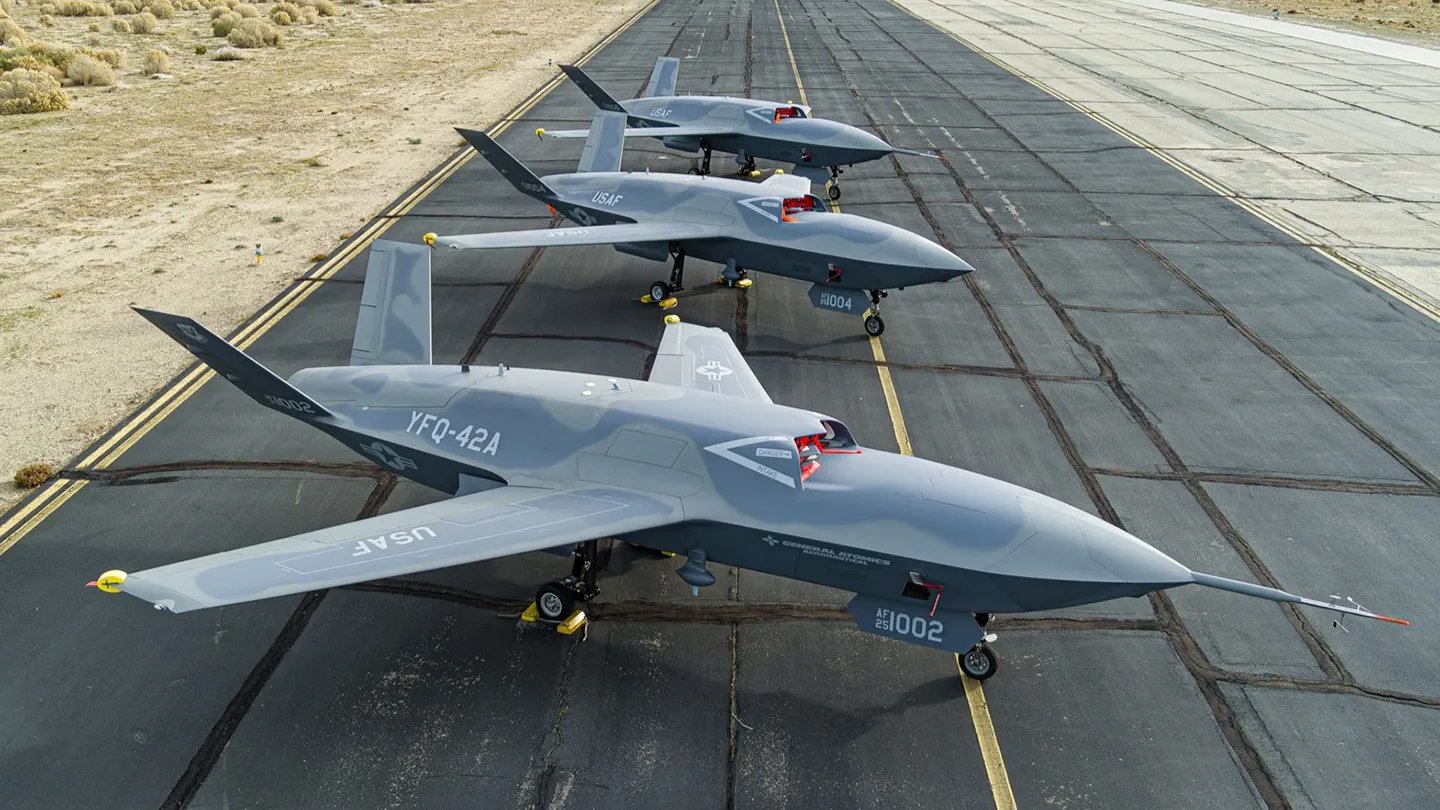
YFQ-44 Dark Merlins on the ramp. (General Atomics)

The report says that requirement was built into the CCA program from the start. The current exercise is therefore a test of whether those early design assumptions can translate into real procedures carried out by military personnel rather than just contractors or development teams.

What the Air Force is testing

The most important detail in the Air Force statement is that operators are running both ground and flight operations from end to end. That suggests the exercise is not limited to observing aircraft performance in the air. It is also about the practical tasks that determine whether a system is usable in distributed operations: handling, launch and recovery workflows, support requirements, sustainment demands, and the degree of manpower needed to keep the aircraft mission-ready.

Lean sustainment is especially important. Uncrewed combat aircraft may promise lower risk to pilots and more flexible force packages, but those advantages can narrow if the platforms require large support tails or specialized infrastructure. Testing at Creech under an ACE framework gives the Air Force a chance to measure how much footprint these aircraft really need and how quickly they can be moved or turned around.

The human-machine teaming element is also central. The Air Force’s language points to an operational model in which service personnel, not just industry teams, develop tactics and procedures for using these aircraft. That matters because collaborative combat platforms are intended to fit into broader force structures, not operate as isolated technology demonstrators.

Program momentum is building

The War Zone describes the CCA program as picking up speed after the Air Force selected Anduril’s YFQ-44 Fury and General Atomics’ YFQ-42 Dark Merlin for production as the two Increment One aircraft. That selection already marked a major transition from competition to acquisition. The Creech exercise adds another layer by focusing attention on how the aircraft may be sustained and employed in practice.

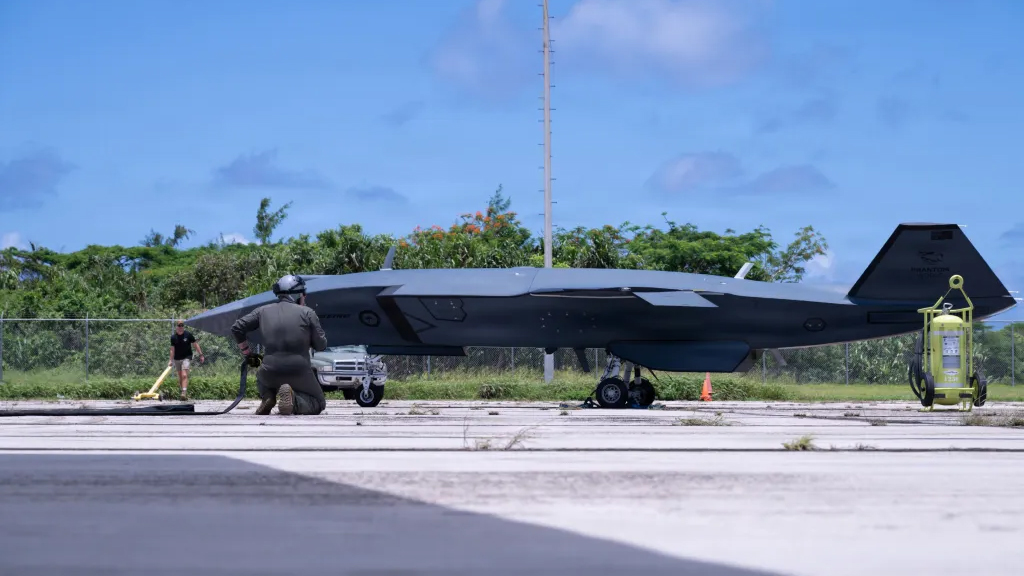
An MQ-28 during the proof-of-concept Forward Arming and Refueling Point at Rota, Commonwealth of the Northern Mariana Islands. U.S. Air Force photo by Senior Airman Austin Salazar Senior Airman Austin Salazar

The participation of both selected designs is also important for comparison. Running the YFQ-44 and YFQ-42 in the same ACE-oriented exercise creates an opportunity for the Air Force to gather operational insights across two distinct air vehicles while refining common concepts for employment. Even if the exact results remain undisclosed, the structure of the event indicates the service is concentrating on doctrine and fieldability as much as on raw aircraft capability.

The presence of Royal Netherlands Air Force observers adds a further signal. The source does not claim a formal partnership beyond observation, but their attendance suggests allied interest in how the United States intends to integrate collaborative combat aircraft into future operations. That is notable because concepts like distributed basing, human-machine teaming, and low-footprint sustainment are not uniquely American concerns.

What comes next

The Air Force statement cited in the report says CCA testing is taking place at a combination of government locations, underscoring that this is part of a broader development effort rather than a one-off event. Even so, the July 20-24 exercise at Creech stands out because it ties together several strands of the program at once: production-selected aircraft, operator-led activity, austere deployment, and doctrinal experimentation under ACE.

That makes this stage more consequential than a routine test movement. The Air Force is now examining whether collaborative combat aircraft can support the kind of mobile, distributed operations that modern air combat planning increasingly demands. If these aircraft cannot be sustained simply and moved efficiently, their strategic utility shrinks. If they can, they become more credible as scalable partners for crewed combat forces.

Much remains unstated in the public reporting, including specific performance data, sortie outcomes, and sustainment metrics. But the exercise itself reveals the direction of travel. The CCA program is no longer only about choosing designs. It is about proving that autonomous or semi-autonomous combat aircraft can function inside a military operating model built for movement, resilience, and reduced logistical burden.

  • The Air Force said its CCA Experimental Operations Unit is running an Agile Combat Employment exercise at Creech from July 20-24, 2026.
  • Both Increment One aircraft, the YFQ-44 Fury and YFQ-42 Dark Merlin, are participating.
  • The service says operators are testing end-to-end ground and flight operations, lean sustainment, and human-machine teaming.
  • Observers from the Royal Netherlands Air Force are attending, according to the Air Force statement cited by the source.

This article is based on reporting by twz.com. Read the original article.

Originally published on twz.com