The Bottleneck in Molecular Analysis
Mass spectrometry has been biology's most powerful tool for answering what molecules are here, and how many — but for decades it has operated under a fundamental constraint: it analyzes molecules sequentially, one at a time. Researchers at Rockefeller University have now built a prototype that breaks this constraint, analyzing billions of molecules simultaneously through a massively parallel architecture they call MultiQ-IT. The result is a 100-fold improvement in sensitivity — a leap that could transform biological research and drug discovery in the same way that parallel computing transformed digital processing.
The device was developed in Brian T. Chait's lab at Rockefeller, inspired by an unlikely biological model: the nuclear pore complex, the protein machine that cells use to manage molecular traffic in and out of the cell's nucleus. Rather than routing everything through a single gate, cells parallelize: hundreds of nuclear pores simultaneously handle traffic. Chait's team asked whether the same principle could be applied to mass spectrometry.
How MultiQ-IT Works
Conventional mass spectrometers ionize molecules — stripping or adding electrons to give them an electric charge — then accelerate them through a field and measure how long they take to reach a detector, or how they move through a curved magnetic field. This generates the signature mass-to-charge ratio that identifies each molecule. It is extraordinarily precise, but the single-stream architecture means that common, abundant molecules dominate the analysis, drowning out rarer species.
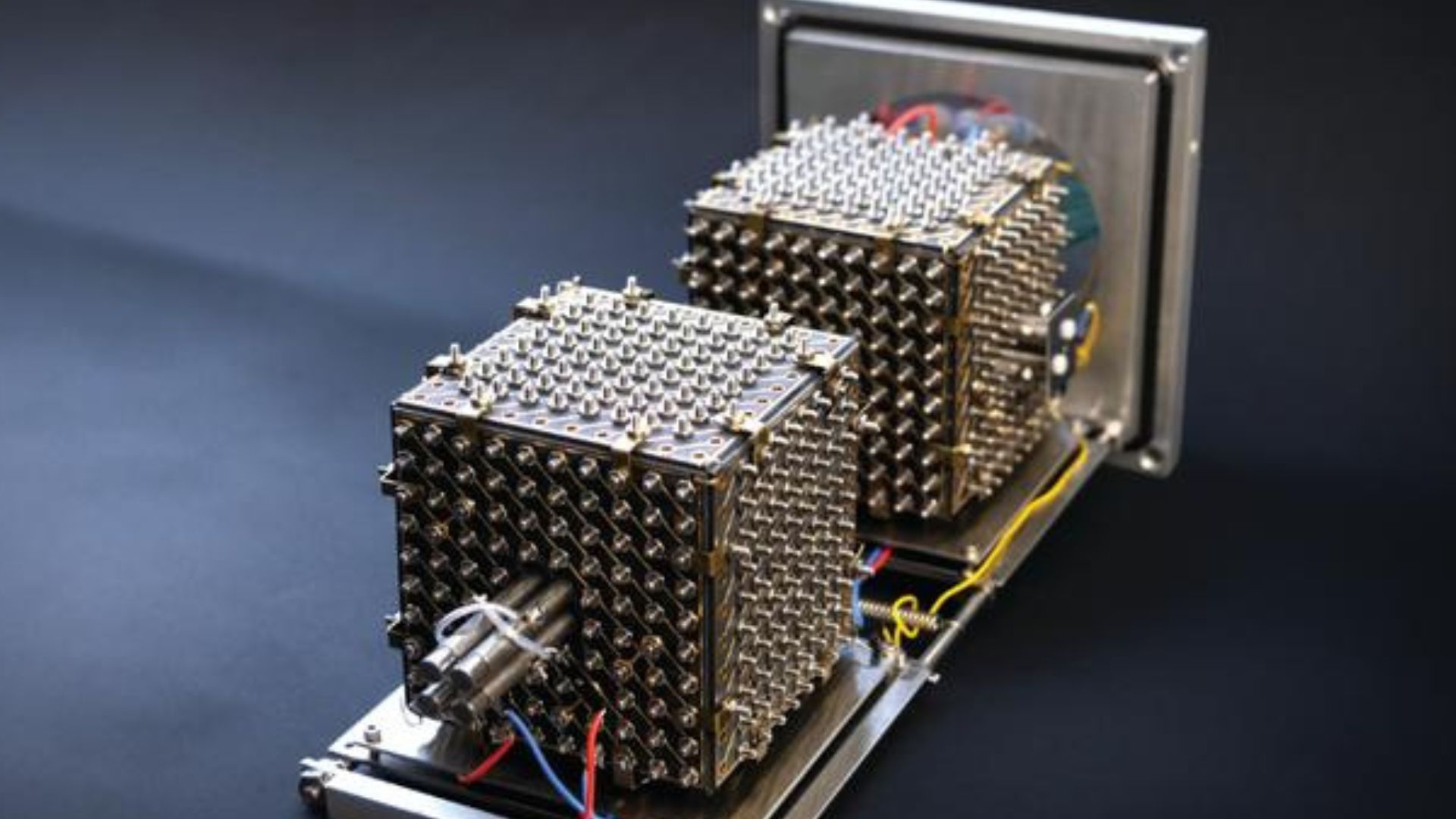
MultiQ-IT replaces this single-stream architecture with a cube-shaped ion-trapping chamber lined with 1,000 electrically controlled openings. Instead of a narrow ion beam flowing through a single trap, MultiQ-IT splits the incoming stream into thousands of parallel channels, each trapping and analyzing its own population of ions simultaneously.
A 486-port version of the prototype can hold ten billion charges simultaneously — roughly a thousand times the capacity of conventional ion traps. That enormous simultaneous capacity changes what is visible: instead of seeing only the most abundant molecules, the system can detect proteins and metabolites present at trace concentrations that would be completely invisible to conventional mass spectrometry.
The Signal-to-Noise Revolution
The practical breakthrough is a 100-fold improvement in signal-to-noise ratio. In complex biological samples — blood, cell extracts, tissue homogenates — the majority of molecules are a small number of highly abundant species. Albumin dominates blood protein samples, for example, swamping signals from the thousands of lower-abundance proteins that may carry meaningful diagnostic or mechanistic information.
MultiQ-IT addresses this through selective retention: electrical barriers at the chamber's exits are tuned to let common, singly charged noise molecules escape while retaining rarer, multiply charged biological molecules of interest. This is a form of chemical discrimination built into the hardware rather than applied after the fact in data analysis.
The result is that proteins which were invisible in conventional mass spectrometry experiments — present in samples but too low in abundance to detect — are rendered in what the researchers describe as high definition. This has immediate implications for single-cell proteomics, the challenge of measuring the complete protein content of individual cells, which requires detecting proteins present in very small quantities.
The GPU Analogy
The Rockefeller team has drawn an explicit analogy between MultiQ-IT and the transition from CPUs to GPUs in computing. Before GPUs, graphics rendering was done sequentially on general-purpose processors. The shift to massively parallel GPU architectures did not just make graphics faster — it unlocked entirely new categories of computation, including the machine learning workloads that now power AI systems.
Mass spectrometry's transition from sequential to parallel analysis could similarly unlock capabilities that are currently impossible rather than merely difficult. Single-cell proteomics, the mapping of protein interaction networks in living tissues, and the detection of rare biomarkers at clinically relevant concentrations in blood are all applications that become more tractable with 100-fold sensitivity improvements.
Path to Clinical and Drug Discovery Applications
MultiQ-IT is still a prototype — a proof of concept that establishes the architecture's viability rather than a polished commercial instrument. The path from laboratory prototype to commercial mass spectrometer involves significant engineering work: miniaturization, automation, software development, and the manufacturing processes needed to produce the precision ion-trapping structures reliably at scale.
But the researchers argue that the architecture is a blueprint, not a dead end. The underlying principle — massive parallelization of ion trapping — can be scaled by adding more ports, improving the selectivity of the electrical barriers, and integrating better detection systems. The current 486-port prototype is a starting point, not a ceiling.
In drug discovery, the ability to detect and quantify trace proteins in complex samples is directly relevant to identifying drug targets, measuring drug-target engagement, and understanding the mechanism of action of candidate therapeutics. The spectrometry revolution promised by MultiQ-IT could accelerate timelines that currently constrain pharmaceutical development across the industry.
This article is based on reporting by Interesting Engineering. Read the original article.