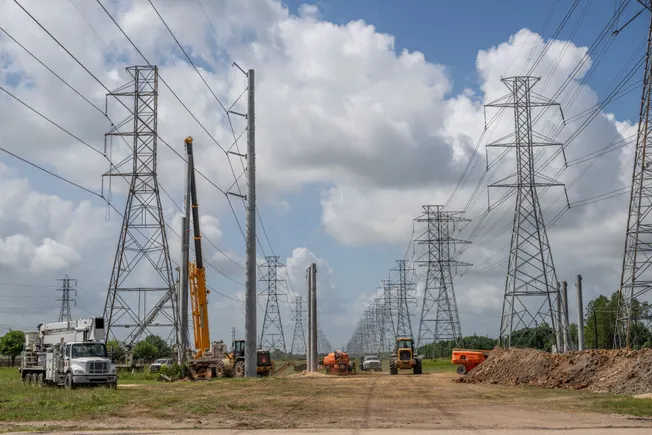
A regulatory dispute with national implications
A coalition of utility and transmission companies including Entergy and Xcel Energy has asked the Federal Energy Regulatory Commission to halt competitive bidding for regional transmission projects in the Midcontinent Independent System Operator and Southwest Power Pool regions. The April 7 complaint argues that requiring some projects to go out for bid, rather than assigning them directly to incumbent utilities, adds 16 to 20 months on average to development timelines. The companies want a decision from FERC by July 16.
That request may sound procedural, but it goes to the center of how the United States plans, pays for, and delivers new transmission. Regional power grids need more long-distance wires to connect generation, move electricity across balancing areas, and handle rising demand. The question is whether competition speeds that work up by lowering costs and forcing discipline, or slows it down by inserting another layer of process into an already cumbersome system.
The filing has already drawn a sharp rebuttal. Former FERC Chairman Neil Chatterjee told Utility Dive that ending competition would be counterproductive and not in the interest of consumers. Instead of suspending competitive solicitation, he argued, regulators should improve the process. A coalition representing large energy users and consumer advocates made a similar case, saying monopoly utilities have little incentive to control costs when they automatically receive projects and can earn more by spending more.
Why this matters now
This dispute arrives at a moment when transmission has become one of the power sector’s biggest bottlenecks. New generation, especially in regions with major renewable resources, increasingly depends on grid expansion. At the same time, load growth from industry, electrification, and data centers is putting new pressure on planning systems that were already slow. Even modest delays in regional transmission can ripple outward into resource adequacy, interconnection queues, and consumer bills.
The complainants frame competition itself as part of the problem. In their telling, giving incumbent utilities the right to build regional projects would remove delays and get steel in the ground faster. Their position taps into a broader industry frustration: the U.S. grid often takes years to move from identified need to actual construction, and every step of review can become another place for litigation, disputes, or redesign.
Opponents see a different risk. They argue that eliminating bidding would trade one form of delay for a more durable structural problem: less pressure to manage cost and schedules. The Electricity Transmission Competition Coalition said competitive projects in MISO and SPP have historically improved cost and schedule discipline, while noncompetitive projects have not. That is the central policy divide here. One side says competition is friction. The other says competition is accountability.

Order 1000 is still shaping the argument
The fight is part of a long-running debate that stretches back to FERC’s 2011 Order 1000 on transmission planning and cost allocation. That order required regional transmission project selection processes to open certain projects to competition, with the stated goal of lowering costs and broadening participation beyond incumbent utilities. Since then, utilities, independent transmission developers, state regulators, consumer advocates, and large customers have all battled over how well the framework works in practice.
The latest complaint does not just reopen that old fight. It lands in a more urgent context. Regional grids are under pressure to deliver major upgrades quickly, and the scale of future needs makes the assignment of projects more economically important than before. Every rule affecting who builds transmission also affects who earns regulated returns over decades. That makes transmission policy both an infrastructure question and a financial one.
Even the opponents of the complaint are not defending the status quo as flawless. Chatterjee explicitly said the competitive solicitation process has challenges and can be improved. That matters because it suggests the likely middle ground in this debate is not a simple yes-or-no answer on competition. FERC may instead be pushed toward narrower reforms aimed at reducing bid-cycle drag while preserving some kind of market test.
Consumers are caught in the middle
For households and businesses, this can look abstract until the bill arrives. Transmission costs flow through rates, but so do the costs of congestion, inefficient dispatch, and delayed access to new resources. A faster buildout could help reliability and reduce some system costs. A less disciplined buildout could also lock in higher asset costs that customers ultimately pay. The regulatory design problem is finding a process that does not sacrifice one objective for the other.
The consumer groups opposing the complaint are emphasizing exactly that point. Their argument is that incumbents, absent competitive pressure, have weak incentives to reduce spending because larger projects can support larger profits. Utilities counter that the current process imposes its own inefficiencies and that assigning projects directly would avoid unnecessary delay. Both claims can be true in part, which is why the case is likely to attract close attention well beyond MISO and SPP.
If FERC were to curtail bidding in these regions, the decision could influence transmission politics nationally. Other regions and stakeholders would read it as a signal about whether the commission still sees competition as a core tool of transmission policy or as a dispensable experiment when buildout pressures intensify.
What to watch next
The immediate deadline is the complainants’ request for a FERC decision by July 16. Before then, the case is likely to generate more filings from utilities, customer groups, and transmission developers. The record will test whether the claimed 16-to-20-month delay from competitive bidding is persuasive enough to justify a major rule shift.
The broader question is harder. The United States needs far more transmission, but it also needs public confidence that the buildout will be economical and well governed. That is why this fight matters. It is not only about regional lines in the Midwest and Great Plains. It is about whether the next era of grid expansion will be defined by monopoly assignment, competitive selection, or some uneasy hybrid of the two.
This article is based on reporting by Utility Dive. Read the original article.
Originally published on utilitydive.com




