The City That Google Cannot See

Every American city and town of any consequence has been photographed by Google Street View cameras — every one except North Oaks, Minnesota. The affluent suburb north of St. Paul has remained invisible on Street View for nearly two decades, not through technical obstacles but through an unusual property rights structure that places its roads — and by extension all access to them — in the hands of the homeowners who live there.

North Oaks is home to roughly 5,000 residents, many of them executives from major corporations headquartered in the Twin Cities. Former Vice President Walter Mondale lived there. It is, by design, a place that resists scrutiny — and for more than fifteen years it had successfully resisted Google's cameras.

The Legal Architecture of Invisibility

Unlike virtually every other American municipality, where roads are public rights-of-way owned by local government, North Oaks' streets are owned by the North Oaks Home Owners Association. Every homeowner's property extends to the center of the adjacent road, meaning there is literally no public land in the city. Signs at the entrances make clear that driving the roads without permission constitutes trespassing. Automated license plate readers capture the identities of vehicles that enter.

When Google's Street View cars entered the city in the early days of the program, the city threatened legal action for trespass. Google complied, deleted the images, and has not returned since.

A Documentarian Finds the Loophole

Chris Parr grew up near North Oaks and had long been fascinated by the city's carefully maintained anonymity. He identified a legal avenue the homeowners' association had apparently not considered: the airspace above North Oaks is governed by the Federal Aviation Administration, not by local property owners.

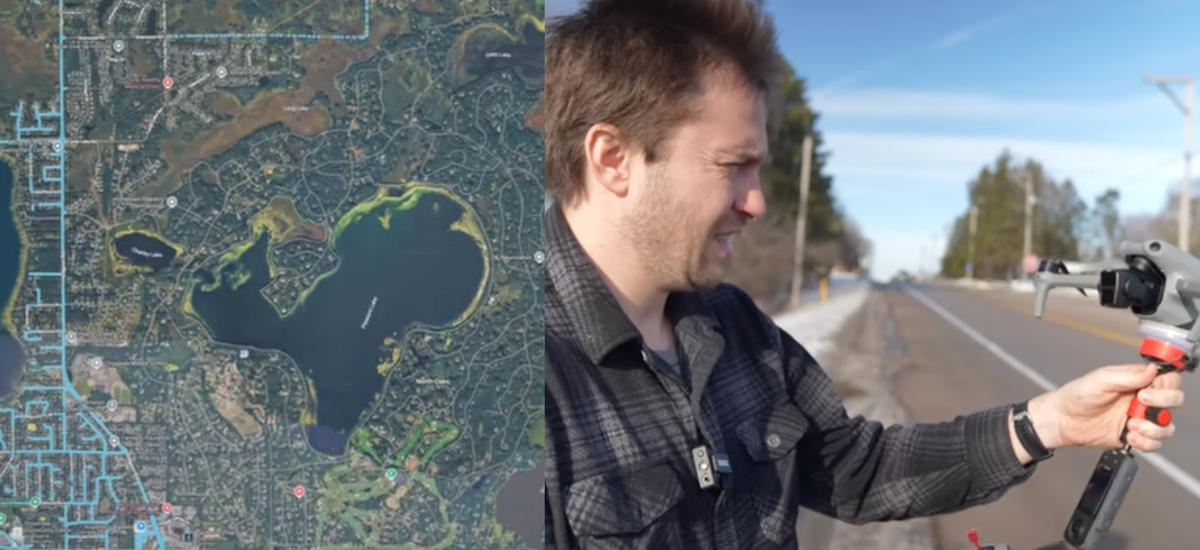
"Technically, if you launch your drone from public property, which anyone can do if you're a registered drone pilot, you can fly it straight up and above private property," Parr explained. The NOHOA's property claims extend to the center of the road on the ground — not into the sky above.

Parr drove to the city's boundaries and launched his drone from public road shoulders, flying it over North Oaks' streets, homes, and parks. He captured extensive aerial footage and uploaded the images to Google Maps, filling in what had been a conspicuous blank spot. For a brief window, North Oaks was mappable. Users could navigate its streets in Street View for the first time since 2008.

The Brief Triumph and Its Aftermath

The experiment did not last. Residents and the homeowners' association quickly flagged Parr's images, and Google removed them. Parr received a letter from a law firm representing the NOHOA — not demanding he take down his own footage, but informing him he was not welcome to return.

Some streets were too far from the boundaries for Parr to reach from public land. To complete his mapping, he posted to Craigslist seeking a resident willing to invite him in, received numerous responses, and connected with a woman named Maggie who granted him access to a park within the city. Armed with the invitation and his drone, he completed the map before it was removed.

Privacy, Wealth, and the Future of Mapping

The North Oaks story inverts the usual dynamics of surveillance in American life. Most communities have no mechanism to resist being photographed, tracked, or mapped. Their streets are public. Their residents' movements are recorded by Ring cameras, CCTV, and license plate readers without meaningful consent. North Oaks, through the accident of its unusual property structure, purchased a degree of collective privacy unavailable to any other American community.

Parr's documentary does not take a firm stance on whether this is right or wrong. "I know that I was able to do this, but I don't know if I should be able to do this, and that's kind of the question I wanted to tackle," he said. YouTube comments on his video are, by his account, split roughly 50-50 between those who see his mapping as a transparency victory and those who see it as an invasion of legitimate privacy.

The episode raises questions that extend beyond one wealthy suburb. As drone technology becomes cheaper and AI-powered image processing makes aerial footage more useful, the ability of any property owner to resist external surveillance will continue to erode. North Oaks may be the last American city to successfully maintain its invisibility — but the legal and technical tools that made that possible are unlikely to remain effective much longer.

This article is based on reporting by 404 Media. Read the original article.