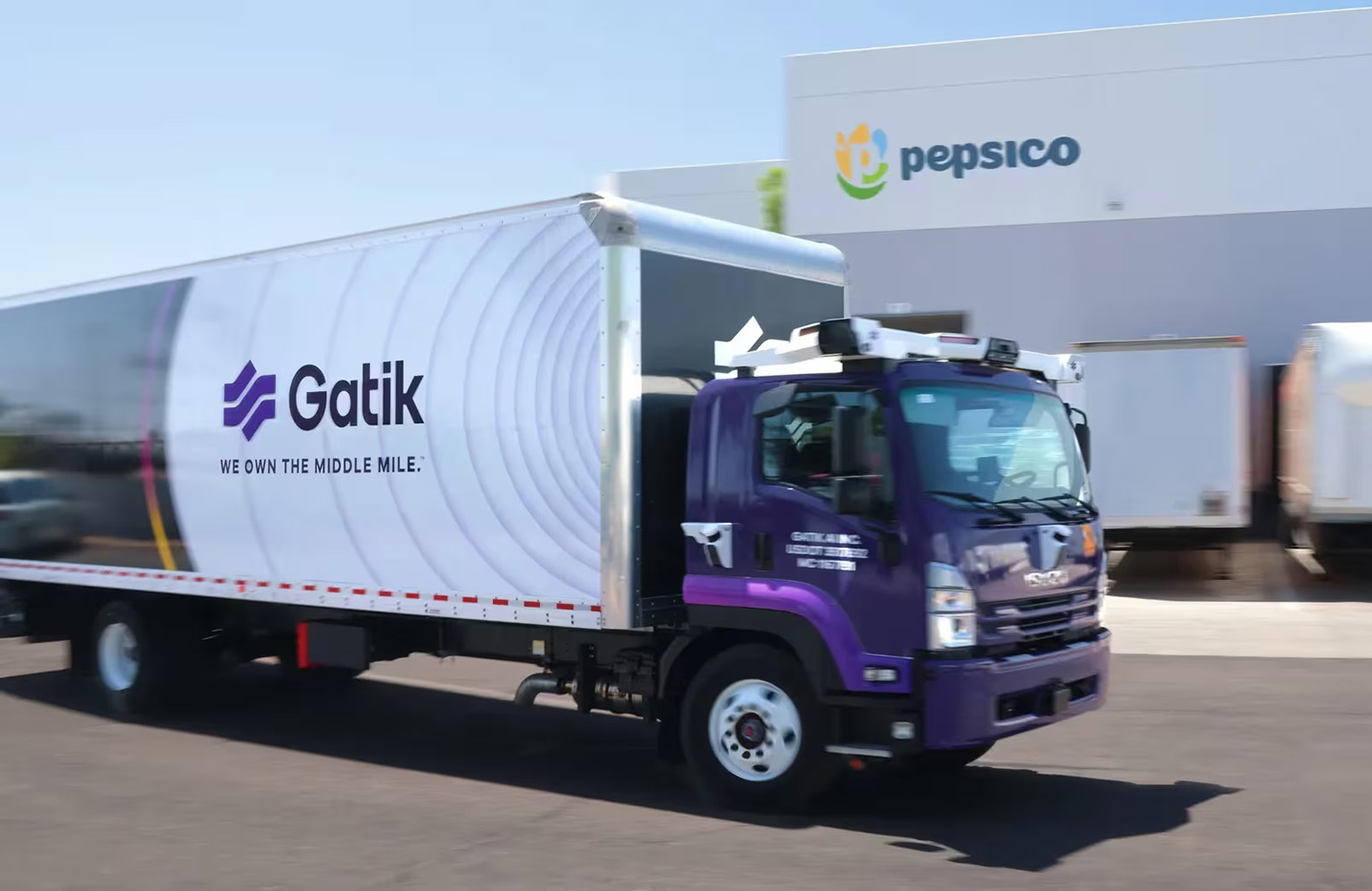
PepsiCo Expands a Live Test of Autonomous Freight
PepsiCo has signed a multi-year strategic partnership with Gatik AI that pushes autonomous trucking further into the company’s North American supply chain. The arrangement builds on operations already underway in Texas, Arizona and Arkansas, where Gatik is moving products for the food and beverage company today.
That existing footprint is what gives the announcement its weight. This is not a concept deployment or a pilot with vague ambitions. According to the source material, Gatik is already operating inside PepsiCo’s network, and the new agreement is focused on regional transportation routes where goods move daily from site to site.
In logistics, that middle-mile segment is a demanding proving ground. Routes are high-frequency, time-sensitive and operationally critical. If autonomous vehicles can perform consistently there, they move closer to becoming a real commercial infrastructure layer rather than a technology showcase.
Why the Middle Mile Matters
The middle mile does not usually get the same attention as robotaxis or long-haul autonomous trucking, but it may be one of the clearest near-term use cases for autonomy. These networks are repetitive enough to support operational learning, yet important enough that better performance can create measurable business value.
PepsiCo framed the partnership in exactly those terms. Jim Farrell, the company’s senior vice president of supply chain, said serving its customer base requires a supply chain that is safe, reliable and built for the future. He added that Gatik already operates inside PepsiCo’s networks and brings the technology, commercial experience and scale needed to strengthen service, add capacity and move products more consistently.
That language points to the main business case. The technology is being justified not as novelty, but as a tool for reducing variability in goods movement while increasing throughput on routes PepsiCo depends on every day.

What Gatik Says Its System Adds
Gatik said its autonomous trucks are designed for end-to-end deliveries across highways and surface streets, a notable detail because it broadens the operating environment beyond simplified depot loops. The company also emphasized dynamic route orchestration for regional logistics networks with hundreds of pickup and drop-off points.
For PepsiCo, that means route plans can be modified in response to daily operating needs. Stops can be added or removed, demand changes can be addressed, and activity levels across distribution centers can be reflected in the routing plan. That flexibility is important because rigid automation often struggles in real-world logistics, where commercial success depends as much on adaptability as on autonomy itself.
Gatik further claimed that autonomous vehicles can reduce variability, improve on-time performance and add capacity without major changes to existing operations. Most notably, the company said it is operating at more than 98% on-time delivery across its operations.
That figure is one of the most concrete indicators in the announcement. It does not answer every question about cost, safety or labor impact, but it does suggest the company is putting performance metrics at the center of its commercial pitch.
From Pilot Stage to Embedded Operations
The partnership also reflects a broader maturation of the autonomy sector. Gatik’s first deployment with PepsiCo dates to 2022. Four years later, the companies are no longer describing the effort as an experiment. They are positioning autonomous freight as part of ordinary supply chain execution.
Gautam Narang, Gatik’s co-founder and chief executive, said autonomous trucking reaches commercial scale when it operates inside one of the most demanding supply chains in the world. His point was less about technical possibility than institutional validation. PepsiCo’s network is large, fast-moving and operationally unforgiving. A continued expansion there signals that the customer sees enough value to move beyond limited trials.
That matters for the wider market because one of the main questions facing autonomous freight has been whether the technology can progress from controlled demos to recurring, revenue-generating use. This partnership suggests at least one segment of the industry believes that transition is already under way.

What This Means for Supply Chain Automation
PepsiCo said its products are consumed more than 1 billion times per day in over 200 countries and territories. That scale makes even incremental improvements in transportation efficiency potentially significant. If autonomous middle-mile operations can reliably support service levels, companies with large private fleets may view them as a way to improve resilience without redesigning their full logistics architecture.
The appeal is practical:
- Regional routes are predictable enough to support automation.
- Distribution schedules create recurring demand for high-frequency movement.
- On-time performance has direct commercial value.
- Capacity gains can help absorb operational pressure without major network overhaul.
There are still unanswered issues around broader rollout, regulation and how different operating conditions will affect deployment at scale. But the announcement’s significance lies in how ordinary the use case sounds. Products move from site to site every day. The claim is that autonomous trucks can now become a stable part of that routine.
A More Grounded Phase for Autonomous Trucking
For years, the autonomy sector often emphasized futurist narratives. This deal points in a more grounded direction. Instead of promising a total reinvention of freight, Gatik and PepsiCo are focusing on a narrower but commercially relevant slice of logistics where repeatability, route density and service reliability align.
That is likely where real adoption will be won or lost. The companies are not asking the market to imagine a distant transport revolution. They are asserting that autonomous freight is already delivering products inside an existing, high-volume network and can expand from there.
If that claim holds, the broader implication is clear. The path to scale in autonomous trucking may not start with the longest routes or the most dramatic use cases. It may begin in the middle mile, where repetitive operations, strong customer incentives and measurable performance can turn autonomy from a research program into logistics infrastructure.
This article is based on reporting by The Robot Report. Read the original article.

Originally published on therobotreport.com