A prosthetics company is feeding a robotics problem
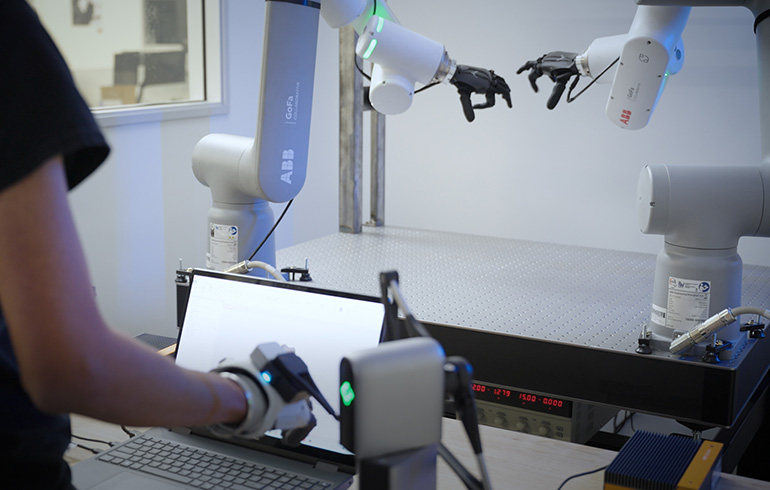
ABB Robotics and PSYONIC have announced a collaboration aimed at one of robotics’ hardest unsolved tasks: giving machines more reliable dexterity in the real world. The project combines ABB’s GoFa collaborative robot with PSYONIC’s Ability Hand, a prosthetic device designed around myoelectric control, touch sensing, and compliant mechanics.
The core idea is straightforward. Prosthetic users generate real interaction data about how humans grip, release, and adapt to objects. ABB and PSYONIC want to use that stream of touch and motion information to train robots to handle tasks that have remained difficult to automate.
That makes this more than a hardware partnership. It is an attempt to turn human-derived manipulation patterns into training material for physical AI systems. ABB explicitly ties the project to its broader push toward what it calls autonomous versatile robotics, or robots that can sense, reason, move, and manipulate objects in changing environments.
Why dexterity is still a bottleneck
Industrial automation has become very good at repetition, structured motion, and tightly controlled environments. It is much less reliable when objects vary in shape, softness, orientation, or fragility. That is where human hands still dominate.
According to ABB, learning from real-world interactions is essential if robots are going to move beyond fixed routines. The company’s position is that progress in physical AI depends not only on perception and planning, but on manipulation that works outside idealized lab conditions.
PSYONIC’s technology gives the partnership a useful starting point because the Ability Hand was built for human use, not originally for factory automation. The system includes pressure sensors and vibration feedback that let users detect contact, grip force, and release. Its flexible fingers can conform to irregular and deformable objects, which is exactly the kind of capability that many standard industrial grippers lack.
From prosthetic design to industrial relevance
PSYONIC founder and CEO Adeel Akhtar says the company began on the prosthetics side and has already reached clinical use, with FDA approval and more than 300 patients using the hand. It is also covered by Medicare in the United States. But he says the balance of demand has changed as interest in physical AI has accelerated.
That shift is telling. Features that matter in assistive devices, such as compliant movement, touch awareness, and natural adaptation to objects, also matter in robotics environments where rigid tooling becomes a constraint. Akhtar argues that suction systems and parallel-jaw grippers often need tool changers, adding delay, maintenance, and failure points.
For work involving deformable objects or spaces built around people, a five-fingered hand can be a more natural fit. The partnership therefore sits at the intersection of two trends: prosthetics becoming more sensor-rich and robotics becoming more dependent on real-world data.
Why the GoFa cobot matters
ABB’s GoFa is a force- and power-limited collaborative robot, which makes it appropriate for experimentation that depends on close, adaptive interaction rather than brute-force repetition. In this setup, the arm is effectively a test platform for the Ability Hand and its data stream.
The significance is not that a single robot hand will suddenly replace industrial end effectors across the board. It is that a sensing-rich hand paired with a collaborative arm can generate examples of how touch, motion, and compliance should work together. For training systems intended to operate in dynamic settings, that kind of data is difficult to fake convincingly.
ABB’s leadership describes human dexterity as one of the hardest things to reproduce in industrial-grade robotics. That assessment aligns with years of slow progress in areas like mixed-object picking, fabric handling, and cluttered bin manipulation. The collaboration suggests the company sees dexterity not as a peripheral improvement but as central to the next phase of robotics capability.
Physical AI needs better data, not just better models
The phrase physical AI often implies smarter software. This partnership emphasizes the opposite constraint: even strong models need grounded interaction data. A robot cannot learn how to handle a soft or awkward object just by looking at it. It needs examples of contact, force, slippage, and recovery.
That is what makes PSYONIC’s background important. Prosthetic users are effectively producing lived manipulation data in everyday settings. If those signals can be translated into robotic training workflows, developers may get a richer picture of how skilled handling actually happens.
The deal also reflects a broader convergence in the robotics market. Technologies once separated into medical devices, industrial tools, and AI research platforms are starting to overlap. Companies are looking for reusable components and data sources that can move between domains.
A focused bet on a long-standing problem
Neither ABB nor PSYONIC is presenting this collaboration as a finished product launch. It is a research and development move aimed at a bottleneck the industry has been discussing for years. That makes the announcement meaningful even without immediate deployment numbers.
If the project works, its value will come from showing that prosthetic touch and motion data can improve robotic manipulation in measurable ways. If it does not, it will still clarify how far the field remains from transferring human-like grasping into broadly deployable machines.
Either way, the partnership reflects where advanced robotics is heading: less emphasis on isolated hardware improvements, and more attention to the data and embodiment needed to make robots handle the physical world with something closer to human judgment.
This article is based on reporting by The Robot Report. Read the original article.
Originally published on therobotreport.com