Ford’s headline number is holding up under independent testing
The Ford Mustang GTD was already notable on paper as the most powerful factory Mustang the company has produced, with Ford rating the car at 815 horsepower and 664 lb-ft of torque at the crank. Now an independent dyno session by Late Model Restoration adds a useful real-world data point: the track-focused halo car appears to be sending a remarkably large share of that output to the pavement.
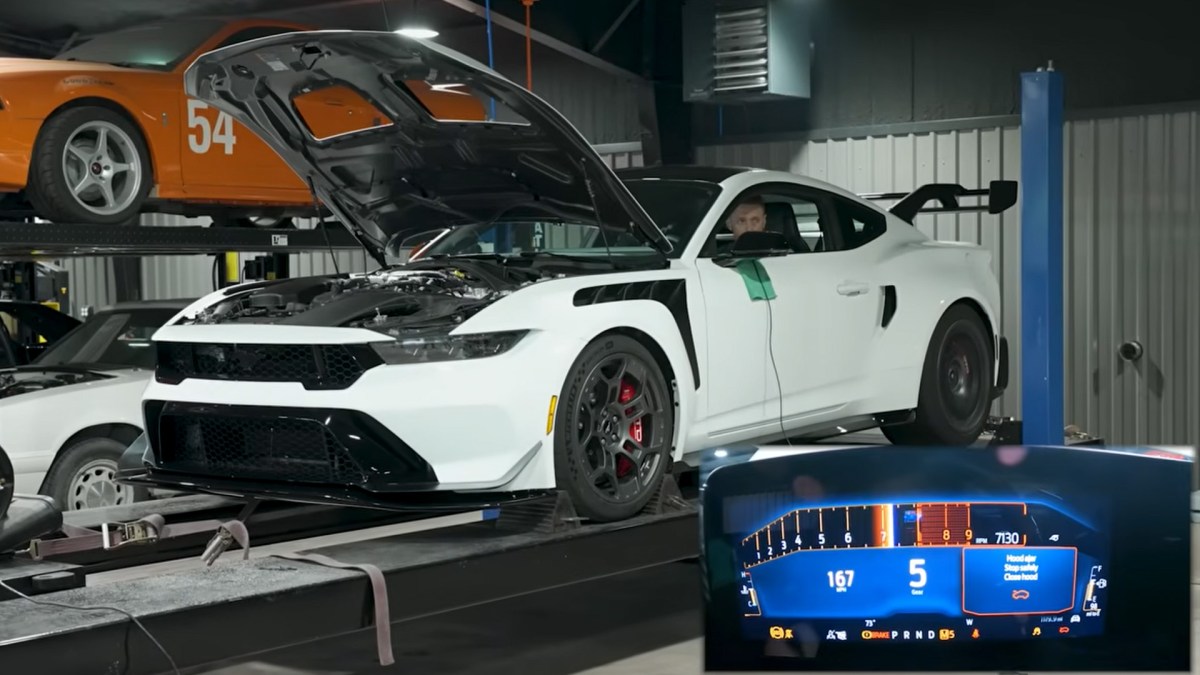
In the test described in the source material, Late Model Restoration strapped a Mustang GTD with just over 1,100 miles to the dyno after a short shakedown. The first pass recorded 740 wheel horsepower at 7,100 rpm and 605 lb-ft of torque at 4,600 rpm. On the second pass, the numbers climbed to 753 wheel horsepower at 7,400 rpm and 609 lb-ft at 4,500 rpm. Those are strong results by any measure, but the more revealing point is what they imply about drivetrain losses.
Based on the numbers cited in the report, the GTD appears to be losing roughly 8 percent of its rated power between crank and wheel. That is an eye-catching figure for a production car, especially one whose layout sends power from a front-mounted engine to an eight-speed transaxle at the rear. The source notes that a rough assumption closer to 15 percent loss is often considered safe, which makes the GTD’s apparent efficiency stand out even more.
Why wheel horsepower matters
Manufacturer power claims are typically measured at the crank, not at the tire. That leaves room for debate because the actual force reaching the ground is always lower once the drivetrain absorbs some energy through mechanical complexity, heat, and friction. Dyno tests do not settle every argument, since conditions and equipment vary, but they offer a more tangible look at how a car performs outside a press release.
That is why the GTD’s result matters. Ford’s 815-horsepower claim was already ambitious, and ultra-high-output cars sometimes generate skepticism about whether official ratings are conservative, optimistic, or simply difficult to compare across different measurement methods. A reading in the 740-to-753 wheel-horsepower range suggests the GTD is at least very much in the territory Ford advertised.
The source also notes that other Mustang GTD dyno videos have appeared online, with results consistently showing about 740 wheel horsepower on the low end. Late Model Restoration’s 753-wheel-horsepower figure was described there as the highest seen so far. That kind of consistency across multiple informal tests strengthens the impression that the GTD’s published output is translating well into real mechanical performance.
Engineering implications for Ford’s flagship Mustang
The GTD is not just another high-power variant. It is positioned as a track-specialized machine with an unusual configuration for a Mustang, and the drivetrain layout is part of what makes these results noteworthy. Sending so much power through a setup that stretches from the engine in front to the transaxle out back would ordinarily invite expectations of more significant losses.
Instead, the dyno numbers suggest that Ford’s engineering package is retaining an unusually large portion of the car’s rated output. That matters because the GTD is meant to function as a technological and performance statement for the brand. Strong wheel-horsepower performance helps validate that claim in a way spec-sheet numbers alone cannot.
The test vehicle also puts the output to the ground through ultra-wide Michelin Pilot Sport Cup 2 R tires sized 345/30R20 at the rear, underscoring how purpose-built the package is. High power only matters if the rest of the car is designed to use it, and the GTD’s combination of output, layout, and tire setup points to a machine built around track credibility rather than simple headline chasing.
Why this story has broader significance
On its face, a dyno session might look niche compared with industry policy or mass-market product launches. But for high-performance automotive engineering, these tests help establish whether a flagship car is substantively different or merely theatrically marketed. The GTD appears to be in the first category.
Independent verification matters especially in an era when halo cars are often used to signal technical prestige. A result showing low drivetrain loss is not just a bragging-rights metric. It suggests efficient power delivery, disciplined engineering, and a product that behaves like the serious performance instrument Ford says it is.
There are limits to what one dyno session can prove. Environmental conditions, dyno calibration, and vehicle state all affect outcomes. But the source text’s broader point is solid: as more examples are tested, the GTD is consistently landing in a range that supports Ford’s headline claim rather than undermining it.
For a car designed to stretch the Mustang nameplate into supercar-adjacent territory, that matters. The GTD is not only claiming extreme output. It is beginning to show that the number survives contact with independent measurement.
Why this story matters
- An independent dyno test recorded up to 753 wheel horsepower from Ford’s Mustang GTD.
- The result implies roughly 8 percent drivetrain loss, lower than many would expect for a production car of this layout.
- Multiple dyno results in a similar range suggest Ford’s 815-horsepower claim is translating credibly into real output.
This article is based on reporting by The Drive. Read the original article.
Originally published on thedrive.com