A One-Off That Pushes Against the Product Trend
Ferrari’s HC25 is not a volume launch, a platform reset, or a roadmap announcement. It is a one-off commission. Yet that is exactly why it is interesting. In a market where performance manufacturers are moving deeper into electrification and hybrid systems, the HC25 revives a configuration that is steadily receding from the center of Ferrari’s lineup: the non-hybrid mid-engine V8.
According to the supplied source text, the HC25 is based on the F8 Spider and retains that car’s 3.9-liter twin-turbo V8, rated at 710 horsepower and 567 pound-feet of torque. Ferrari’s estimated zero-to-62 mph time also remains unchanged at 2.9 seconds. What changes is not the core powertrain but the bodywork and visual identity wrapped around it.
Yesterday’s Mechanical Package, Today’s Styling Direction
The source describes the HC25 as a bridge between F8 underpinnings and the styling direction Ferrari has established in newer models such as the F80 and 12Cilindri. That makes the car more than a nostalgia exercise. It is a design experiment that uses an older mechanical foundation to express a newer visual language.
That approach reveals something useful about Ferrari’s present moment. The company is evolving its product line, but it is also managing customer appetite for configurations that defined the previous era. The HC25 gives one customer a way to hold onto the sound and feel of a conventional mid-engine V8 while adopting bodywork aligned with Ferrari’s latest aesthetic priorities.
In that sense, the car functions as a custom-built overlap zone between product generations.
Design as Signal
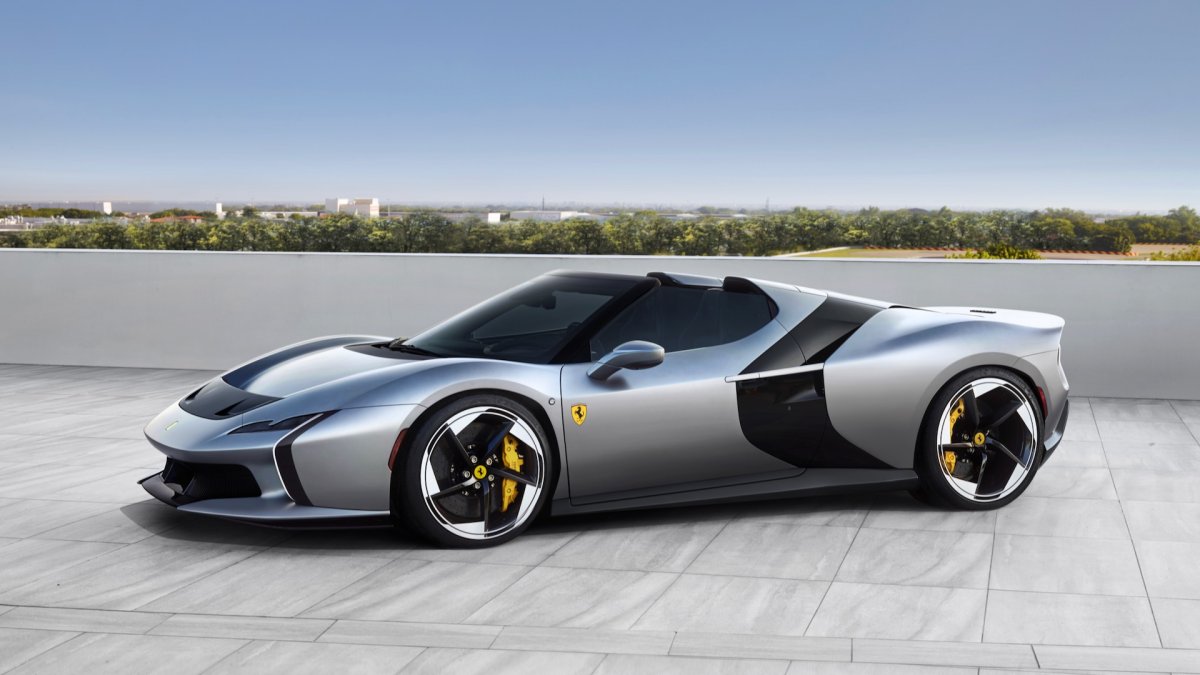
The supplied text emphasizes that every inch of bodywork has changed. Aerodynamic elements are described as less visually dominant than on the F8-era design, with a softer presentation influenced by current Ferrari styling. Engine intakes and vents are hidden within a black ribbon wrapping the middle of the car, while a large black graphic marks the hood. The matte Moonlight Grey bodywork is contrasted by gloss black surfaces, and the headlights were developed specifically for this car with extra-slim lenses.
One detail stands out in the source: vertical daytime running lights are said to appear here for the first time on a Ferrari. That suggests the HC25 is not simply a cosmetic remix for a wealthy collector. It is also a place where Ferrari can explore an idea that sits slightly outside its standard production constraints.
One-off programs often operate like small laboratories. They allow manufacturers to test combinations of brand heritage, current design language, and customer preference without committing to large-scale manufacturing decisions.
The Powertrain Choice Matters More Than the Production Count
Because the HC25 is unique, its direct commercial impact will be limited. But the powertrain choice still sends a clear cultural signal. Ferrari’s entry-level mid-engine line moved on when the F8 was replaced by the 296 GTB, and the source notes that the non-hybrid V8 option went away in that segment. The HC25 effectively restores that formula for one buyer through the company’s One-Off program.
That matters because high-end automotive strategy is no longer just about performance numbers. It is also about what kind of emotional and mechanical experience brands decide to preserve as the industry changes. A non-hybrid V8, especially in a mid-engine Ferrari, carries symbolic weight. It represents a set of assumptions about responsiveness, sound, and mechanical identity that many enthusiasts still value intensely.
Even if the broader market direction is fixed, bespoke projects like the HC25 show that legacy configurations can remain desirable enough to justify special treatment.
A Reminder About Luxury Manufacturing Flexibility
The HC25 also illustrates something broader about the modern supercar business: at the very top of the market, manufacturers can use customization programs to extend the life of specific ideas even as mainstream product planning moves on. Ferrari’s One-Off program exists precisely for that purpose. It lets the company translate individual customer taste into an officially sanctioned object, using factory design resources rather than aftermarket improvisation.
That capability has strategic value. It preserves exclusivity, deepens customer relationships, and gives Ferrari room to serve buyers who want something that the current catalog no longer offers. In the HC25’s case, that means a singular car with present-day styling but a previous-generation drivetrain philosophy.
More Than a Curiosity
It would be easy to dismiss the HC25 as an expensive side note, but that would miss the point. One-off cars often reveal tensions inside the industry more clearly than mass-market launches do. Here, the tension is between where performance-car engineering is headed and what a slice of buyers still wants to experience.
The HC25 does not reverse Ferrari’s trajectory. It does, however, document the staying power of the pure internal-combustion supercar as a luxury object. That is enough to make it worth watching, even if only one example exists.
Why Developments Today Chose This Story
- It captures how customization programs can preserve older powertrain formats during an industry transition.
- It highlights a rare non-hybrid V8 configuration in a segment moving beyond it.
- It offers a design and strategy story, not just a styling reveal.
This article is based on reporting by The Drive. Read the original article.
Originally published on thedrive.com