NASA’s lunar return mission reaches its final test
After an eight-day journey that took four astronauts away from Earth, around the Moon, and back again, NASA’s Artemis 2 mission is approaching its last major milestone: atmospheric reentry and splashdown. The Orion spacecraft is targeting a landing off the coast of San Diego, California, at about 8:07 p.m. Eastern time on Friday, according to the supplied source text, bringing an end to a mission that has served as a major demonstration of the agency’s deep-space transportation system.
The return is not just a ceremonial finale. Reentry is described in the source material as the most dangerous part of the mission. Orion is expected to hit Earth’s atmosphere at roughly 25,000 miles per hour, or about 40,000 kilometers per hour, before slowing dramatically for an ocean landing at about 17 miles per hour. That enormous reduction in speed depends on the capsule’s heat shield, atmospheric aerodynamics, and recovery procedures all working in sequence.
A free-return trajectory brings Orion home
The spacecraft’s path back to Earth reflects a classic lunar mission design. Orion performed a translunar injection burn early in the flight, setting up a figure-eight-style free-return trajectory that let the spacecraft loop around the Moon and head back toward Earth using gravity rather than large amounts of additional propulsion. The source text says mission controllers were able to skip the first two planned trajectory correction burns after that injection because the maneuver was so accurate.
That matters because one of Artemis 2’s roles is to validate the systems and planning that will be needed for future Moon missions. A free-return route offers a built-in path home, a valuable feature for crewed exploration. Even so, the return is not passive. Orion still required small course adjustments, and the spacecraft continued accelerating as Earth’s gravity pulled it inward. The source says Orion was traveling at nearly 2,000 miles per hour while still on approach, with gravity increasing its speed dramatically before atmospheric interface.

The heat shield faces its defining moment
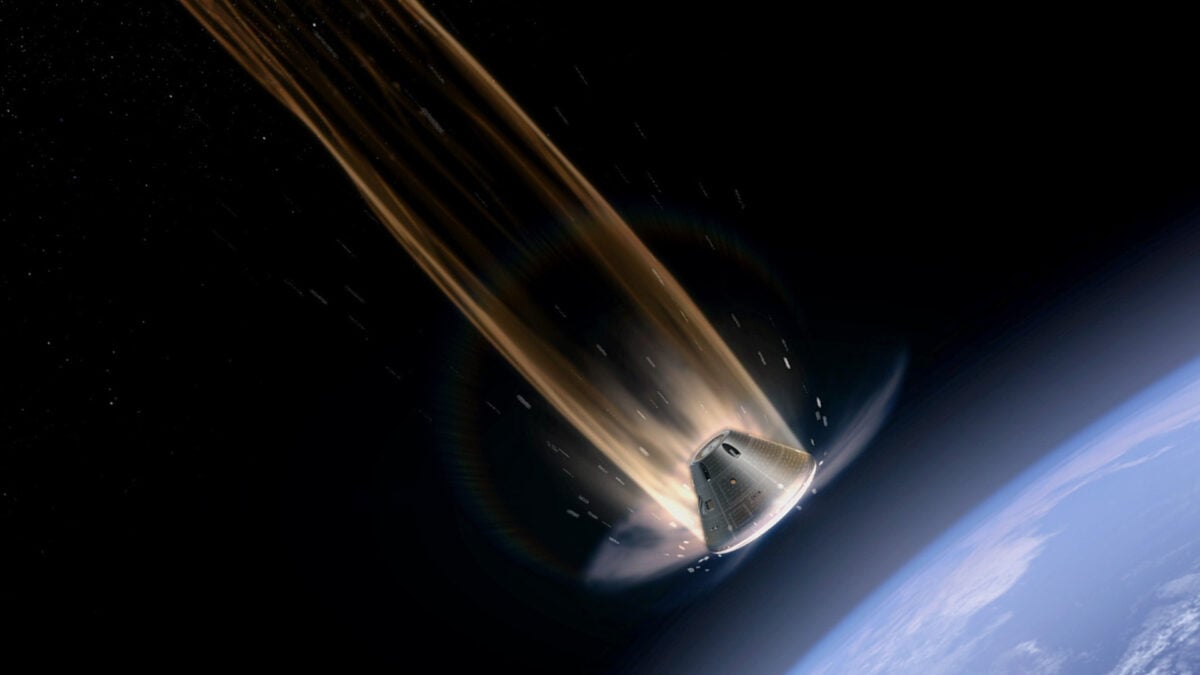
The most technically punishing part of the journey begins when Orion meets the atmosphere. At reentry velocity, the spacecraft compresses air in front of it so violently that extreme heating builds around the capsule. Orion’s heat shield is designed to withstand temperatures up to 5,000 degrees Fahrenheit, or about 2,760 degrees Celsius, according to the supplied text. That shield is central to the mission: without it, the spacecraft could not safely bring astronauts back from lunar distances.
For NASA, the return is also a live test of whether Orion can perform as intended after operating in deep space. Artemis 2 is not just about flying around the Moon. It is also about proving that the spacecraft can protect a crew through the full mission profile, including the high-energy return that distinguishes lunar missions from lower-Earth-orbit flights.
The source material frames the reentry as a blaze of compressed heat and speed, and that description is appropriate. A spacecraft coming home from the Moon returns far faster than a vehicle descending from the International Space Station or other low-Earth orbit missions. That makes thermal protection, flight control, and parachute deployment especially consequential in this final phase.
Recovery operations are part of the mission itself
Once Orion splashes down in the Pacific, the operation shifts from flight to recovery. Teams are set to retrieve the crew by helicopter and transport them to the USS John P. Murtha. From there, the astronauts are expected to undergo post-mission medical evaluations before continuing on to NASA’s Johnson Space Center in Houston.
Those steps are not just routine optics. Crew recovery and post-flight assessment are part of the operational chain NASA must prove as it moves toward a broader Artemis campaign. Returning astronauts safely from the ocean, supporting them immediately after landing, and transitioning them into medical review are all part of demonstrating end-to-end mission readiness.
The mission’s public visibility has also mattered. The source text describes the flight as having drawn global attention over its eight-day span, with moments of reverence, camaraderie, and bravery helping define the trip. That public interest is part of why Artemis 2 carries symbolic weight beyond the engineering. It is a crewed lunar flyby in an era when NASA is trying to rebuild momentum for human exploration beyond low-Earth orbit.

Why the ending matters as much as the launch
Space missions are often remembered for liftoff and distant milestones, but Artemis 2’s most decisive proof point may be its ending. Launch shows that a system can leave Earth. A lunar flyby shows that navigation, propulsion, and communications can function deep in space. Reentry, splashdown, and recovery show that the system can bring people back alive after the hardest part of the trip.
That is why Orion’s return is more than a closing spectacle. It is the moment where hardware performance, trajectory planning, and crew safety converge under the most severe conditions of the mission. If splashdown proceeds as planned, Artemis 2 will close out not only with a successful lunar flyby but with a full demonstration of the return architecture that future crewed Moon missions will depend on.
For NASA, that would mark an important threshold. The agency’s Artemis program is meant to extend human spaceflight farther than low-Earth orbit and build toward sustained lunar operations. A clean return by Artemis 2 would not answer every open question about that effort, but it would validate one of its core premises: that Orion can take astronauts to lunar distance and bring them safely home.
This article is based on reporting by Gizmodo. Read the original article.
Originally published on gizmodo.com