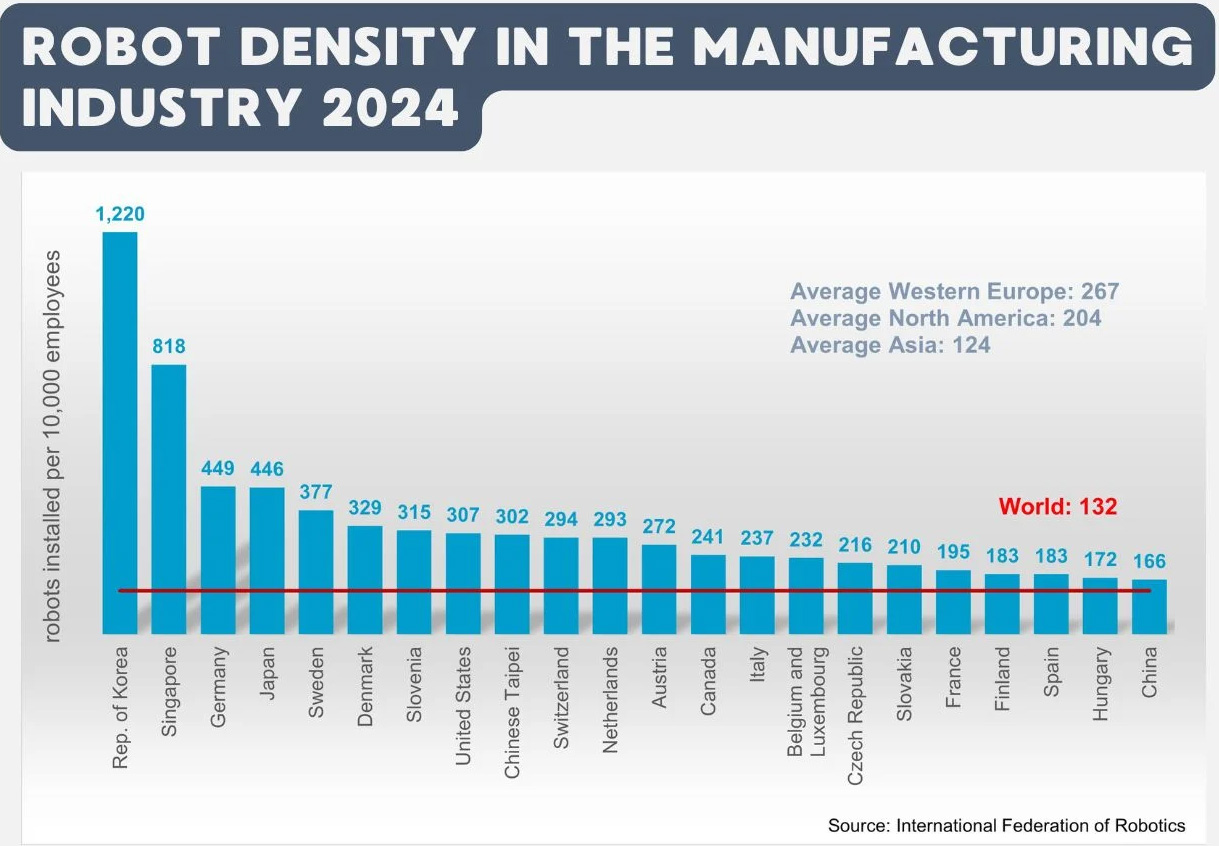
A core automation metric is still moving upward
Robot density in manufacturing increased across Europe, Asia, and the Americas, according to a report from the International Federation of Robotics cited this week by The Robot Report. The figure tracks the number of industrial robots per 10,000 manufacturing employees, making it one of the clearest shorthand indicators of how deeply automation is being embedded into factory operations.
Even without a full country-by-country breakdown in the available source material, the broad regional increase is meaningful. Robot density is not just a sales number. It is a structural measure. It captures how much robotic capacity manufacturers are installing relative to human labor in production environments, and it tends to reflect long-term decisions about productivity, labor availability, process consistency, and industrial competitiveness.
Why robot density matters more than raw shipment totals
Industrial robotics headlines often focus on the number of robots sold in a given year. That can be useful, but it does not always reveal how concentrated or mature automation is inside a manufacturing base. Robot density is more informative because it normalizes deployment against workforce size. A country or region can buy many robots and still remain comparatively less automated if its manufacturing workforce is vast. By contrast, rising density indicates that robotics are becoming more central to day-to-day production intensity.
The metric is especially useful when tracking cross-regional trends. If Europe, Asia, and the Americas all show increases, the story is not one of isolated adoption. It points to a wider industrial movement in which manufacturers across distinct labor markets and policy environments are expanding their use of robotics. That is a stronger signal than a localized boom tied to one sector or one national subsidy program.
The IFR’s focus on Europe in particular, as described in the report, suggests that some of the strongest movement is occurring in a region where manufacturers have long balanced high labor costs, export pressure, and a strong engineering base. Robot density growth there often reflects strategic modernization rather than one-off experimentation.

What a density increase usually reflects
A rise in robot density typically implies a combination of forces rather than a single cause. Manufacturers may be dealing with labor shortages, seeking more repeatable quality, redesigning factories for higher output, or trying to defend margins in more competitive global markets. In practice, robotics becomes attractive when companies want throughput and consistency that are difficult to achieve through manual processes alone.
Density increases can also indicate maturation in industries that once used robots in only a limited way. Automotive production has long been a major center of industrial robot use, but rising regional density can suggest that deployment is broadening across more manufacturing categories. The source material does not specify sectors, so that broader conclusion remains an inference. Still, the regional scope of the increase makes the trend notable because it points to automation momentum that is not confined to a single geography.
Another reason the density number matters is that it often outlasts market cycles. Capital spending can fluctuate year to year, but when robot density climbs over time, it usually means companies are redesigning production systems in ways that are difficult to reverse. Once a process is automated and integrated into factory layout, maintenance routines, and quality control, robotics becomes part of the operating baseline.
Regional growth, common pressures
The fact that the increase spans Europe, Asia, and the Americas suggests common industrial pressures are outweighing regional differences. Manufacturing companies everywhere face some mix of cost pressure, skilled labor constraints, demand volatility, and the need to improve operational resilience. Robotics does not solve all of those problems, but it is one of the few tools that can simultaneously affect throughput, consistency, and labor allocation.
That does not mean every region is moving for the same reasons. Europe may emphasize productivity and advanced manufacturing competitiveness. Parts of Asia may be scaling automation alongside high-volume industrial output. The Americas may be using robotics to support reshoring, nearshoring, or labor substitution in specific sectors. The source summary does not distinguish among those motives, but the broad result is the same: more robots relative to manufacturing employment.

The strategic implication for industry
Higher robot density raises the bar for manufacturers that lag behind. As automation becomes more common, it changes the competitive baseline for cost, quality, and speed. Companies that delay investment risk falling behind peers whose processes are already becoming more automated and data-driven. That is one reason density reports draw attention well beyond robotics vendors. They matter to plant operators, industrial software firms, component suppliers, and policymakers trying to assess manufacturing strength.
There is also a workforce implication. Robot density is often misunderstood as a simple measure of replacement. In practice, it is better understood as a measure of production system design. A factory with higher robot density is not automatically one with fewer people overall, but it is one where human labor is likely being reorganized around programming, supervision, maintenance, logistics, and exception handling rather than repetitive manual tasks alone. The source material does not make a labor-market claim, so the safe reading is that rising density signals change in how work is structured inside manufacturing.
A useful reminder about the pace of industrial change
Industrial transformation can feel gradual until a metric like this makes it legible. A rise in robot density across three major world regions is evidence that automation is not standing still, even when public attention shifts to consumer AI, humanoid demos, or flashy robotics prototypes. Much of the real economic impact of robotics still happens in factories, where deployment is measured not by viral visibility but by operational integration.
The IFR report therefore matters because it tracks adoption at the level of industrial reality. Robots per 10,000 workers is an unglamorous statistic, but it is one of the clearest indicators that manufacturers continue to invest in automation as a core capability. If density is rising across Europe, Asia, and the Americas at the same time, the global manufacturing system is still moving in the same direction: toward deeper robotic integration, higher production automation, and a more technology-intensive factory floor.
That trend does not resolve every question about cost, jobs, or resilience. But it does make one conclusion difficult to avoid. Industrial robotics is no longer a niche modernization story. It is an increasingly standard part of how major manufacturing regions are choosing to compete.
This article is based on reporting by The Robot Report. Read the original article.

Originally published on therobotreport.com