China has revealed one of its biggest domestic composite rocket structures yet
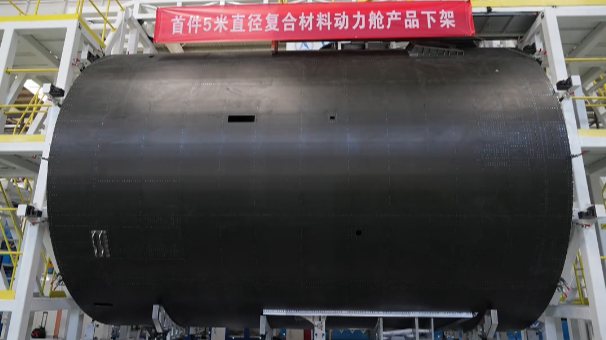
China has unveiled a reusable five-meter-wide composite propulsion module developed by the China Aerospace Science and Technology Corporation and its China Academy of Launch Vehicle Technology, marking what state-linked reporting describes as the country’s largest integrated composite structure yet produced for aerospace use.
The prototype was completed in seven months from design to delivery, a pace that underlines how aggressively China is moving to strengthen the industrial base behind its next generation of launch systems. While the announcement does not explicitly name the vehicle it will fly on, the dimensions and program context strongly point toward the Long March 10 family.
Why composites matter for reusable rockets
Reusable launch systems are fundamentally mass-sensitive machines. Every kilogram of dry structure is mass that cannot be devoted to payload or propellant. That tradeoff is especially severe when a vehicle must reserve fuel for controlled descent and recovery.
Composite materials offer a way to reduce structural weight while maintaining the strength needed for flight loads. According to the supplied report, China’s new propulsion module uses more than 60% composite material. That does not make it fully composite, but it is a substantial shift away from heavier all-metal construction.
The module’s wall panels are designed to withstand axial loads of up to 1,000 metric tons, and the structure includes adaptive interface capabilities such as maneuverable fins associated with reusable descent operations. Those details indicate a component intended not merely for static demonstration, but for the practical stresses of future reusable flight hardware.
The likely connection to Long March 10
The article notes that the official announcement does not say which rocket will use the module, but it also points out that the answer is fairly obvious to close observers of China’s space program. The Long March 10, formerly known as the 921 rocket, is central to China’s plan to support crewed lunar missions in the 2030s using the Mengzhou spacecraft and the Lanyue lunar lander.
The Long March 10 core is built around a five-meter diameter, matching the new module. China is also said to be developing a partially reusable version as it seeks to compete more directly with the economics of reusable launch systems pioneered by SpaceX. In that context, a lighter composite propulsion module is not a side project. It is a necessary piece of the architecture.
Why this is strategically important
For years, the reusable rocket race was framed largely around the United States, and especially around SpaceX. China has since made clear that it does not intend to remain a spectator. The unveiling of a large domestic composite module suggests the country is working through one of the less glamorous but most important challenges in launch modernization: advanced manufacturing.
That matters because launch competition is not just about engines or mission ambition. It is also about industrial throughput, materials capability, and the ability to compress development timelines. Completing the first prototype in seven months is therefore almost as notable as the module itself.
If China can repeatedly manufacture large composite structures at speed, it will improve not only the Long March 10 program but also the country’s broader competence in reusable and high-performance launch vehicles.

What the announcement does and does not prove
The unveiling is a meaningful milestone, but it is still a milestone. It does not demonstrate a complete reusable rocket, nor does it guarantee that China will match the operational cadence or cost structure of leading reusable systems in the near term. Hardware announcements can arrive well ahead of flight readiness.
Even so, the module is important because it shows China progressing in a domain where capability is cumulative. Nations do not become competitive in reusable launch by a single leap. They do it by solving materials, structures, recovery, guidance, and manufacturing problems one by one.
The reported inclusion of descent-related interfaces and the alignment with Long March 10 development make this more than a laboratory curiosity. It looks like a real component inside a broader roadmap.
The larger space race context
China’s lunar ambitions and reusable launch efforts are converging. Long March 10 is expected to support human lunar missions, but partial reusability is also about lowering costs and increasing strategic flexibility. That is exactly why the world’s leading launch providers have put so much effort into recovery and reuse.
The unveiling also shows how competition in space is broadening from headline launches to the materials and production technologies underneath them. Composite structures, automated manufacturing, and faster prototyping are becoming strategic assets in their own right.
For outside observers, the main takeaway is straightforward: China is still climbing the reusable launch curve, but it is doing so with increasing industrial seriousness. A five-meter composite propulsion module may not be as visually dramatic as a booster landing, yet it represents the kind of enabling technology without which reusable heavy launch systems do not scale.
That makes this development significant well beyond one cylinder on a factory floor. It is another sign that China’s challenge in the modern space race is being built not only on ambition, but on the manufacturing capacity required to support it.
This article is based on reporting by Universe Today. Read the original article.

Originally published on universetoday.com