An interstellar visitor carries a rare chemical signature
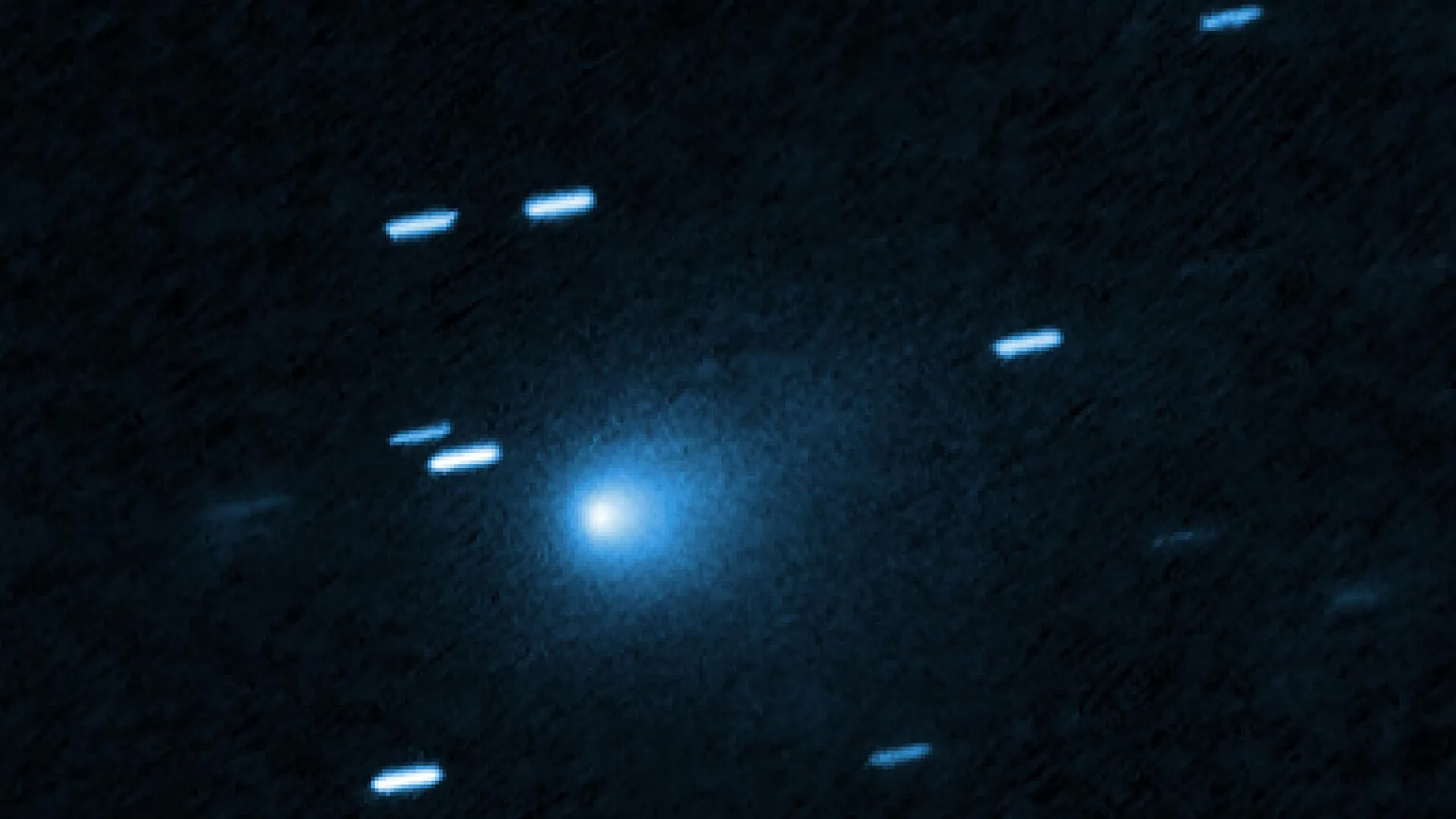
NASA’s James Webb Space Telescope has delivered the first mid-infrared chemical fingerprint of an interstellar object, revealing that comet 3I/ATLAS carries methane and exceptionally high levels of carbon dioxide. The observations provide one of the clearest looks yet at the composition of material formed around another star, and they suggest this object followed a very different path from most comets in our own solar system.
The methane result is especially significant. According to NASA, it is the first direct detection of methane gas on an interstellar visitor. That matters because methane is highly volatile, meaning it can transition rapidly from ice to gas. Its appearance only after the comet had already passed close to the Sun suggests the methane was buried under the surface and released only when solar heating reached deeper layers.
That buried-reservoir explanation gives scientists a more detailed picture of the comet’s structure. Rather than evenly exposing all of its volatile materials at once, 3I/ATLAS appears to have preserved methane beneath an outer layer that initially shielded it from solar heating.
Why 3I/ATLAS stands out
Webb’s observations also confirmed that the comet releases unusually large amounts of carbon dioxide relative to water. NASA says those levels are far above what is commonly measured in solar system comets. Together with the methane reading, the result points to a formation environment unlike the one that shaped most icy bodies orbiting our Sun.
The methane-to-water ratio also surprised the research team. NASA notes that only a handful of known solar-system comets show similar characteristics. That does not make 3I/ATLAS completely alien in every respect, but it does place it well outside the normal compositional range astronomers are used to seeing in local comet populations.
These differences are precisely why interstellar objects are so valuable scientifically. They are not just travelers passing through. They are samples from other planetary systems, offering brief but important chances to compare how common or uncommon our own solar system’s chemistry may be.

How Webb captured the data
The measurements came from two observing runs with Webb’s Mid-Infrared Instrument, or MIRI, after the comet had passed its closest point to the Sun. The first observations were taken on December 15 and 16, when 3I/ATLAS was about 205 million miles, or 329 million kilometers, from the Sun. A second set followed on December 27, with the comet about 236 million miles, or 379 million kilometers, away.
Those mid-infrared observations are critical because they let scientists identify specific molecular signatures instead of relying only on brightness or visible structure. In this case, Webb was able to move beyond imaging the comet and directly characterize what gases it was releasing.
That level of chemical resolution is what turns a rare sighting into a meaningful data point. Interstellar objects are hard to study because they move quickly through the inner solar system and offer only a short observational window. Instruments capable of extracting detailed composition during that window are therefore unusually important.
A wider view of planetary formation
The findings, published in The Astrophysical Journal Letters, add to a small but growing record of interstellar objects observed in detail. Each new case helps astronomers test how diverse planetary systems may be, especially in the cold outer regions where comets form and preserve ancient chemistry.
For 3I/ATLAS, the combination of hidden methane and carbon-dioxide richness hints at a formation history that diverges sharply from the typical cometary recipe of our solar neighborhood. That does not mean scientists can yet reconstruct the exact conditions of its parent system, but it does strengthen the case that interstellar comets can preserve chemistry that is rare here.
The larger significance is that Webb is not merely spotting exotic visitors. It is beginning to read their chemical histories. In the case of 3I/ATLAS, that history includes volatile reservoirs, an unusual carbon balance and a reminder that the ingredients of comet formation elsewhere in the galaxy may not look much like the ones close to home.
This article is based on reporting by Science Daily. Read the original article.

Originally published on sciencedaily.com