A Needle in a Cosmic Haystack
The center of the Milky Way is one of the most extreme environments in the known universe. Swirling around Sagittarius A*, the supermassive black hole containing roughly four million times the mass of our Sun, is a maelstrom of gas, dust, intense radiation, and gravitational forces that warp the fabric of space-time itself. Scientists have long theorized that pulsars — rapidly spinning neutron stars that emit beams of radio waves like cosmic lighthouses — should exist in this region, but detecting them has proved extraordinarily difficult. Now, a team from Columbia University has done just that, identifying a candidate millisecond pulsar spinning with a period of just 8.19 milliseconds in the galactic center.
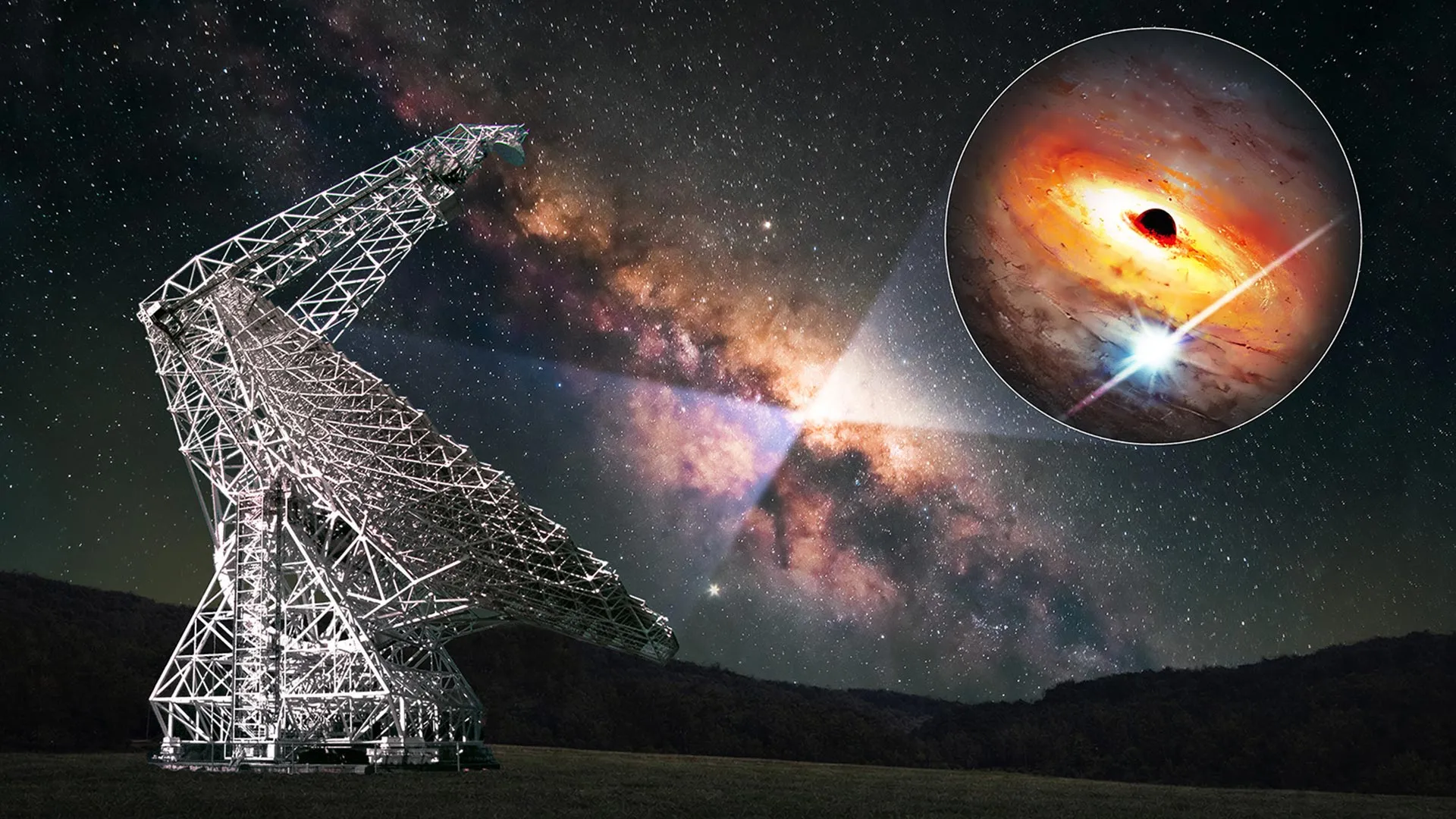
The discovery, published in The Astrophysical Journal, emerged from the Breakthrough Listen Galactic Center Survey, one of the most sensitive radio investigations ever conducted in the turbulent heart of our galaxy. Led by recent Columbia PhD graduate Karen I. Perez and co-authored by Slavko Bogdanov from the Columbia Astrophysics Laboratory, the study represents years of painstaking observation and data analysis using the Green Bank Telescope in West Virginia.
Why Millisecond Pulsars Matter
Pulsars are the collapsed remnants of massive stars that ended their lives in supernova explosions. What remains is an incredibly dense neutron star — a sphere roughly the size of a city but containing more mass than the Sun — that spins rapidly and emits focused beams of electromagnetic radiation. As the pulsar rotates, these beams sweep across space like a lighthouse beam, creating regular pulses that can be detected by radio telescopes on Earth.
Millisecond pulsars are a special subclass that spin especially fast, completing hundreds of rotations per second. Their extraordinary rotation rates make their timing behavior remarkably stable — in some cases rivaling atomic clocks in precision. This stability is what makes them invaluable tools for fundamental physics experiments, because any deviation from their expected timing can reveal the influence of external forces, including gravity.
The candidate pulsar identified near Sagittarius A* completes a full rotation every 8.19 milliseconds, placing it firmly in the millisecond category. At this rate, it would be spinning approximately 122 times per second — a staggering figure for an object that may weigh more than our Sun.

A Laboratory for Einstein's Theory
The scientific excitement surrounding this discovery extends far beyond the detection of another pulsar. A millisecond pulsar orbiting close to a supermassive black hole would create what physicists describe as an ideal natural laboratory for testing general relativity under conditions that cannot be replicated on Earth or anywhere else in the observable universe.
Einstein's general theory of relativity, published in 1915, predicts that massive objects warp the geometry of space-time around them. Near a supermassive black hole, these warping effects become extreme. The precise timing signals from a millisecond pulsar passing through this distorted space-time would carry measurable anomalies — tiny but detectable deviations from the regular pulse pattern that encode information about the gravitational environment.
By carefully monitoring these timing anomalies over months and years, scientists could test whether general relativity's predictions hold up under the most extreme gravitational conditions possible. Any discrepancies between observed and predicted behavior could point toward new physics beyond Einstein's framework, potentially providing clues about the nature of gravity at the quantum level — one of the deepest unsolved problems in modern physics.
The Challenge of Detection
Finding pulsars near the galactic center is enormously difficult for several reasons. The region is dense with gas and dust that scatter and absorb radio signals, a phenomenon known as interstellar scattering. This scattering broadens and distorts pulsar signals, making them harder to distinguish from background noise. The effect is particularly severe at lower radio frequencies, which is why the research team used the Green Bank Telescope's high-frequency capabilities to cut through the interference.
Additionally, the sheer density of radio sources near the galactic center creates a cacophonous background that complicates signal identification. The Breakthrough Listen survey employed sophisticated signal processing algorithms to sift through massive volumes of data, searching for the periodic signatures that distinguish pulsars from other radio sources.
Despite decades of searching, very few pulsars have been confirmed near Sagittarius A*. The scarcity of detections has itself been a puzzle — models predict that thousands of pulsars should populate the galactic center, yet only a handful have been found. Each new detection helps constrain our understanding of the pulsar population in this extreme environment.

Confirmation Still Needed
The researchers are careful to classify their finding as a candidate rather than a confirmed pulsar. Follow-up observations are underway to verify the detection and rule out alternative explanations for the observed signal. The periodic nature and spectral characteristics of the signal are consistent with a millisecond pulsar, but independent confirmation from additional observing epochs is required before the discovery can be considered definitive.
In a move that reflects the collaborative spirit of modern astrophysics, the research team has made their data publicly available, encouraging astronomers around the world to analyze the observations independently. This open approach accelerates the verification process and allows the broader scientific community to contribute to what could be a landmark discovery.
Looking Ahead
If confirmed, this pulsar would join a very small club of known pulsars near the galactic center and would be the first millisecond pulsar detected in this region. The combination of its rapid spin — providing high-precision timing — and its proximity to the most massive object in our galaxy creates a scientific opportunity that astrophysicists have been pursuing for decades.
The next generation of radio telescopes, including the Square Kilometre Array currently under construction in Australia and South Africa, will have even greater sensitivity to detect pulsars in challenging environments. But for now, the Green Bank Telescope and the Breakthrough Listen program have demonstrated that with sufficient patience, sensitivity, and analytical sophistication, the galactic center is beginning to yield its secrets — one pulse at a time.
This article is based on reporting by Science Daily. Read the original article.

Originally published on sciencedaily.com