A Storm-Chasing Experiment Finds A Forest Glow
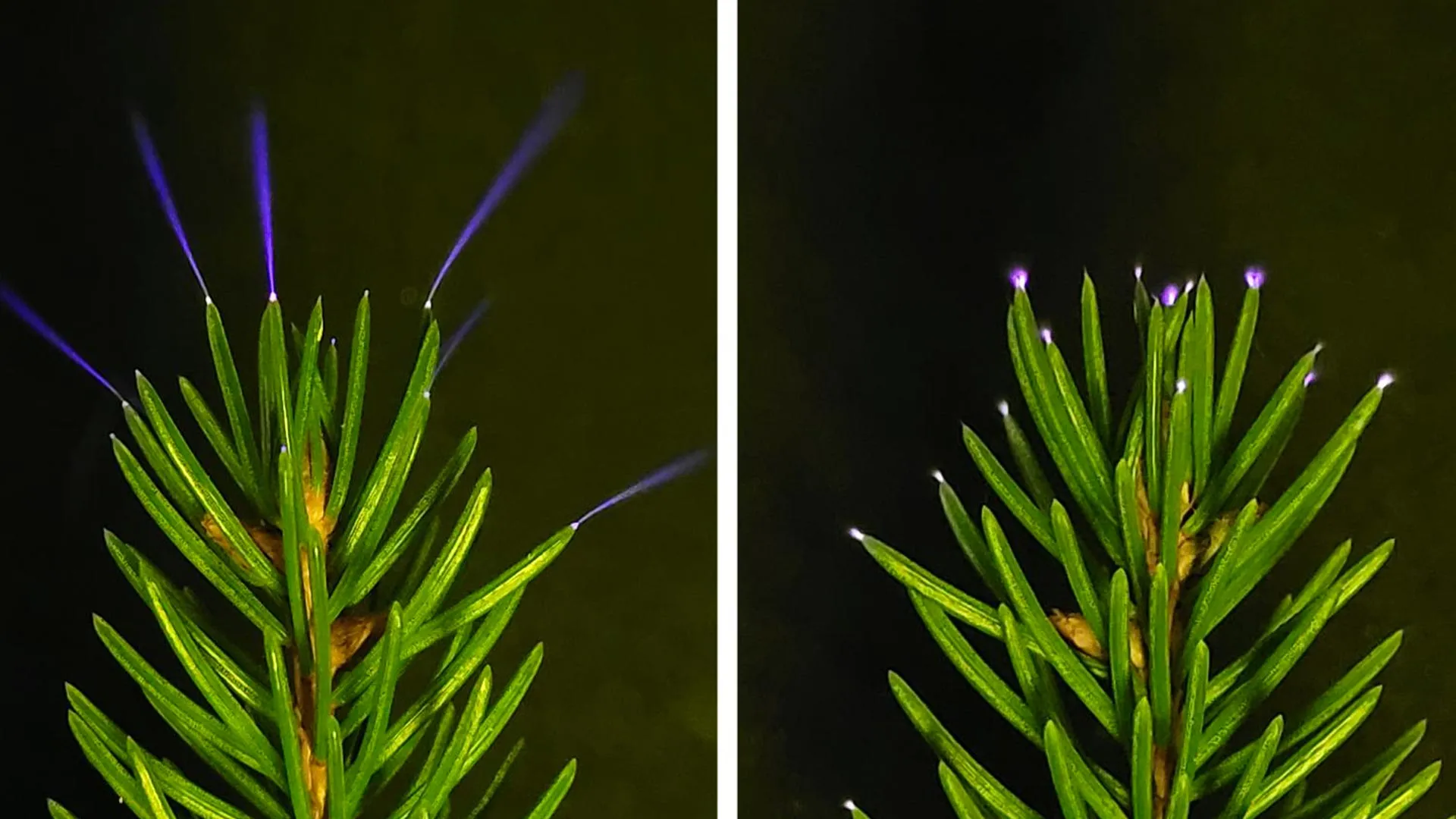
Penn State researchers have captured faint electrical glows from treetops during a thunderstorm, directly observing a natural phenomenon that scientists had suspected for more than 70 years. The event, reported by Science Daily from Penn State source material, involved corona discharges: tiny bursts of electricity forming at the tips of leaves during storm-driven electric field activity.
The team’s field campaign began in June 2024 with a modified 2013 Toyota Sienna equipped with a custom telescopic weather instrument extending from the roof. Researchers set out along the East Coast looking for thunderstorms strong enough to test whether corona discharges seen in laboratory settings also occur naturally in forests.
What Corona Discharge Means
Corona discharge occurs when a strong electric field around a pointed object ionizes nearby air. In the case of trees, leaf tips and branch structures can become sites where tiny electrical pulses form. The glow is subtle and appears in the ultraviolet range, which means it is not something people would normally see while standing under a stormy sky.
In laboratory settings, such glows are easier to observe because light levels can be tightly controlled. The Penn State report notes that coronae are much easier to see in a nearly pitch-dark meteorology and atmospheric science lab. Outdoors, visible sunlight and storm conditions make detection far more difficult.

Why It Took So Long
The idea that forests might produce corona discharges during storms has been discussed for decades, but field confirmation remained elusive. Thunderstorms are difficult research platforms. They move, change, dissipate, and create safety constraints. The Penn State team initially targeted Florida because of its frequent summer thunderstorms, but the weather did not cooperate. For three weeks, the researchers followed short-lived storms that ended before useful data could be collected.
The breakthrough came as the team began returning to Pennsylvania. Conditions changed in North Carolina, where larger storms gave the researchers the opportunity they needed. The resulting observation marked the first direct confirmation described in the supplied source text of natural corona discharges from treetops.
Potential Atmospheric Importance
The discovery may matter beyond the visual novelty of glowing trees. The Science Daily summary says these electrical bursts may help clean the air by breaking down pollutants. That possibility connects the finding to atmospheric chemistry, not only storm physics.
During electrical activity, reactive chemical species can form. If corona discharges occur widely across forests during thunderstorms, they could represent a previously underappreciated process in near-surface air chemistry. The supplied text does not quantify how large that effect might be, so it would be premature to claim forests are major storm-time air cleaners. But the observation gives researchers a real natural process to measure rather than a laboratory hypothesis to infer from.

A New Measurement Problem
Now that the phenomenon has been observed, the next challenge is scale. Scientists will need to determine how often these discharges happen, which tree species and canopy structures produce them most readily, what storm conditions trigger them, and whether the chemical effects are meaningful over large areas. Field measurements will also need to separate corona-driven chemistry from lightning, rain, wind, and background pollution.
The instrumentation problem is not trivial. Researchers must capture faint ultraviolet signals in bright, dynamic, electrically active environments. That is why the team’s storm-chasing setup matters. It suggests that mobile, targeted observation can reveal phenomena that fixed stations may miss.
Why This Discovery Stands Out
The result is a reminder that familiar environments can still hide basic physical processes. Forests during storms are common, but the electrical behavior at leaf tips has been difficult to confirm outside controlled experiments. By documenting the glows in nature, the Penn State researchers have turned a long-standing suspicion into an observable atmospheric process.
The finding also adds a new layer to how forests interact with the atmosphere. Trees exchange gases, emit organic compounds, intercept rainfall, shape wind, and influence local climate. Corona discharge suggests they may also participate directly in storm-time electrical chemistry. That does not make forests passive scenery beneath thunderstorms. It makes them part of the storm environment itself.
This article is based on reporting by Science Daily. Read the original article.
Originally published on sciencedaily.com