Simulating Matter Beneath Ice Giants
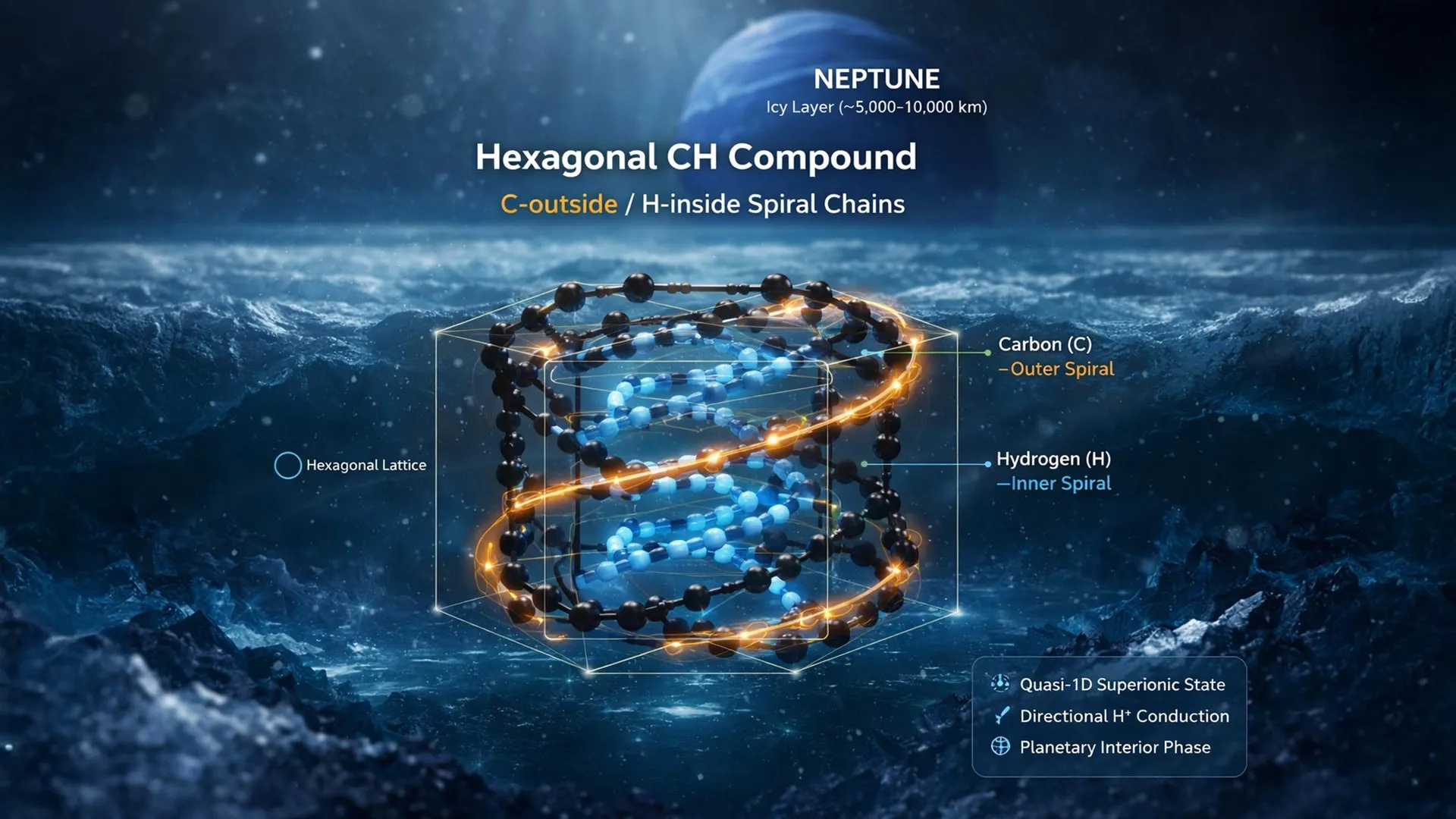
Deep inside Uranus and Neptune, matter may behave in ways that do not fit familiar categories of solid, liquid, or gas. New computer simulations by Carnegie scientists Cong Liu and Ronald Cohen suggest that carbon hydride could form an unusual quasi-one-dimensional superionic state under the extreme pressures and temperatures believed to exist inside ice giant planets.
The study, published in Nature Communications according to Science Daily, focuses on conditions far below the visible atmospheres of Uranus and Neptune. These planets are often called ice giants, but that label can be misleading. Their interiors are not simply frozen reservoirs. They are high-pressure environments where common compounds can take exotic forms.
What Superionic Means
In a superionic material, part of the structure behaves like a solid while another part behaves more like a fluid. The supplied source describes a predicted phase in which hydrogen atoms spiral through a rigid carbon framework. That hybrid behavior could affect how heat and electricity move through the interiors of Uranus, Neptune, and similar planets.
The phrase quasi-one-dimensional points to the simulated motion pattern. Instead of moving freely in all directions, hydrogen behavior is constrained along spiral pathways within the carbon structure. That kind of internal arrangement is far removed from everyday chemistry, but it may be exactly the kind of physics that dominates planetary interiors.

Why Uranus And Neptune Are Hard To Explain
Uranus and Neptune have long presented puzzles for planetary scientists, including unusual magnetic fields and complex internal heat behavior. Science Daily’s source text says the simulated superionic structure could reshape how heat and electricity flow inside these distant worlds, potentially helping explain their mysterious magnetic fields.
Planetary magnetic fields are generated by moving electrically conductive material in a planet’s interior. If the conductivity, viscosity, or heat transport properties of deep materials differ from previous assumptions, models of those fields may need revision. A superionic carbon hydride phase would therefore be more than a chemistry curiosity. It could influence the basic architecture of planetary models.
The Broader Exoplanet Context
The finding also matters because more than 6,000 exoplanets have been discovered, according to the supplied text. Many are unlike Earth, and some may resemble or exceed the conditions found inside Uranus and Neptune. Understanding exotic interior states helps scientists interpret planetary mass, radius, magnetic behavior, and thermal evolution from limited observational data.
For exoplanets, researchers cannot sample interiors directly. They rely on models that connect observed properties to plausible compositions and internal phases. If carbon, hydrogen, water, methane, and ammonia form unexpected structures under pressure, then planetary classifications based on simple composition labels become less complete.

Hot Ice Is Not Ordinary Ice
The interiors of Uranus and Neptune are thought to include layers sometimes described as hot ices. These regions sit beneath outer hydrogen-helium atmospheres and above solid cores. Scientists believe they include compounds such as water, methane, and ammonia, but under immense pressure and temperature those molecules may transform into unfamiliar states.
The carbon hydride simulation fits into that broader search for the real materials of ice-giant interiors. It suggests that carbon and hydrogen, both central ingredients in planetary chemistry, can organize into a structure with properties that ordinary intuition would not predict.
Simulation First, Evidence Next
The supported finding is computational. The researchers used advanced simulations to predict the state; the supplied source does not describe a laboratory experiment that physically created it. That distinction is important. Simulations can guide theory and identify likely phases, but experimental confirmation under comparable pressures and temperatures would strengthen the case.
Even so, first-principles simulations are a key tool for studying environments that are extremely difficult to reproduce. They allow scientists to test how atoms might arrange and move when direct measurement is not yet feasible. In planetary science, that theoretical work often shapes what experiments and missions look for next.
A Deeper View Of Distant Worlds
The possible superionic carbon hydride state gives researchers a new candidate ingredient for ice-giant models. It may help explain how heat and electricity behave inside Uranus and Neptune, and it may improve interpretations of distant planets with similar internal conditions.
The discovery is not a final answer to the mysteries of the ice giants. It is a more precise question: if hydrogen can move through a rigid carbon framework under Neptune-like conditions, how does that change the planet above it? For worlds that can only be studied from afar, that kind of material insight is a major step toward understanding what lies beneath the clouds.
This article is based on reporting by Science Daily. Read the original article.
Originally published on sciencedaily.com