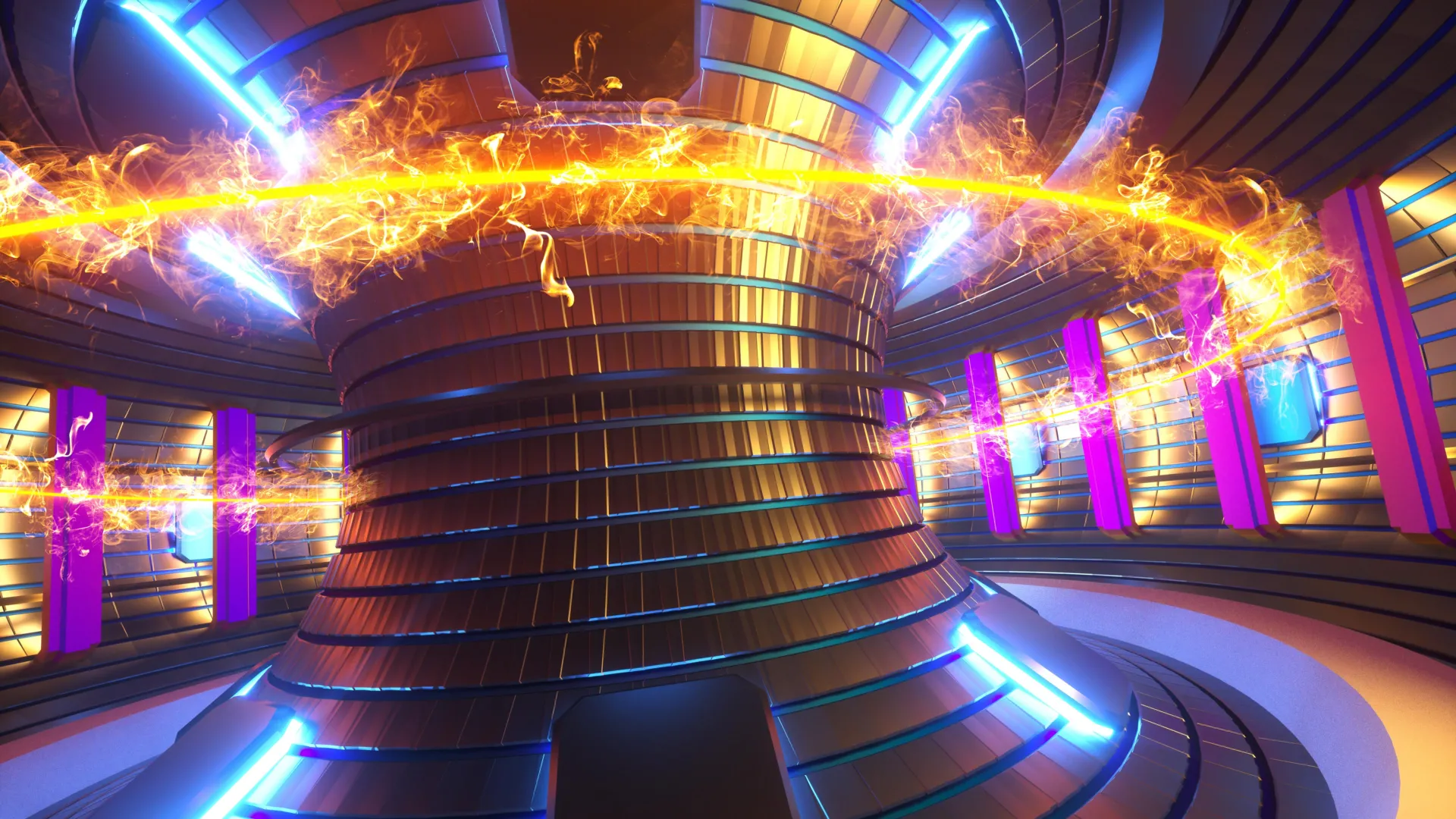
A revised path toward self-sustaining fusion
Researchers at the U.S. Department of Energy’s Princeton Plasma Physics Laboratory have identified a potentially more efficient route to fusion ignition by changing the order in which plasma is heated and compressed.
The work suggests that heating plasma first and then increasing its density could lower the energy needed to reach a self-sustaining fusion reaction. The researchers say their calculations may help future reactors avoid effects that make ignition harder while pursuing a burning plasma, the state in which fusion reactions provide enough heat to sustain the process without continued external heating.
The findings were published in Physical Review Letters and were developed by PPPL physicists Luis Delgado-Aparicio, Masayuki Ono and Jonathan Menard.
The challenge behind ignition
Fusion seeks to release energy by combining atomic nuclei. Doing so requires plasma, a highly energetic state of matter in which particles carry electrical charges. In a fusion system, researchers must keep that plasma hot and dense enough for long enough that fusion reactions can continue on their own.
For more than seven decades, researchers have used the Lawson criterion to describe the conditions required for ignition. The criterion addresses the relationship among the relevant plasma conditions, but it does not by itself identify the most efficient route for achieving them.
PPPL’s new analysis expands that framework by incorporating four additional factors that influence fusion performance. The result is a more comprehensive map of how a plasma might be taken toward ignition, rather than simply a statement of the destination it must reach.
Why sequence may matter
The central idea is simple but consequential: the path to a target condition can matter as much as the target itself. Traditional approaches can focus on bringing plasma to the necessary combination of temperature, density and confinement. The PPPL analysis indicates that changing the sequence—raising the temperature before increasing density—could substantially reduce the energy required.
That prospect is important because efficient ignition remains among the central challenges in fusion energy research. A reactor must do more than create extreme conditions; it must create them in a way that does not demand impractical amounts of energy or undermine the plasma’s ability to sustain the fusion process.
The researchers describe their result as a potentially more efficient path rather than a finished reactor design. It is based on calculations, and translating the concept into an operating system will require further research and validation. Even so, identifying a route that requires less energy could inform how future experiments and reactor concepts are designed.
A broader Lawson criterion
By extending the criterion used to reason about fusion ignition, the PPPL team aims to capture influences that can be missed by a simpler threshold-based view. That can help researchers compare different ways of preparing plasma and identify conditions in which a promising approach carries hidden penalties.
The laboratory’s analysis therefore does not discard the Lawson criterion. It builds on the longstanding benchmark by adding more of the factors that shape fusion performance. In practical terms, that can turn a broad requirement into a more useful guide for choosing an experimental pathway.
The goal remains a burning plasma: a regime in which the heat generated by fusion reactions is sufficient to maintain the conditions needed for further fusion. Reaching that point reliably and efficiently is a prerequisite for fusion systems intended to produce useful energy.

Potential implications for fusion development
The new work reinforces a lesson that extends beyond any single reactor concept: advances in fusion may come not only from increasing available power or improving materials, but also from better understanding the physics of how plasma is brought to ignition.
If the heating-first, compression-second route holds up through subsequent research, it could give scientists another way to pursue ignition with less input energy. That could affect how future systems are modeled and tested, particularly where the energy cost of preparing plasma is a limiting factor.
Fusion remains a difficult scientific and engineering objective, and this result does not establish a timetable for commercial power. But it offers a more promising theoretical route toward one of fusion’s defining milestones: sustaining the reaction without continuous external heating.
For a field defined by extreme operating conditions and demanding energy balances, a more efficient path to ignition would be a meaningful advance. The next question is whether the calculation can guide experiments that reproduce the advantage in practice.
This article is based on reporting by Science Daily. Read the original article.
Originally published on sciencedaily.com


