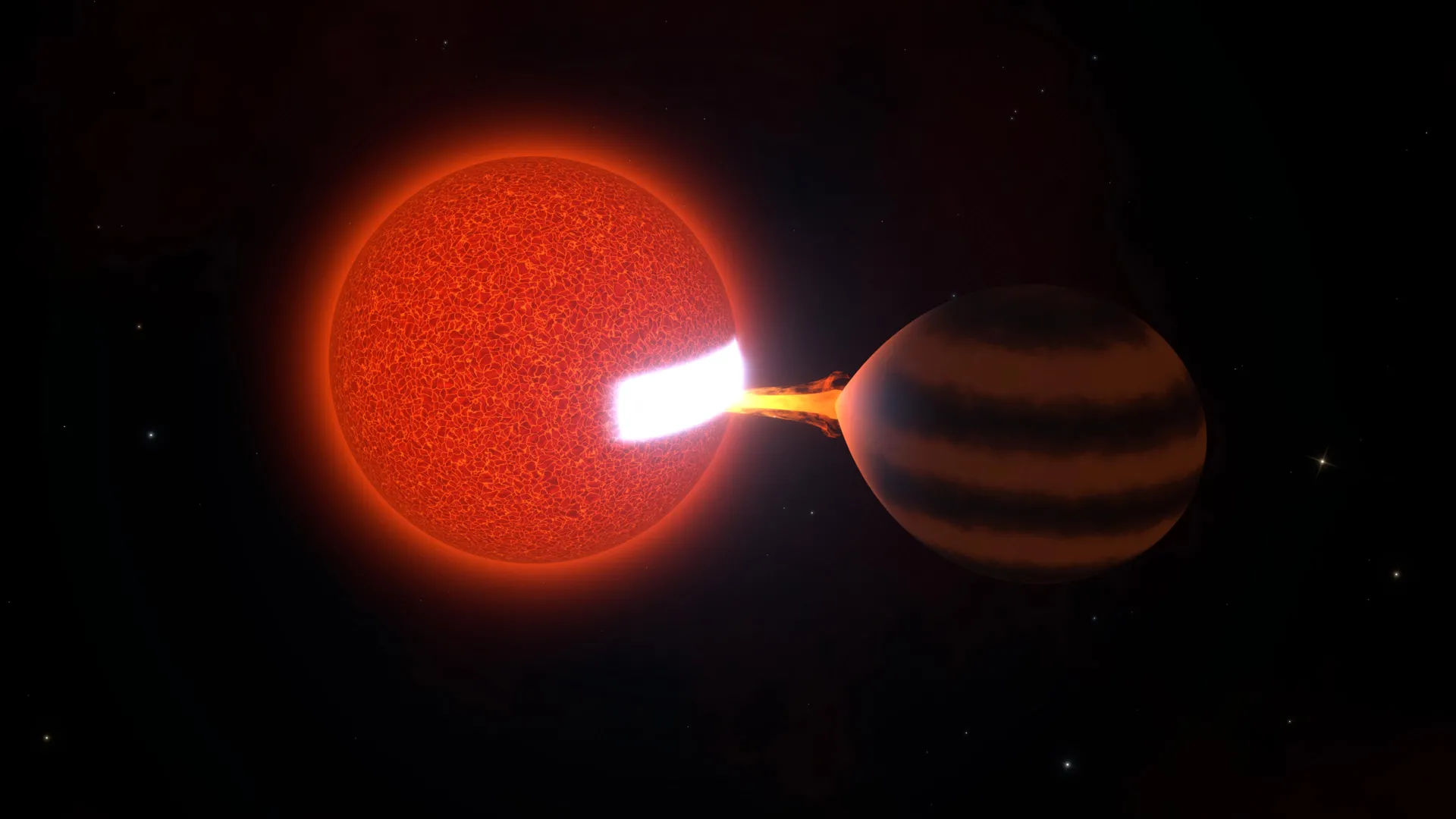
A star about 300 light-years from Earth is gradually pulling material from a brown dwarf companion, creating a long-lived feeding process unlike the more dramatic stellar engulfment events astronomers usually imagine.
The system, designated ZTF J0440+2325, consists of a red dwarf and a brown dwarf orbiting each other every 86.65 minutes. In research published October 5 in Nature Astronomy, an international team led by scientists at MIT described the system as the first observed example of a low-mass star steadily drawing material from another low-mass object.
Rather than quickly swallowing its companion, the red dwarf appears to be fed by material overflowing from the brown dwarf. The transfer is slow enough that it could continue for hundreds of thousands of years and potentially for billions of years, according to the researchers.
A rare middle ground in stellar interactions
Planetary systems are often stable for extremely long periods, but close interactions can become destructive when an orbiting body moves too near its host star. In some cases, gravity draws that companion inward until it is engulfed.
Astronomers have observed stable systems and have also identified a small number of stars rapidly swallowing planetary companions. ZTF J0440+2325 lies between those more familiar pictures. Its companion is not an ordinary planet and is not a full-fledged star: it is a brown dwarf, an object more massive than a typical planet but not massive enough to sustain the hydrogen fusion that powers ordinary stars.
That combination makes the discovery important for understanding how compact, low-mass binary systems evolve. The system offers a view of material transfer occurring on a much slower timetable than a single catastrophic merger.

Material strikes a hot spot on the star
An artist’s impression released with the research depicts the brown dwarf overflowing onto the red dwarf. The stream of transferred material strikes the red dwarf’s surface and heats a large hot spot at the impact point.
The orbital period of just 86.65 minutes underlines how tightly bound the pair is. At that separation, the brown dwarf can lose material to its companion without being immediately consumed. The observed system therefore gives scientists a chance to study a sustained exchange between two low-mass objects.
MIT physicist Kevin Burdge, a coauthor of the study, said the usual expectation is that a star interacting with a planet or brown dwarf will eventually swallow the smaller object. This system instead shows a star slowly feeding on a companion, a process that could remain active far longer than a rapid engulfment event.
Why brown dwarfs are useful test cases
Brown dwarfs occupy an in-between category. They are heavier than most planets, but they do not sustain the hydrogen fusion that defines ordinary stars. Their interactions with small stars can therefore reveal evolutionary pathways that are not easily captured by comparisons involving only planets or only stellar pairs.
In ZTF J0440+2325, the brown dwarf is being gradually stripped while the red dwarf accretes the transferred material. The finding does not mean every close red-dwarf and brown-dwarf pair will develop in this way. It identifies one observed system whose properties demonstrate that a long-lived transfer state can exist.
The discovery also broadens the set of outcomes astronomers must consider when modeling close companions. A companion’s final fate need not always be immediate destruction or an unchanged orbit. Under the right conditions, an extended interval of steady mass transfer may be possible.

A nearby laboratory for long-term evolution
At approximately 300 light-years away, ZTF J0440+2325 is within the Milky Way and close enough to be a valuable target for continued observation. Its unusual configuration allows researchers to investigate how the rate of transferred material, orbital motion and the impact region on the red dwarf change over time.
The team’s interpretation is necessarily tied to the measurements available now, but the prospect of a process lasting hundreds of thousands to billions of years makes the system especially compelling. Astronomers can watch a short segment of an interaction that may shape both objects over cosmic timescales.
For the public, stellar engulfment often evokes a sudden ending. This system presents a different image: a small star and a brown dwarf locked in an extremely close orbit, with one object gradually feeding the other. It is a quieter process than a one-time cosmic feast, but one that may endure long enough to illuminate how low-mass companions live and change together.
This article is based on reporting by Science Daily. Read the original article.
Originally published on sciencedaily.com


