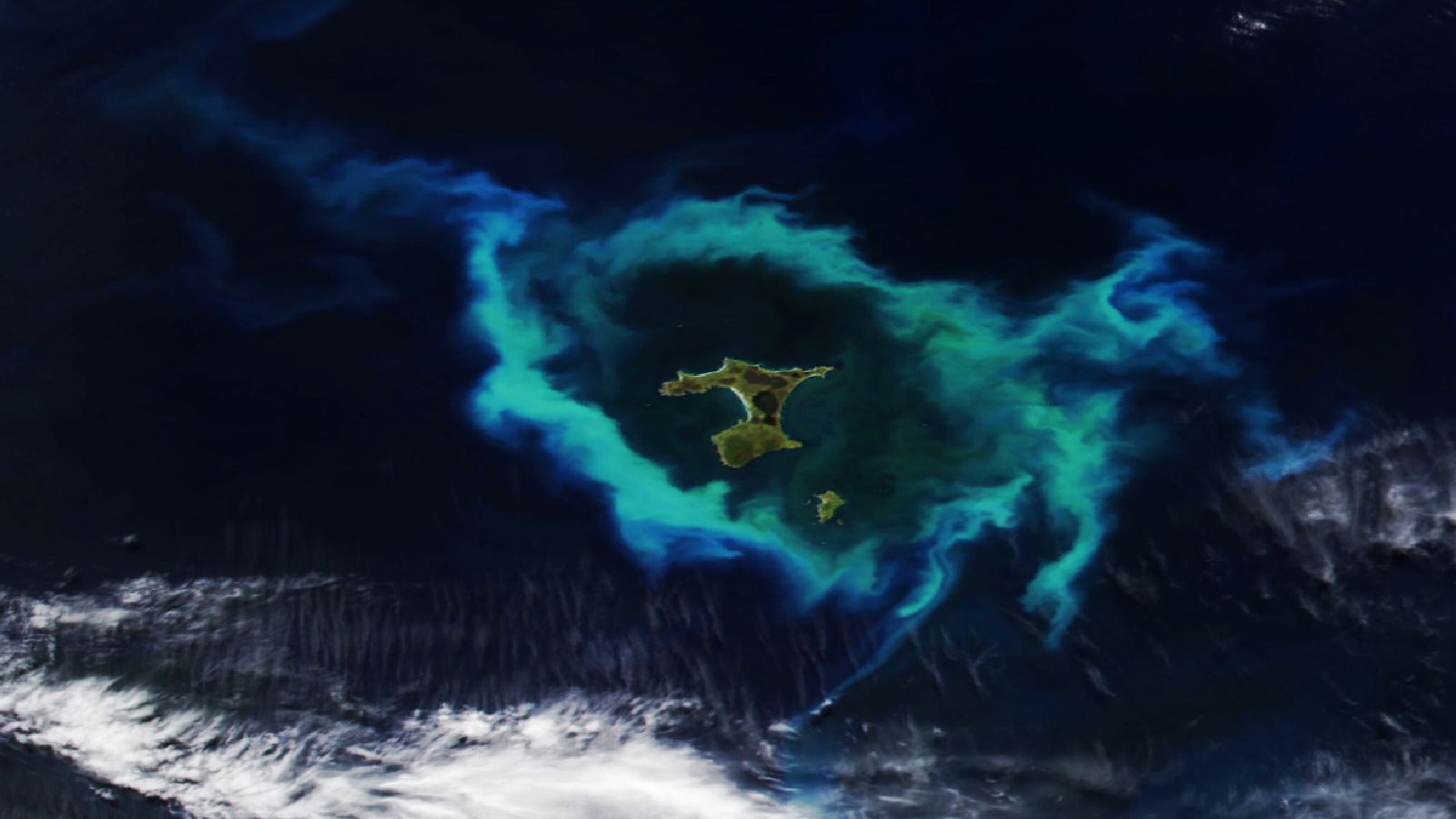
A glowing ring seen from orbit
A satellite image taken in January 2026 captured a striking halo of phytoplankton around New Zealand’s Chatham Islands, turning a remote stretch of the South Pacific into a visible signal of ocean biology and seafloor geography. The image, reported by Live Science and credited to NASA and NOAA, shows a bright bloom encircling the archipelago.
The Chatham Islands sit far east of mainland New Zealand. In the image, the bloom appears as a luminous ring around the islands rather than a diffuse patch, suggesting that local ocean structure is shaping where microscopic life concentrates at the surface.
The hidden structure beneath the bloom
The source article links the bloom to an underwater plateau. Such submerged terrain can influence currents, mixing, and nutrient availability, creating conditions in which phytoplankton can multiply rapidly enough to be detected by satellites.
Phytoplankton are microscopic, photosynthetic organisms that form the base of many marine food webs. When the right combination of light, nutrients, and water movement arrives, populations can surge into blooms large enough to be seen from space.

Beauty with a darker connection
The same underwater feature associated with the bloom has also been linked to the deaths of hundreds of cetaceans, according to the source. The article frames the Chatham Islands as a place where dramatic marine productivity and dangerous navigation conditions for whales and dolphins can overlap.
The connection matters because satellite imagery can reveal more than color in the ocean. It can point scientists toward physical structures and biological events that influence entire marine ecosystems, including the movement of large animals.
Why this image matters
The Chatham Islands bloom is visually unusual, but its larger value is scientific. It shows how orbiting instruments can connect surface patterns with underwater features that would otherwise remain hidden from public view.
For ocean researchers, events like this are a reminder that the seafloor is not passive background. Plateaus, ridges, and other structures can shape currents and nutrient flows, leaving fingerprints at the ocean surface. In this case, that fingerprint appeared as a glowing ring around a remote archipelago.
The image also underscores the importance of long-term Earth observation. A single satellite pass can capture a vivid event, but repeated observations help determine whether blooms are seasonal, episodic, or changing over time. Around isolated island systems, that context can be especially valuable for understanding marine life, hazards, and ecosystem change.
This article is based on reporting by Live Science. Read the original article.

Originally published on livescience.com