A Tiny Island, a Large Symbol
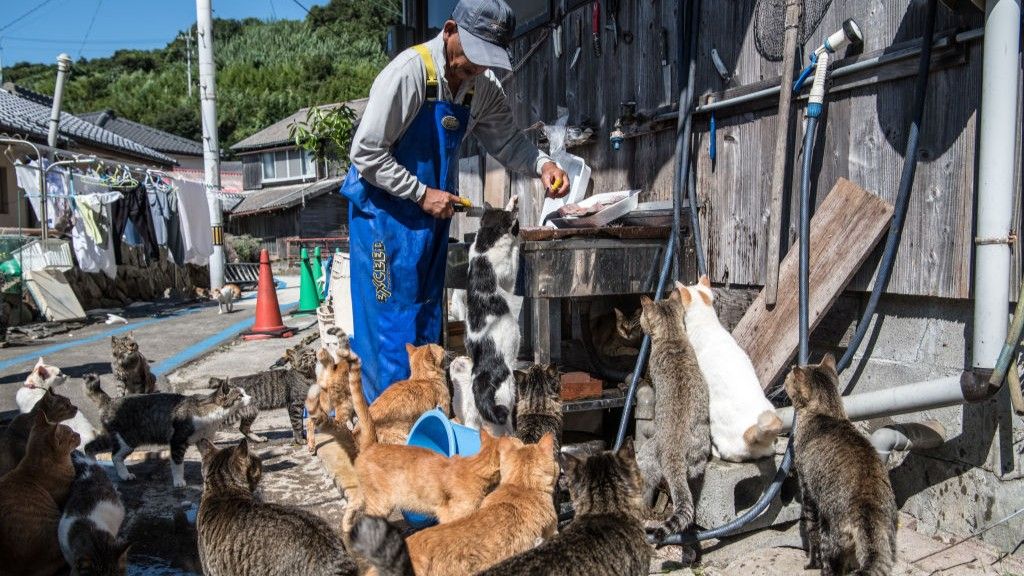
Aoshima, a small island in Japan’s Ehime prefecture, has become widely known for a simple reason: cats vastly outnumber people there. According to Live Science, the island covers about 0.2 square miles and is home to roughly 80 cats and only a handful of human residents, producing a ratio of about 27 cats for every person. On the surface, that makes for a striking curiosity. At a deeper level, it reflects a more consequential story about depopulation, human-managed animal populations, and the afterlife of once-working communities.
The island was once a thriving sardine-fishing settlement. Today, Live Science says, food donations from around Japan help residents care for the feline population. That arc from active local industry to symbolic destination is not unique to Aoshima, even if the cat-to-human ratio is unusually dramatic. Across many rural and island communities, the disappearance of younger populations transforms both daily life and the ecological balance of place.
How an Island Becomes a Cat Island
The available source material does not present Aoshima as a scientific experiment or a formal conservation case. It presents it as a place where demographic contraction and animal persistence intersect. The human population has fallen to only a few residents, while cats remain numerous enough to define the island’s identity.
That imbalance changes how the island is perceived from the outside. Aoshima is now often discussed less as a community than as a phenomenon. The danger in that framing is that it can flatten the social reality beneath the novelty. The cats are not separate from the island’s human story. They are part of it, sustained in part by residents who continue to look after them and by a wider donation network that effectively extends care beyond the island itself.
That arrangement hints at an unusual support model: a place with very few people on the ground can still become the focus of distributed public attention. In Aoshima’s case, that attention appears to take the form of food donations and continuing fascination. The island’s visibility has likely helped support the cats’ care, even as its human population remains extremely small.
Depopulation Changes More Than Census Numbers
Aoshima’s story also fits into a broader pattern of rural decline in aging societies. When industries contract and younger residents leave, communities do not simply become smaller versions of themselves. Their infrastructure, labor capacity, and social rhythms all change. Essential care work falls on fewer people. Maintenance becomes harder. Animal populations, whether domesticated, semi-feral, or opportunistically supported, can take on a much more visible role in the local environment.
That is part of what makes Aoshima interesting from a science and society perspective. It is not only a location with many cats. It is a living example of how human demographic change can reshape species relationships and landscape identity. An island that once centered on fishing now centers, at least in public imagination, on felines.
The island’s dimensions also matter. At just 0.2 square miles, spatial limits intensify the impression of abundance. A population of 80 cats spread across a large mainland area might seem unremarkable. On a compact island with very few people, the same number produces a highly visible social and ecological condition.
A Cultural Curiosity With Real Care Behind It
Stories like Aoshima’s can easily drift into internet folklore, where animal abundance becomes a tourism shorthand detached from context. But the details supplied by Live Science point back to the people who remain. A handful of residents are still caring for the animals, aided by donations. That means the island is not simply overrun. It is being managed, however modestly, through ongoing human effort.
This distinction matters because public fascination with animal-centric places often obscures the labor required to sustain them. Feeding, monitoring, and coexisting with a large cat population is work. On a small island with very few residents, that work is likely highly visible and difficult to ignore. The cats may be the attraction, but the underlying story is one of maintenance under demographic strain.
Aoshima therefore occupies an unusual space between ecology, demography, and culture. It is part population story, part animal-management story, and part symbol of how communities are reinterpreted after economic decline. The fact that donations arrive from around Japan suggests the island’s significance now extends beyond its physical boundaries.
There is no evidence in the supplied material that Aoshima represents a model to be copied. Instead, it serves as a vivid snapshot of what happens when local history, shrinking human settlement, and resilient animal populations converge in one confined place. That convergence is why the island continues to draw attention. The cats are the headline, but the more durable story is about what remains when a once-busy community becomes small enough to be counted in single digits.
This article is based on reporting by Live Science. Read the original article.

Originally published on livescience.com