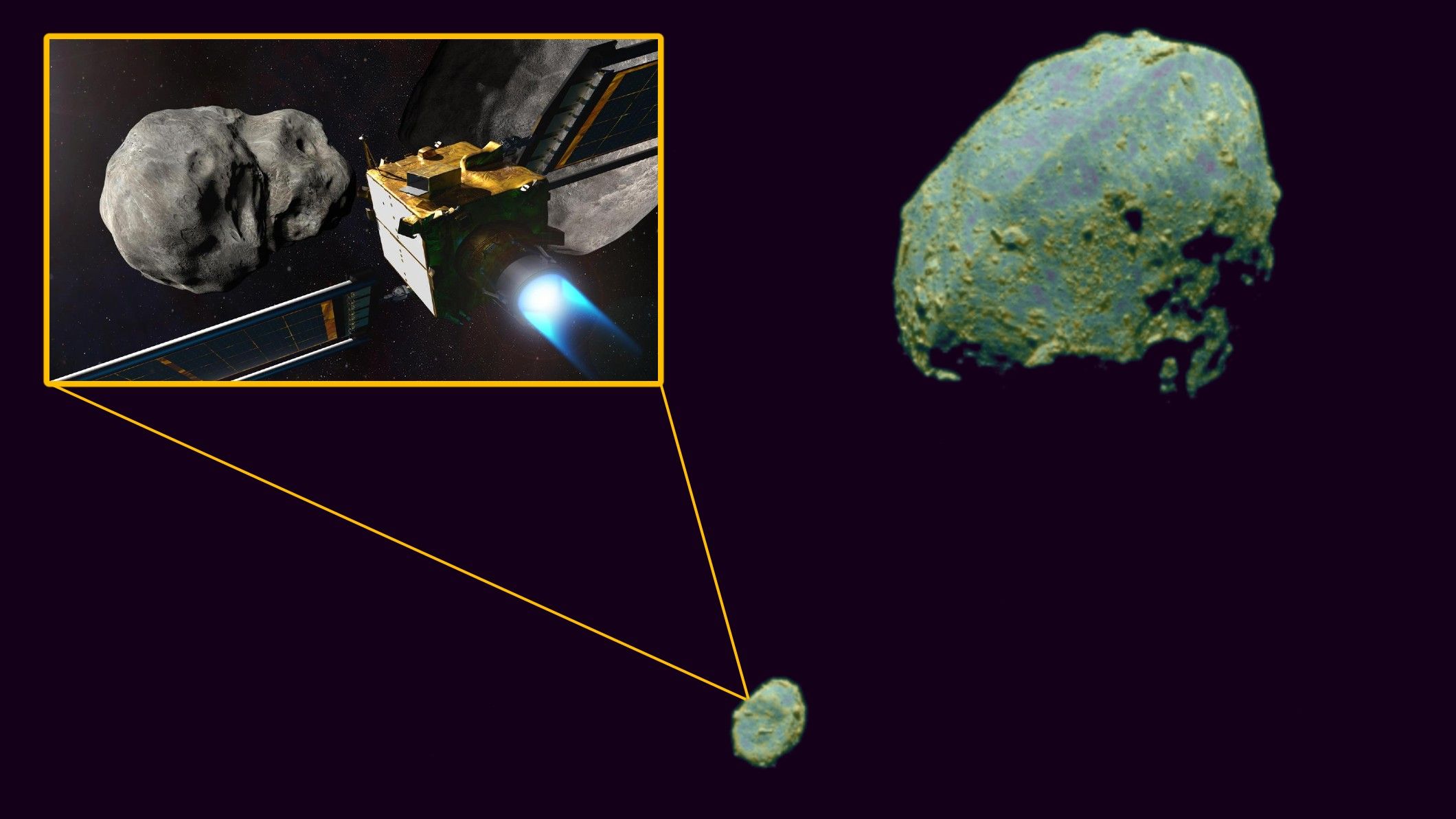
Hera’s first close-up look at DART’s target
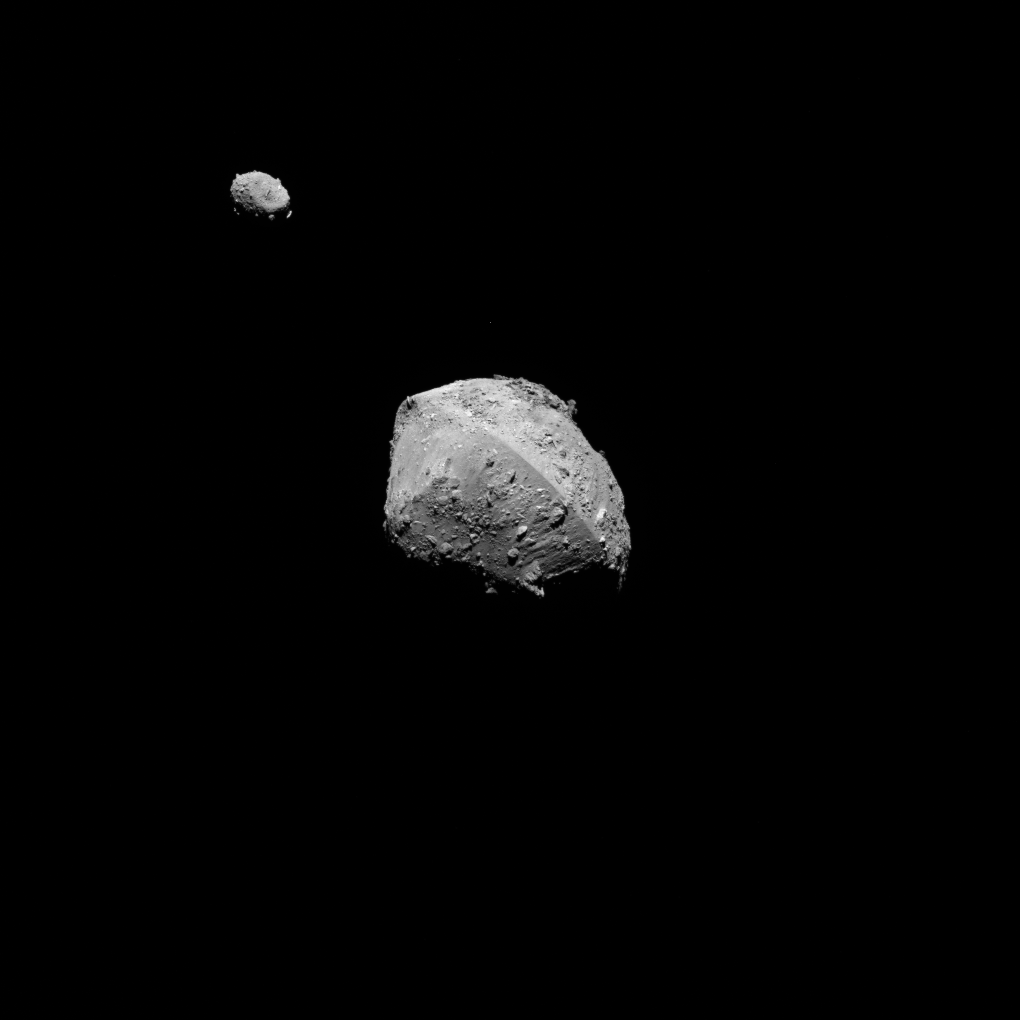
Four years after NASA deliberately crashed a spacecraft into the small asteroid Dimorphos, Europe’s Hera mission has supplied the clearest evidence yet of what that impact did to the target. The first close-up images released by the European Space Agency show a dramatically altered world: one side of Dimorphos appears flattened and contains an enormous crater that ESA compared with the size of a sports stadium.
The observations are the first detailed inspection of the Didymos–Dimorphos asteroid system since NASA’s Double Asteroid Redirection Test, or DART, struck Dimorphos in September 2022. DART was humanity’s first operational test of whether a spacecraft could change an asteroid’s motion. The impact shortened Dimorphos’ orbit around its larger companion, Didymos, by 33 minutes, demonstrating that the technique can alter an asteroid orbit.
What remained uncertain was the physical aftermath at the impact site. Ground- and space-based observatories watched the collision flash and the expanding debris plume from afar, but they could not resolve the damaged asteroid itself. Hera is now filling in that gap while operating near the binary system.
A small target with a disproportionately large scar
Dimorphos is only about 150 meters, or roughly 500 feet, across. In Hera’s new images, the DART impact scar dominates a substantial portion of that compact body. The apparent flattening of one hemisphere is especially important because it indicates that the collision did not simply punch a neat hole into a solid rock. It reshaped the surface of an object whose structure and strength are central to understanding how momentum was transferred during the impact.
The spacecraft’s images were taken from as close as 24 kilometers, or 15 miles, away. They also show the larger asteroid Didymos and reveal surface detail across the pair. The new views describe Dimorphos as tumbling chaotically as it continues to orbit its companion, adding another dimension to the system scientists must account for when reconstructing the impact’s consequences.
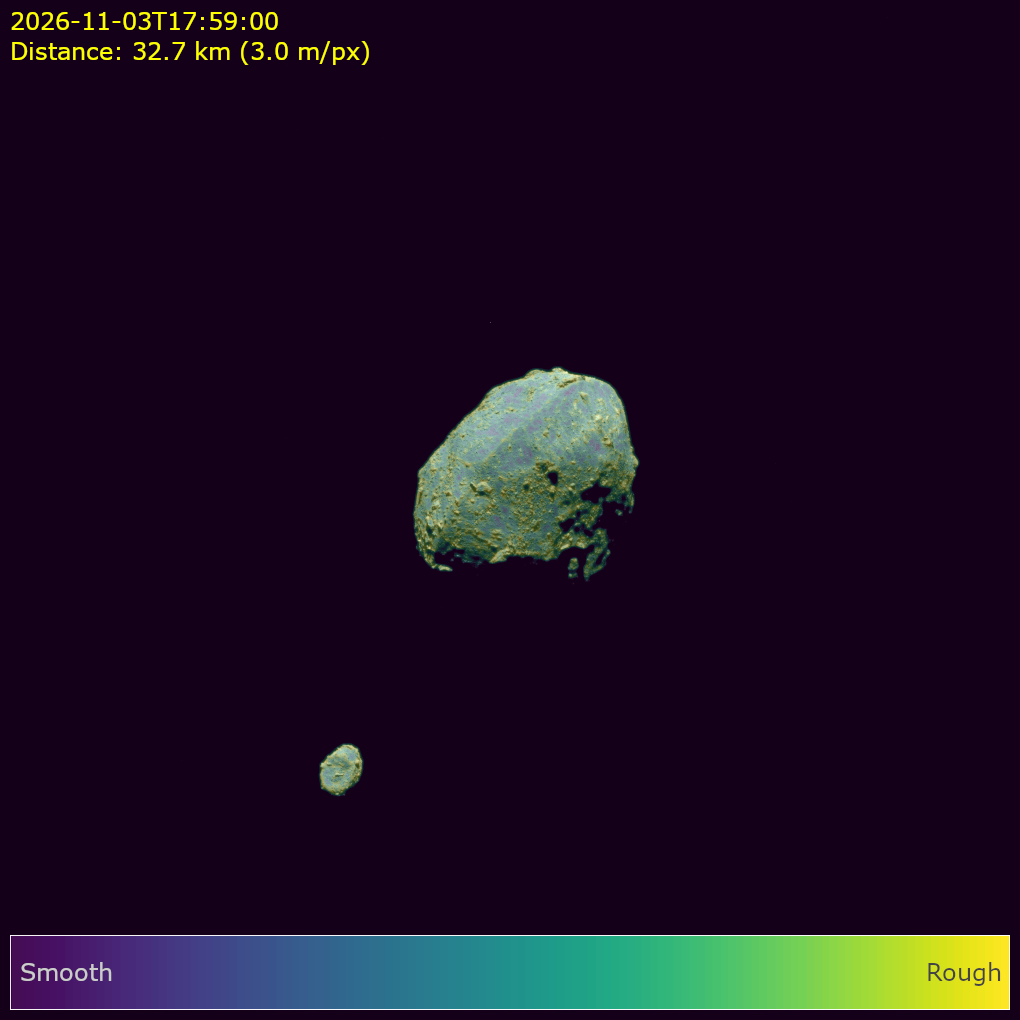
That reconstruction matters because DART’s result depended on more than the momentum carried by the incoming spacecraft. Material blasted away from Dimorphos added a recoil-like effect, helping amplify the change in the asteroid’s orbit. The scale of the crater and the distribution of ejecta can help researchers determine how that momentum enhancement arose.
Debris remains part of the story
The aftermath was not confined to the crater. Earlier telescopic observations had shown a swarm of boulders and dust spreading through space after impact. Hera’s first images add close-range context, including hundreds of boulders around the asteroid system. The observations also indicate that Didymos has small new craters associated with material ejected by DART.
That secondary cratering is a reminder that an asteroid-deflection mission is not a one-object experiment when the target is a binary system. Material pushed off Dimorphos can strike its companion, settle into nearby orbits, or escape. Each outcome contains information about the gravity, surface materials and mechanical behavior of these bodies.
The image set therefore turns a successful demonstration into a more useful physical experiment. A changed orbital period establishes that deflection worked. Mapping the crater, altered terrain and surrounding debris should help explain why it worked as well as it did.
From a demonstration to a planning tool
DART was not aimed at an asteroid threatening Earth. Dimorphos was chosen because it provided a measurable orbital target: changes in its path around Didymos could be tracked from Earth. That made it possible to assess the test without requiring a hazardous near-Earth object.
For planetary-defense planning, however, a single successful collision is only a beginning. Future decisions would depend on an incoming asteroid’s size, composition, internal structure, spin and the time available before a possible impact. A loosely assembled object may react differently from a stronger monolithic rock. A crater that looks large relative to the target may reflect the target’s weak, rubble-like makeup, but detailed analysis will be needed before the Hera observations can resolve those questions.
Hera’s work is designed to provide that essential context. By examining the aftermath at close range, the mission can connect the known orbital change to the physical conditions that produced it. The result should improve models used to predict the consequences of a future kinetic-impact mission.

A laboratory in deep space
The Didymos system has become a rare natural laboratory: a place where scientists know the timing and approximate conditions of an artificial impact and can now inspect the resulting terrain. The fresh crater, altered surface and surrounding boulders preserve evidence that is difficult to obtain in any other way.
The first images are not a final verdict on the asteroid’s makeup or on every stage of the impact. They are an opening view of a closer investigation. But they already show that DART’s encounter with Dimorphos was a transformational event for the small asteroid, not merely a brief flash observed across millions of miles.
For a test intended to inform planetary defense, that is the significance of Hera’s arrival. It gives researchers a chance to study the lasting record of the first asteroid-deflection experiment and to turn a historic proof of concept into better evidence for how to protect Earth in the future.
This article is based on reporting by Live Science. Read the original article.
Originally published on livescience.com


