Solar activity is setting up a rare weekend sky show
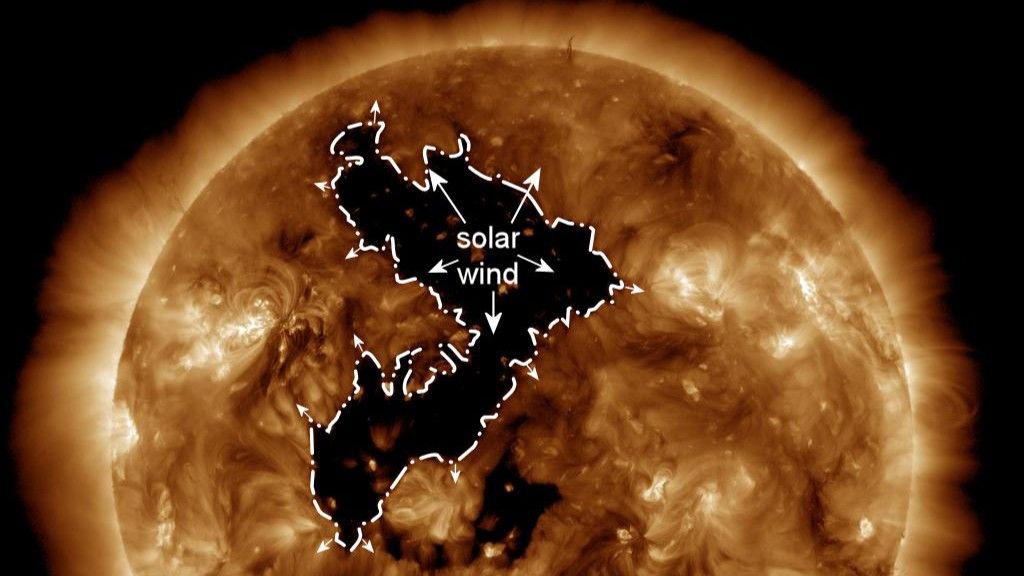
Skywatchers across parts of the United States could get an unusual view of the northern lights on Friday and Saturday after a large coronal hole opened in the sun’s atmosphere. According to the supplied source text, the opening is releasing high-speed solar wind that is expected to buffet Earth’s magnetic field strongly enough to push auroral activity well south of its usual range.
The forecast is especially notable because auroras are typically confined to higher latitudes. This event could make them visible from several northern US states, with the source text saying displays may reach as far south as Idaho and New York. For casual observers, that means a phenomenon usually associated with Alaska, Canada, or Scandinavia may briefly become visible much farther down the map.
What a coronal hole actually is
Despite the name, a coronal hole is not a physical gap in the sun. It is a region in the solar atmosphere where magnetic field lines open outward into space rather than looping back to the surface. Those open lines allow charged particles to stream away more easily, producing faster solar wind than usual.
When that wind reaches Earth, it can disturb the planet’s magnetosphere. The particles and energy channeled into the upper atmosphere then interact with gases there, generating the familiar ribbons and curtains of light known as auroras. The colors depend on altitude and the type of gas being excited, but the main point for observers is simple: stronger solar wind raises the chance of stronger, more widespread displays.
Why this weekend matters
Not every burst of solar wind produces auroras visible beyond the far north. What makes this event worth watching is the scale of the coronal hole and the expectation that the resulting wind stream will be strong enough to expand the auroral oval farther south. In practical terms, people in places that do not usually think of themselves as aurora territory may have a chance if skies are clear and local light pollution is limited.
The forecast is also a reminder of how space weather can turn ordinary nights into short-lived observational opportunities. Unlike an eclipse, auroras are harder to schedule around perfectly. They depend on both solar output and local conditions on Earth, including cloud cover, darkness, and how intense the geomagnetic disturbance becomes when the solar wind arrives.
Where and how to watch
The source text points to Friday and Saturday as the key viewing window. For anyone hoping to see the lights, the best odds will generally come after full darkness, away from city glare, with a clear view of the northern horizon. Even in states where auroras are technically possible, urban lighting can wash out weaker activity. That makes rural or semi-rural locations a major advantage.
Observers should also manage expectations. Auroras do not always appear as the vivid green curtains often seen in long-exposure photographs. In weaker displays, they can look like a pale glow, a faint arc, or shifting white-gray bands to the naked eye. Cameras frequently reveal more color and structure than the eye can detect in real time.
Still, the possibility of seeing them at all from relatively low latitudes is what makes events like this memorable. For many people in the continental US, a strong aurora is uncommon enough to feel almost like an astronomical surprise rather than a seasonal occurrence.

A visible sign of the sun-Earth connection
The event is also a useful example of how active and dynamic the sun really is. The star at the center of the solar system is not a steady lamp. Its magnetic behavior constantly reshapes the surrounding space environment, sometimes in ways that become visible on Earth as striking atmospheric light.
That connection is why solar monitoring matters far beyond astronomy enthusiasts. The same space weather processes that create auroras can also affect satellites, communications, navigation systems, and power infrastructure when they become intense enough. This weekend’s forecast is mainly a visual story, but it sits inside a much larger system of sun-driven variability.
A short-lived opportunity
If the forecast holds, the coming nights may offer one of the better aurora chances for US observers this spring. The window is brief, and outcomes will still depend on the exact strength and timing of the incoming solar wind. But the setup is clear enough to make the weekend worth watching.
For people in northern states, especially those with dark skies and clear weather, this is the kind of event that rewards a quick look outside. A giant coronal hole on the sun may be nearly impossible to imagine from the ground. The aurora it can trigger is much easier to appreciate.
This article is based on reporting by Live Science. Read the original article.

Originally published on livescience.com