Europe’s prehistoric landscapes may have been far more open than the dense primeval forests often imagined in popular accounts of the continent’s past. A new study led by researchers at Aarhus University concludes that, for more than 20 million years, much of Europe was characterized by a changing mosaic of scattered trees, open woodland, clearings and flower-rich grasslands.
The finding, reported in Biological Conservation, challenges a widely held baseline for restoration: the idea that Europe’s natural condition before major human influence was predominantly closed-canopy forest. The researchers instead describe sunlit habitats maintained by a combination of large herbivores, beavers and other disturbances. In that view, dense forests common in parts of Europe today are comparatively recent in the continent’s ecological history.
A landscape shaped by movement and disturbance
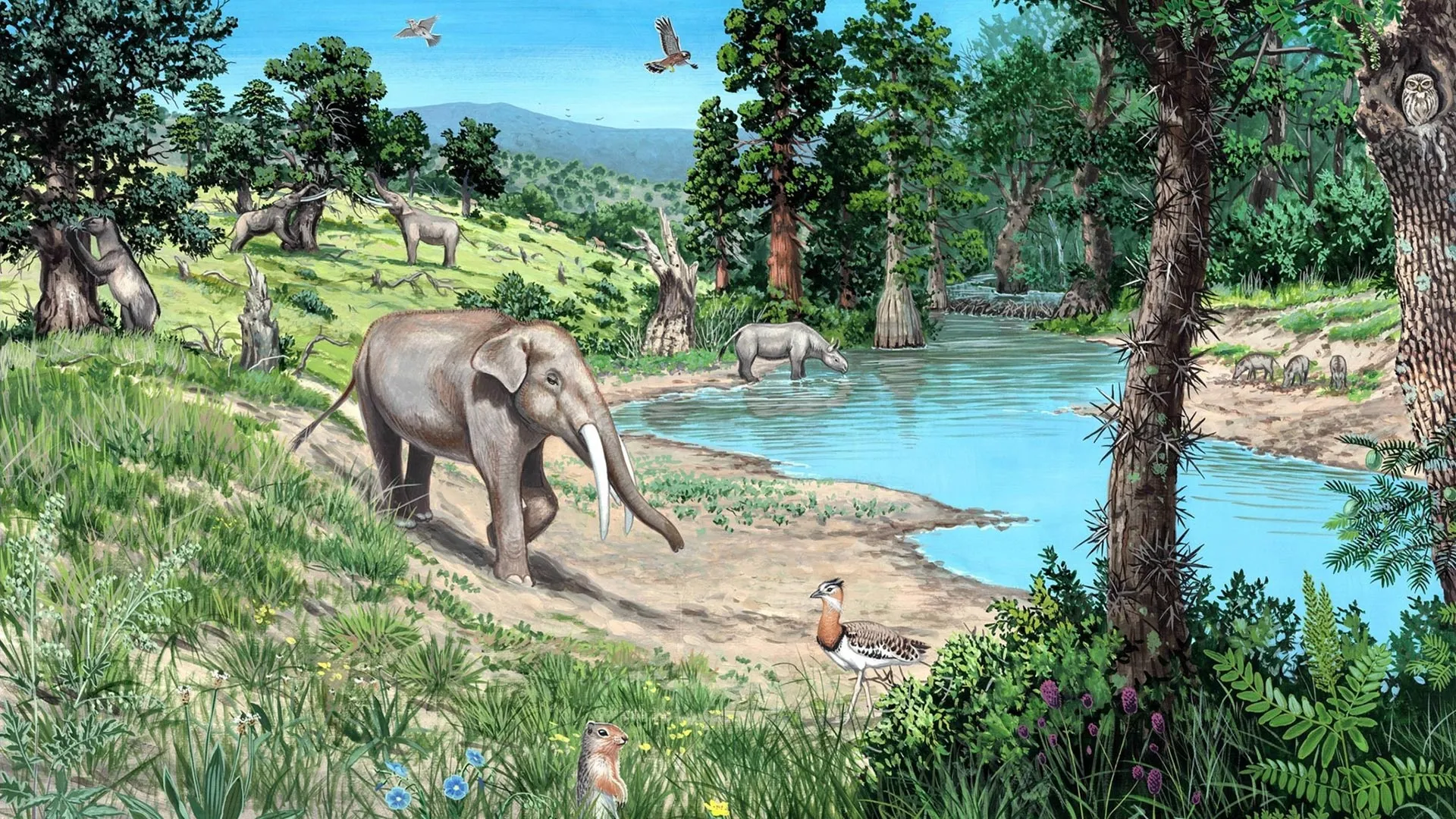
The study’s reconstruction places early elephants, rhinoceroses and horses alongside scattered trees and a diverse herb layer in central European landscapes during the Early Late Miocene. Large grazing animals did more than occupy those environments. Their feeding and movement could help prevent shrubs and trees from closing over open ground, while beaver activity added another source of environmental change.
That does not mean Europe was treeless. The central point is diversity of structure. Woodlands, grasslands, clearings and meadows existed together, rather than forming a single unbroken forest type. This variety would have created different conditions for plants, birds, insects and other animals, including species dependent on open, sunny habitat.
The research team says this mosaic persisted for more than 20 million years. Such a long time span matters because it reframes open habitats as more than temporary gaps in an otherwise forested landscape. They may have been a durable and important part of Europe’s ecological past.

A challenge for tree-planting policy
The paper enters a live debate over reforestation. Tree planting is often presented as a straightforward response to climate change, and forests can provide important climate, water and habitat benefits. But the study argues that policies focused narrowly on creating dense forest can overlook what is already valuable in open habitats.
According to the researchers, planting thick woodland where open ecosystems persist could harm biodiversity rather than protect it. Species adapted to meadow, grassland and open woodland conditions need light, space and a different mix of vegetation than a closed canopy provides. Replacing those places with dense stands of trees may therefore simplify the landscape even while increasing tree cover.
The authors’ warning is not that every reforestation project is misguided. It is that restoration goals need an ecological reference point more precise than “more trees.” A project intended to store carbon, protect a threatened species, improve water management or reconnect habitat should be assessed against the particular conditions of the site.
Restoration needs more than one template
For policymakers and conservation groups, the study suggests a practical shift in emphasis. Restoring nature may sometimes mean allowing forests to expand, but it may also mean protecting grasslands, retaining scattered trees, maintaining open woodland or supporting the processes that keep a landscape structurally varied.
That is especially relevant where financial incentives define success largely through dense tree planting. The study’s authors point to Denmark, where they say subsidies are granted for planting dense forests, as an example of a policy direction that may conflict with biodiversity needs. Their broader argument applies across Europe: conservation should not assume that forest density alone is a proxy for ecological health.
The distinction is consequential because large restoration programs can shape landscapes for decades. Once land is planted and a canopy develops, the species associated with open areas can be displaced. Conversely, treating an open habitat as inherently degraded can obscure its role in a longer ecological history.

Reconsidering what “wild” looks like
The study also changes the visual story people tell about European wilderness. Rather than endless dark woodland, the researchers describe a dynamic setting of trees, clearings, grasses, flowers and large animals. In that setting, disturbance was not necessarily evidence of damage. It was part of the system that helped sustain habitat diversity.
Modern Europe is not a Miocene landscape, and the research does not provide a simple blueprint for recreating the past. Climate, species distributions, land use and human pressures are different. But the long record assembled by the researchers provides a caution against relying on a single historical image when setting restoration targets.
As countries invest in climate and biodiversity programs, the central lesson is one of fit. Trees remain important, but the ecological value of a place cannot be measured only by how densely it can be planted. In parts of Europe, protecting a living mosaic of woodland, meadow and open ground may be closer to restoring nature than turning every available area into forest.
This article is based on reporting by Science Daily. Read the original article.
Originally published on sciencedaily.com