The hidden fires of Indonesia
Wildfires are a familiar part of Indonesia's seasonal rhythm, but the fires drawing concern in 2026 are mostly out of sight. A severe drought and a strengthening El Niño have dried broad stretches of the country's peatlands, allowing fires to take hold in the ground itself. Where ordinary forest fires move quickly through leaves and branches, peat fires creep through wet soils and dense organic layers, sometimes continuing to burn underground for months at relatively low temperatures. These slow-moving flames are hard to find, hard to reach and hard to extinguish.
Indonesia contains roughly 36 percent of the world's tropical peatlands. That gives the country a large and valuable carbon reservoir, but it also creates the conditions for an outsized fire problem whenever the rains fail. Over the past three decades, drought-driven blazes have repeatedly turned these normally soggy landscapes into long-burning sources of smoke and pollutants.
A satellite view of the new fire season
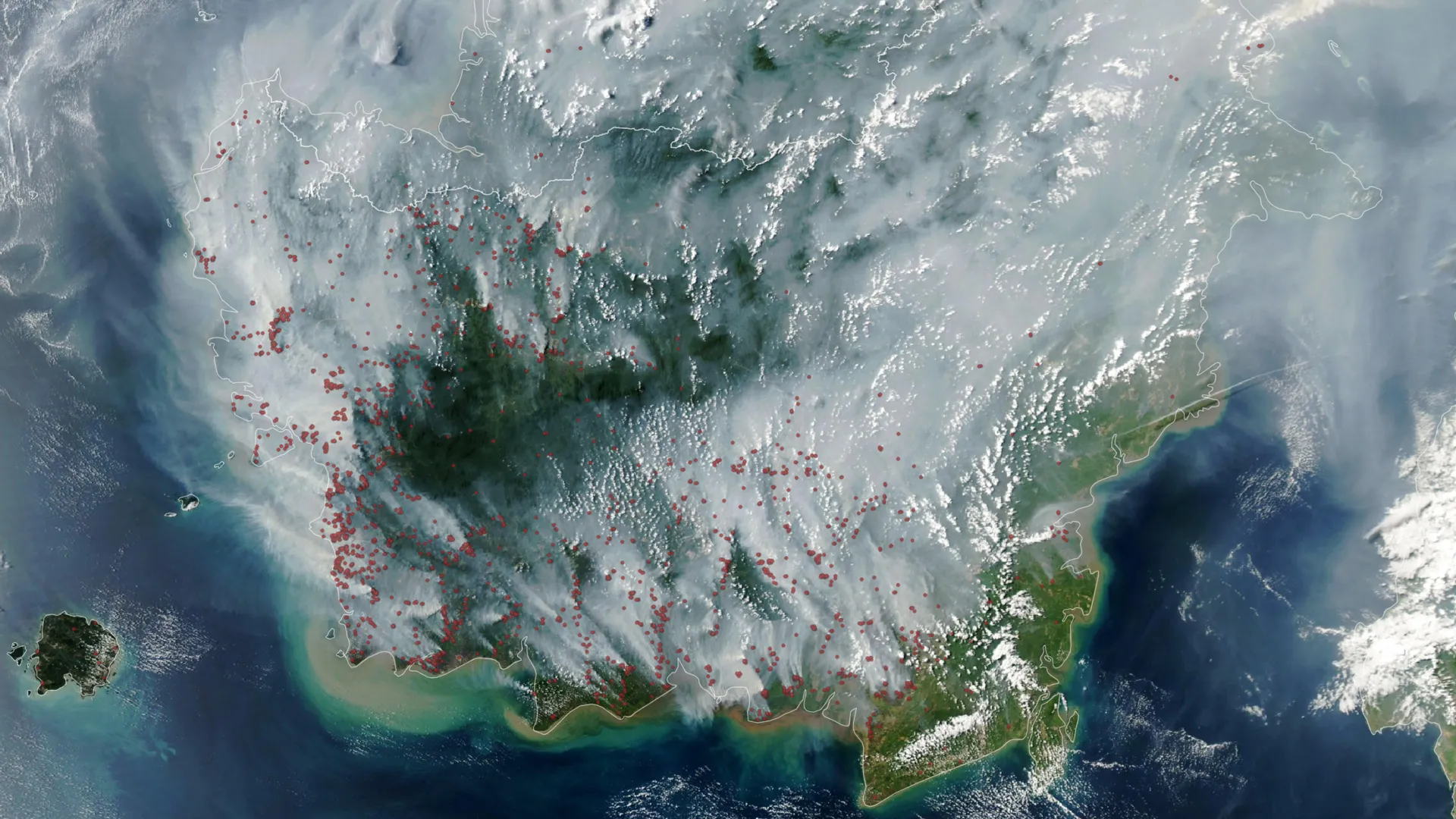
NASA's Aqua satellite passed over Indonesia on September 1, 2026, with the MODIS instrument scanning the landscape below. The resulting image showed many active-fire detections across the region. On the annotated map, each red dot marks a pixel identified by satellite algorithms as containing a thermal anomaly linked to fire. One ground fire can produce multiple dots, so the detections are not equal to the number of individual fires, but they offer a broad measure of how widespread the burning has become.
Yet satellites see only part of the problem. Peat fires emit thick smoke that can obscure the ground from view, and because the combustion is happening below the surface, heat signatures can be muted. That makes these fires easy for remote sensors to overlook even as they pump out enormous quantities of pollution.

Pollution far above a typical forest fire
While peat fires do not generate the towering flames of tropical forest fires, their exhaust is disproportionately toxic. By one estimate, peat fires release three times more fine particulate matter than other tropical forest fires. They also emit significantly higher levels of a range of harmful substances:
- Five times more sulfur dioxide
- Three times more organic carbon
- Twice as much methane and carbon monoxide
The combination of fine particles, sulfur gases and carbon-based compounds means these fires worsen air quality beyond what their modest temperatures might suggest. Large peat burns have previously blanketed broad areas of Southeast Asia in smoke for weeks at a time, disrupting daily life for millions of people.
El Niño is fanning the dry season
Tropical weather patterns play a decisive role in Indonesia's fire seasons. The country sees fires every year, but the worst seasons of recent decades, especially 1997 and 2015, coincided with strong El Niño events. El Niño alters rainfall patterns across the Pacific and surrounding regions, commonly cutting precipitation over Indonesia. The 2026 event is already making itself felt. In August 2026, NOAA reported that El Niño was present and strengthening, raising concern that the current fire season could intensify.
There is another ingredient that can make dry conditions worse. When El Niño occurs together with a positive phase of the Indian Ocean Dipole, the drying over Indonesia can become even more pronounced. If that pattern emerges or persists during this fire season, the wetlands that supply moisture to peatlands may stay parched longer, leaving underground fuel available for an extended burn.

A slow-moving emergency
Underground fires are uniquely troublesome. Because they smolder in dense peat soil, they survive light rain and return even after above-ground flames seem to be out. Their low temperatures do not stop them from becoming uncontrolled; they simply make the fire slower, tougher and more polluting. For Indonesia, a country with a vast share of the world's tropical peatlands, an extended El Niño carries the risk of a season like 2015, when haze and air pollution became a regional disaster.
The satellite detections recorded on September 1, 2026, are an early warning. With El Niño still strengthening and drought conditions deepening, the country may be entering a period in which the most dangerous fires are burning invisibly beneath its wetlands. Detecting them, tracking their emissions and preparing for weeks of smoke will be among the most pressing tasks for scientists and emergency responders in the coming months.
This article is based on reporting by Science Daily. Read the original article.
Originally published on sciencedaily.com