A Counterintuitive Signal in Cancer Immunology
Interferons have long held a privileged position in cancer research. Type II interferon, better known as interferon-gamma, is one of the immune system's principal tools for restraining malignant cells, and for decades it has been treated as a reliable marker of an effective antitumor response. A newly published study in Science complicates that assumption. The paper, appearing in Volume 393, Issue 6816, at pages 1107–1116 in September 2026, is titled around a striking claim: chronic type II interferon promotes tumor growth through mitochondrial RNA–induced type I interferon and prostaglandin synthesis.
That single sentence reverses a familiar narrative. Instead of a protective cytokine, interferon-gamma becomes, under the right conditions, a driver of disease progression. The distinction the study draws is not that interferon-gamma is inherently harmful, but that its effects depend heavily on duration, context, and the downstream cascades it activates. Understanding those cascades is now central to interpreting why some patients respond poorly to immunotherapy while others thrive.
Two Interferon Systems, One Complicated Relationship
Interferons are signaling proteins that cells release in response to infection and other threats. They are conventionally grouped into families, each with its own receptors and downstream programs.
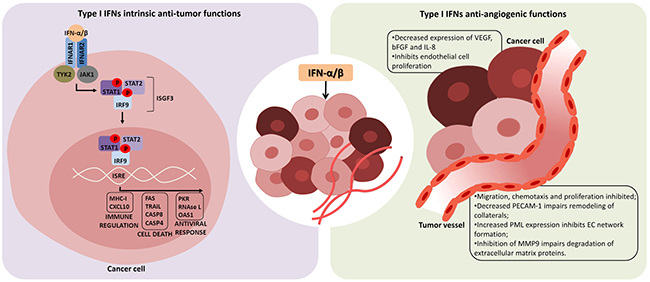
- Type I interferons, including interferon-alpha and interferon-beta, are produced by many cell types and are best known for antiviral defense. They are also potent activators of immune surveillance.
- Type II interferon, or interferon-gamma, is produced largely by activated T cells and natural killer cells. It enhances antigen presentation, recruits immune cells to tissues, and directly inhibits proliferation of some tumor cells.
- Type III interferons act primarily at barrier surfaces, and are less central to the tumor setting.
Because type I and type II interferons use separate receptors but overlapping gene programs, signals from one can amplify or antagonize the other. That crosstalk is exactly where the new study locates its mechanism.
The Mechanism: Mitochondrial RNA and Prostaglandins
According to the study's framing, the trouble begins when type II interferon signaling persists over time rather than arriving as a short, decisive pulse. Chronic signaling appears to destabilize the handling of mitochondrial RNA — the genetic material normally kept safely inside the mitochondria, where it supports energy production.
When that RNA escapes into the broader cellular interior, it can be mistaken for foreign genetic material. Cells are wired to detect nucleic acids that appear in the wrong place at the wrong time, a defense evolved to catch viruses. Mitochondrial RNA appearing in the cytosol trips the same alarm, triggering a type I interferon response. The result is a feedback loop: type II interferon drives mitochondrial RNA release, which drives type I interferon production, which reshapes the surrounding tissue.
The second half of the pathway centers on prostaglandin synthesis. Prostaglandins are lipid signaling molecules with broad roles in inflammation, blood vessel behavior, and immune regulation. In the tumor context, the study links this synthesis step to an environment that favors growth rather than restraint — an outcome consistent with the well-documented ability of prostaglandins to dampen vigorous immune attack.
Acute Versus Chronic: Why Duration Changes Everything
The conceptual heart of the finding is a distinction that has been gaining traction across immunology: the difference between acute and chronic signaling. Short bursts of interferon-gamma mobilize immune defenses, sharpen antigen presentation, and help clear abnormal cells. Sustained interferon-gamma, by contrast, produces a persistently inflamed, stressed tissue environment.
Chronic inflammation is already understood to be a permissive condition for many tumors. What this study adds is a specific molecular route by which a normally protective cytokine becomes part of that permissive state. Rather than a general observation about inflammation, the work traces a defined sequence: chronic type II interferon, mitochondrial RNA release, type I interferon induction, and prostaglandin synthesis.
That sequence has a notable feature. It involves both arms of the interferon system working at cross purposes with their usual roles. Type I interferon, typically a strong ally of antitumor immunity, becomes part of a circuit that supports tumor growth when it is provoked chronically by misplaced mitochondrial RNA.

Implications for Immunotherapy
The findings carry direct implications for how researchers think about treatments that deliberately stimulate immune activity.
- Timing and dosing matter. If chronic exposure to interferon-gamma can be counterproductive, then therapeutic strategies may need to favor transient, well-timed activation over continuous stimulation.
- Mitochondrial RNA handling becomes a target. Pathways that control whether mitochondrial RNA stays contained could represent new points of intervention.
- Prostaglandin synthesis is a potential pressure point. Interrupting the prostaglandin arm of the cascade could limit the tumor-promoting consequences of chronic interferon signaling.
- Biomarkers may need rethinking. If interferon-gamma signatures are read simply as evidence of a robust immune response, that interpretation could mislead in settings where the signal has become chronic.
None of these ideas displace existing immunotherapies, which have transformed outcomes across multiple cancer types. Instead, they suggest that the field's readouts and intervention strategies may need to account for duration and mechanism, not just intensity.
Open Questions and Cautions
Several questions follow from the study's premise. How long does type II interferon signaling need to persist before the tumor-promoting cascade engages? Which tumor types are most susceptible to this route? And can the pathway be interrupted without losing the beneficial, acute functions of interferon-gamma?
There is also the question of translation. Findings at this level of mechanism do not automatically map onto patient outcomes, and the relationship between mitochondrial RNA release, type I interferon, and prostaglandins may vary substantially across tissues and genetic backgrounds. The study's value is that it identifies a concrete, testable mechanism rather than a vague association.

The Takeaway
For years, interferon-gamma has served as shorthand for immune activation against cancer. This Science paper argues that the shorthand is incomplete. Under chronic conditions, the same cytokine can set off a chain reaction — mitochondrial RNA detected in the wrong compartment, type I interferon induced in response, prostaglandins synthesized — that ultimately helps tumors grow. That reframing does not diminish interferon biology; it sharpens it, replacing a binary view of good and bad signals with a more accurate picture in which context and timing determine which way the balance tips.
This article is based on reporting by Science (AAAS). Read the original article.
Originally published on science.org