An image that marks a threshold
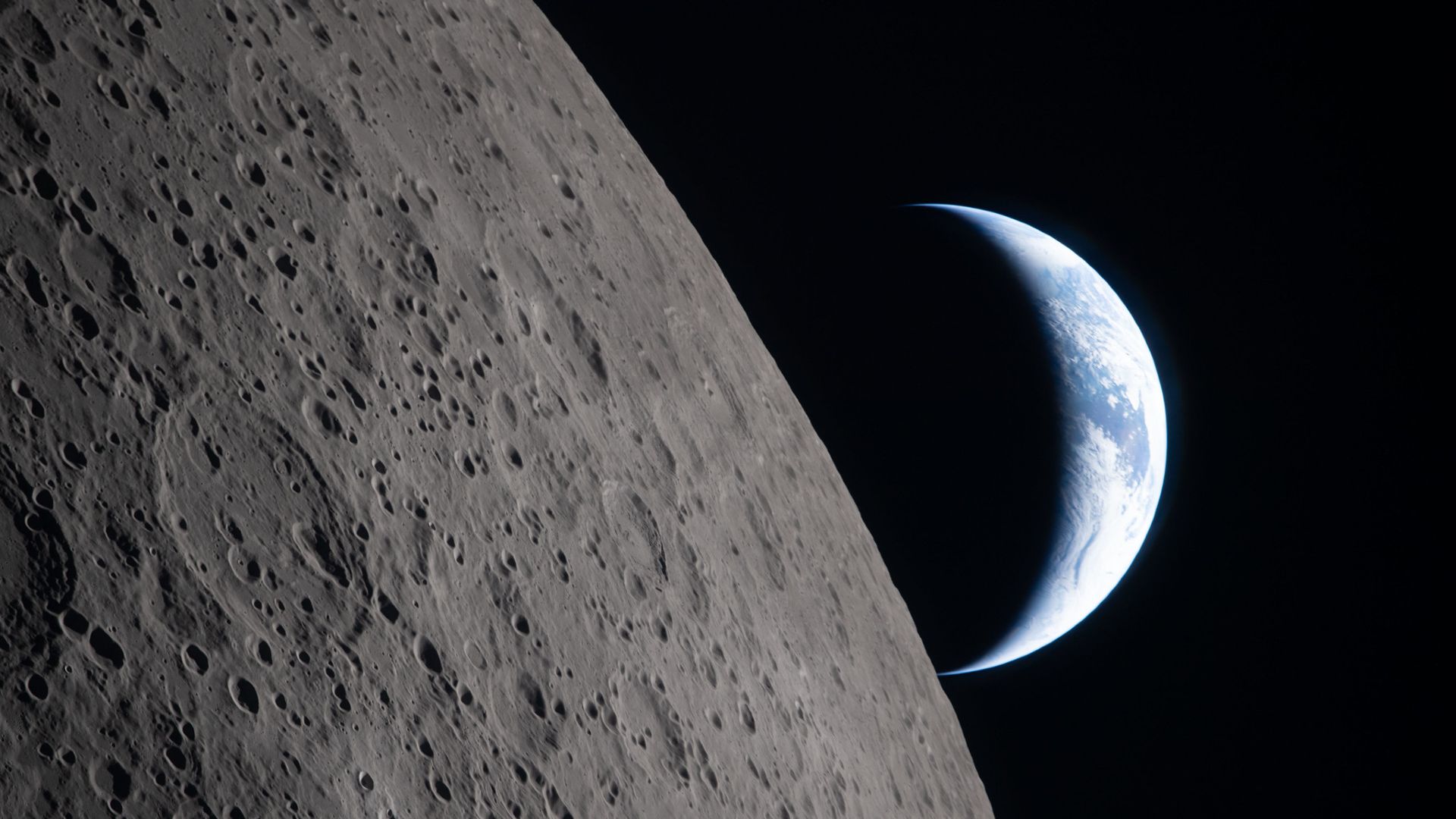
NASA’s Artemis II mission has produced the kind of picture that can define an era. Just before the crew passed behind the Moon, astronauts captured an image of a crescent Earth appearing to set beyond the lunar horizon. Shared on April 6, 2026, the photograph was taken from about 4,070 miles above the lunar surface and immediately invited comparison with the Apollo program’s most enduring visuals.
Live Science framed the scene as an “Earthset,” a reversal of the famous Earthrise imagery that came to symbolize both lunar exploration and a transformed view of our own planet. The new image arrives in a different context, but its significance is similar: it records not only where the spacecraft was, but what it means for humans to travel far enough from Earth for home itself to shrink into a distant crescent.
That is why the picture has resonated beyond mission photography. Artemis II represents humanity’s return to deep space, and the moment when Earth disappears from view is not simply a striking visual milestone. It is a psychological one.
Why the crew’s experience matters
The source account emphasizes the crew’s reaction to the moment before loss of line of sight. That reaction is important because deep-space travel is often discussed in engineering terms first: trajectories, propulsion, communications windows, radiation exposure, and hardware margins. Those remain essential. But the human experience of leaving Earth visually and mentally behind is part of the mission architecture too.
At low Earth orbit distances, astronauts still live in a regime where Earth dominates the window. The planet remains immediate, detailed, and familiar. Lunar missions alter that relationship. Distances expand, the frame changes, and orientation becomes less intuitive. In the case of Artemis II, the image of Earth setting over the Moon’s limb made that abstraction visible in a single shot.
The title of the source piece reflects that psychological dislocation directly. Even without relying on lengthy quoted recollections, the idea is clear: there is something uncanny about watching Earth vanish as your spacecraft slips behind another world. It compresses the technical achievement of the mission into a human-scale feeling that audiences can understand instantly.
A new mission, an old echo
The historical comparison to Apollo 8 is unavoidable. Apollo 8’s Earthrise image changed how many people thought about exploration, Earth systems, and planetary fragility. Artemis II’s Earthset is not the same composition and does not need to be. Its value lies in showing that lunar missions still have the power to reset perspective.
That matters for Artemis because the program is not trying merely to repeat the Apollo formula. It is intended to establish a renewed human presence beyond low Earth orbit and to support future missions deeper into cislunar space. For that strategy to matter politically and culturally, it needs public images that do more than document equipment. It needs images that translate distance into meaning.
Earthset does that by inverting the usual relationship between observer and planet. On Earth, the Moon is the wandering object. From Artemis II’s vantage point, Earth becomes the moving light on the horizon. The result is a subtle but profound shift in viewpoint. It reminds audiences that exploration changes not just destination but perception.
The practical importance of symbolic moments
Space programs are often judged by launch schedules, budgets, technical milestones, and follow-on contracts. Those metrics are real, and Artemis will continue to face scrutiny on each of them. But symbolic moments are not ornamental extras. They help establish why human spaceflight remains distinct from robotic exploration.
A robotic spacecraft can return extraordinary science and astonishing imagery. What it cannot do is communicate the felt experience of human departure in the same way a crewed mission can. When a human crew looks back and records the instant Earth becomes small, partial, and temporary, the image carries an emotional register that policy documents cannot.
That register also affects how future missions will be understood. If Artemis is to become the foundation for longer-range exploration, then the public must grasp what “deep space” means at a human level. Earthset provides one of the clearest illustrations yet. Deep space begins where Earth stops behaving like a constant backdrop and starts becoming a distant object in the frame.
- The image was captured just before the Artemis II crew passed behind the Moon.
- It shows a crescent Earth near the lunar limb from thousands of miles above the surface.
- It has drawn comparisons with Apollo-era imagery because it marks a renewed human return to deep space.
Pictures alone do not build missions, but they can define how missions are remembered. Artemis II’s Earthset image is likely to endure because it captures a threshold moment: the point where the familiar world recedes, another world fills the window, and human exploration feels genuinely distant again.
This article is based on reporting by Live Science. Read the original article.
Originally published on livescience.com