A meadow returned without being planted
An 11-year study in North Norfolk suggests that abandoned farmland can recover into a species-rich wildflower meadow with little direct intervention. Researchers led by University College London tracked plant life from 2011 to 2022 in a two-hectare field where farming had ended after the final crop in 2005. Aside from a traditional annual hay cut, the site was largely left alone.
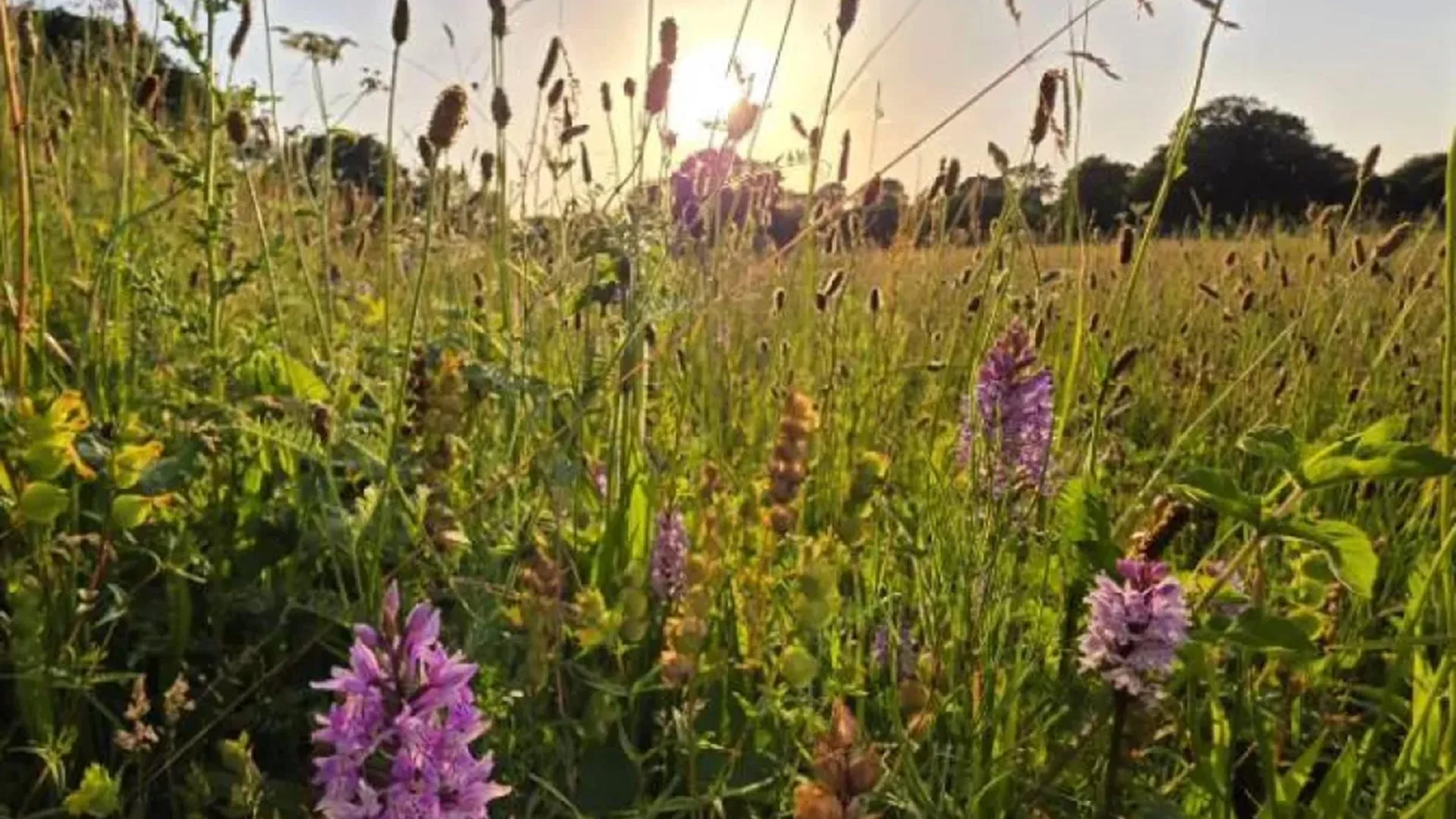
Over roughly 10 to 15 years, the former arable field developed into a diverse meadow, according to the study, which was published in Restoration Ecology. Plant diversity increased over time, and the site gained locally rare species including southern marsh orchid, greater tussock-sedge, yellow rattle, and common centaury. Thousands of orchids appeared naturally.
The result is striking not only because biodiversity recovered, but because the recovery happened without one of the most common tools in grassland restoration: sowing commercial seed mixes. Instead, the field appears to have regenerated through natural ecological processes.
A challenge to standard restoration practice
The study raises a practical question for conservation policy: when should land managers intervene, and when should they wait? In many restoration projects, species-rich grassland is established through purchased seed mixtures and active planting. Those measures can be expensive, and they often assume that nature needs direct assistance to return.
The Norfolk field points to another possibility. In this case, patience may have been a powerful restoration tool in its own right. The researchers argue that natural recovery can restore biodiversity while preserving the genetic diversity of plants already adapted to local conditions. That is an important distinction. A meadow assembled from standard seed mixes may contain the right names on paper, but not necessarily the same locally tuned populations that would emerge from nearby ecological networks, buried seed banks, or natural dispersal.
Professor Carl Sayer of UCL said the study shows that resisting seeding and allowing nature to lead may be worth trying far more often in meadow restoration. The implication is not that all restoration should be passive, but that some landscapes may be more capable of self-repair than current practice assumes.

Why the findings matter beyond one field
The timing is notable. Governments across the UK and Europe are searching for ways to restore biodiversity at large scale, particularly on former farmland. Species-rich grasslands matter because they provide habitat for pollinating insects, birds, and mammals. They can also help landscapes become more resilient and better able to adapt to climate change.
If natural meadow recovery can succeed more often than expected, the policy implications could be substantial. Passive restoration is potentially cheaper than intensive reseeding programs, which means limited public and private conservation budgets could stretch further. It could also make large-area restoration more feasible, especially where the cost and logistics of active intervention become a barrier.
That does not mean every abandoned field will transform into a high-value meadow on its own. Outcomes depend on soil conditions, surrounding habitats, seed sources, management, and local ecological history. But the study suggests that the range of viable options may be broader than many restoration frameworks currently acknowledge.
What the researchers actually observed
The field was not managed as a fully hands-off experiment. It continued to receive an annual hay cut, a traditional practice that can influence the structure of meadow vegetation by preventing domination by a smaller set of aggressive plants. Even with that light-touch management, however, the site was largely allowed to develop on its own.
Across the study period, the number and variety of plants increased. The appearance of locally rare species is especially significant because it suggests that the field did not merely become greener or more overgrown. It moved toward a meadow community with higher ecological value.
The emergence of southern marsh orchids is perhaps the most vivid symbol of that transition. Orchids are often treated as markers of ecological quality because they can be sensitive to habitat conditions. Their arrival in large numbers makes the recovery easier to grasp for non-specialists, but it also underlines the scientific point: the site’s ecological trajectory exceeded what many might expect from an ex-arable field left to recover naturally.

Patience as a restoration strategy
Modern conservation often operates under pressure for visible, measurable gains on short timelines. Seed mixes, planting schemes, and engineered interventions offer a sense of control and immediate action. Passive recovery, by contrast, can look uncertain, slow, and politically harder to defend.
Yet this study suggests that waiting can sometimes be a rigorous strategy rather than a lack of one. Allowing natural processes to unfold may produce meadows that are less generic and more rooted in local ecological context. It may also reduce the risk of replacing place-specific biodiversity with standardized restoration templates.
The researchers’ argument is therefore broader than a single success story. They are asking whether restoration programs should more often test low-intervention approaches before assuming that biodiversity recovery requires a seed packet and a spending plan. In places where ecological memory remains intact, time itself may be one of the most effective inputs available.
A useful caution for restoration policy
The findings should be read as a prompt for better decision-making, not as a universal rule. Some degraded habitats will still need active restoration. Others may have lost the soil conditions, hydrology, or nearby species pools needed for spontaneous recovery. The Norfolk meadow does not erase those cases.
What it does provide is evidence that natural regeneration can work impressively on former farmland under the right circumstances. For policymakers, landowners, and conservation groups, that opens the door to a more selective approach: intervene where necessary, but do not underestimate what landscapes can do when given time.
As biodiversity targets expand across Europe, that could be one of the most important lessons from this field. Restoration is not always about adding more. Sometimes it is about removing pressure, keeping management light, and letting ecological processes rebuild complexity on their own schedule.
This article is based on reporting by Science Daily. Read the original article.

Originally published on sciencedaily.com