Sailing on Light
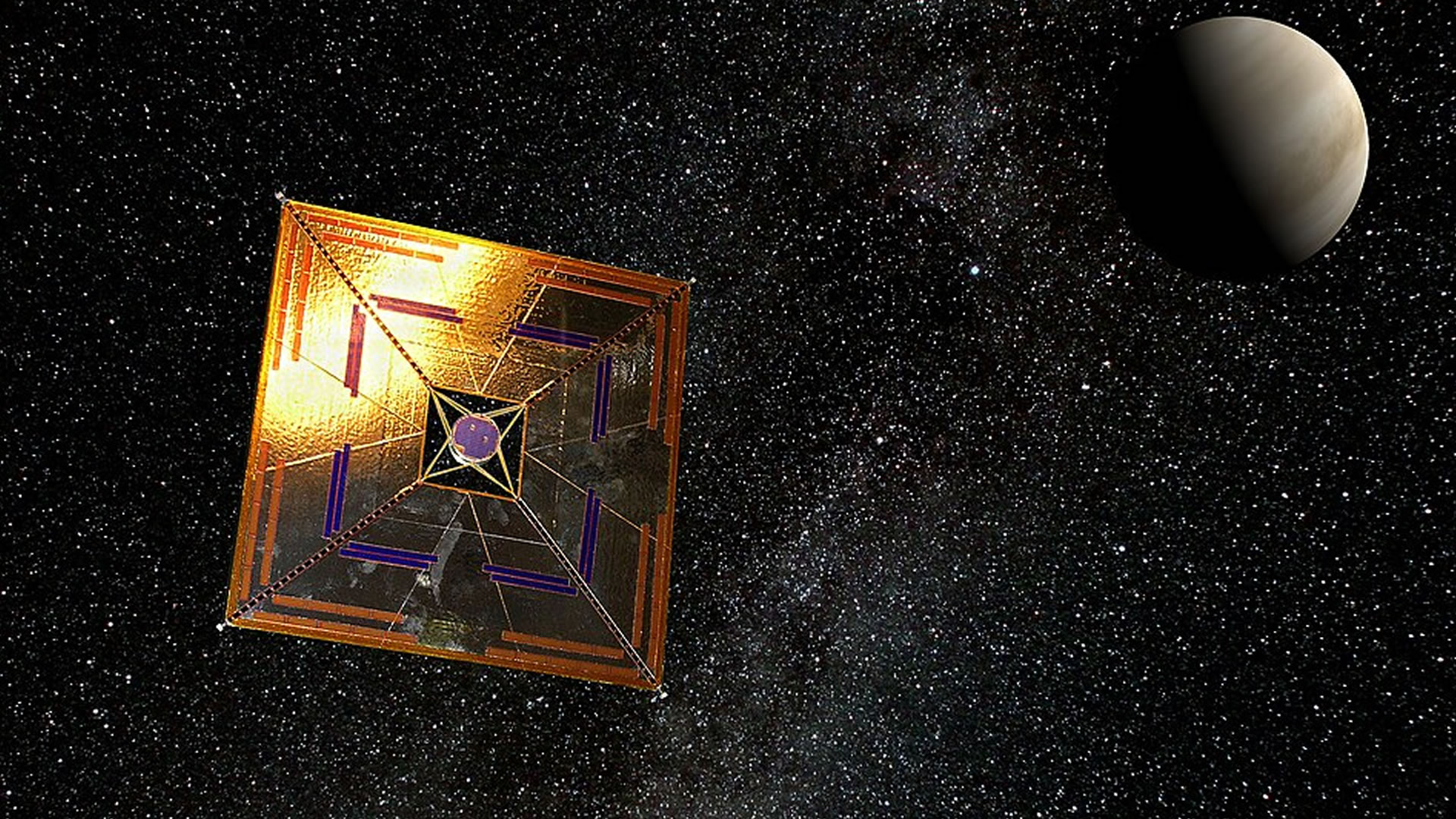
Most spacecraft rely on chemical rockets that carry their fuel with them — a fundamental constraint that limits how far and how fast we can travel through space. Light sails offer a radical alternative: propulsion using nothing but photons. By reflecting laser light from a powerful ground-based or orbital source, a light sail generates thrust through radiation pressure, accelerating continuously without carrying any fuel at all.
The concept is the foundation of ambitious projects like Breakthrough Starshot, which aims to accelerate tiny spacecraft to a fraction of light speed using powerful lasers. However, existing light sail designs face a critical problem: conventional sails made of thin plastic films with metallic coatings absorb some of the light that hits them, converting it to heat. Under a powerful directed laser, this absorption can cause the sail to melt, setting a fundamental limit on how much thrust can be applied.
Now, researchers at Tuskegee University in Alabama have developed a new type of light sail using photonic crystals — nanostructured materials that can control how light moves through them — that achieves 90 percent reflectivity at the propulsion laser wavelength while remaining transparent to other light sources. The design could solve the heating problem that has constrained light sail performance and bring laser-driven spacecraft closer to practical reality.
The Heating Problem
Conventional light sails use thin polymer films coated with a reflective metal, typically aluminum. When laser light strikes the sail, most of it is reflected — creating the thrust that propels the spacecraft — but a small percentage is absorbed by the metallic coating and converted to heat. For sunlight or modest laser powers, this heating is manageable. But for the powerful directed lasers needed to accelerate a spacecraft to interplanetary or interstellar velocities, even a few percent absorption generates enormous thermal loads.
Increasing the metallic coating thickness to improve reflectivity adds weight, which reduces the acceleration the sail can achieve for a given laser power. The fundamental trade-off — reflectivity versus mass — has been a central challenge in light sail engineering for decades. Adding thermal management systems like radiators would solve the heating problem but again adds mass, undermining the key advantage of light sails: their extreme lightness.

Photonic Crystals as a Solution
Photonic crystals offer an elegant way around this trade-off. These materials contain tiny repeating structural patterns smaller than the wavelength of light, creating what physicists call a photonic band gap — a range of wavelengths that the material strongly reflects while allowing other wavelengths to pass through. The concept is analogous to how semiconductors create electronic band gaps that block certain electron energies.
The Tuskegee team's photonic crystal sail consists of three components: germanium pillars with high refractive index, air holes with low refractive index, and a polymer matrix as the base material. The nanoscale structures — between 100 and 400 nanometers wide, roughly one-thousandth the thickness of a human hair — are arranged to create a photonic band gap precisely aligned with the frequency of the propulsion laser.
This wavelength selectivity is the key innovation. The sail strongly reflects the specific laser wavelength being used for propulsion while remaining mostly transparent to ambient solar radiation. Because sunlight passes through rather than being absorbed, the sail stays cooler during operation. And because the reflective mechanism is structural rather than depending on a metallic coating, the sail can be made extremely lightweight — potentially lighter than equivalent metallic sails while achieving comparable or superior reflectivity.
Experimental Results
Testing a one-square-meter prototype, the researchers achieved approximately 90 percent reflectivity at a wavelength of 1.2 micrometers from a 100-kilowatt laser source. While this is slightly below what optimized metallic coatings can achieve at their peak wavelength, the photonic crystal sail accomplished this reflectivity at far lower mass and with significantly reduced thermal loading.
The team calculated that the demonstrated performance is sufficient for experimental propulsion systems. A sail with these characteristics receiving continuous laser illumination could achieve velocities of hundreds of meters per second within approximately one hour. While this is far below the fraction-of-light-speed targets of projects like Breakthrough Starshot, it represents a practical demonstration of the concept and a foundation for scaling to higher performance.
Dimitar Dimitrov, an assistant professor at Tuskegee University who led the research, emphasized the scalability of the approach. The manufacturing process uses techniques compatible with existing semiconductor fabrication infrastructure, meaning that scaling from laboratory prototypes to mission-capable sails does not require fundamentally new manufacturing technology — a significant advantage over some competing approaches that rely on exotic materials or processes.
Design Flexibility
One advantage of the photonic crystal approach is its tunability. By adjusting the geometry of the nanostructures — the diameter of the germanium pillars, the spacing of the air holes, the thickness of the polymer layers — engineers can shift the photonic band gap to match different laser wavelengths. This means the same fundamental sail design can be optimized for different propulsion laser systems, providing flexibility that rigid metallic coatings cannot match.
The wavelength selectivity also opens possibilities beyond simple propulsion. A sail that reflects its propulsion laser while transmitting other wavelengths could incorporate sensors or communication equipment that observe the universe through the sail itself, rather than requiring separate optical windows. This integration of propulsion and instrumentation could enable more compact and capable spacecraft designs.
Road to Deployment
Significant engineering challenges remain before photonic crystal sails can be deployed in space. The nanostructures must survive the vibration and acceleration of launch, the thermal cycling of space, and long-duration exposure to cosmic radiation — all of which could degrade the precisely engineered photonic crystal lattice. The researchers plan to conduct radiation hardness testing and thermal cycling experiments to assess the sail's durability under space conditions.
The propulsion infrastructure required for laser-driven sails also remains largely theoretical. Breakthrough Starshot envisions a ground-based laser array generating 100 gigawatts of power focused on a sail millions of kilometers away — an engineering challenge that dwarfs the sail design itself. However, nearer-term applications using more modest laser powers for interplanetary rather than interstellar propulsion may be feasible within the coming decade.
The study, published in the Journal of Nanophotonics, demonstrates that photonic crystal technology can address the fundamental heating constraint that has limited light sail performance. If further development confirms the approach's durability and scalability, photonic crystal sails could become the enabling technology for a new generation of fuel-free spacecraft capable of reaching destinations throughout the solar system and eventually beyond.
This article is based on reporting by Interesting Engineering. Read the original article.
Originally published on interestingengineering.com