Rice has been cultivated by humans for thousands of years, but new research suggests the pace of climate change is now outrunning the crop’s ability to adapt. In the supplied report, researchers argue that global warming is proceeding roughly 5,000 times faster than rice has ever evolved, pushing many growing regions toward temperatures beyond those that have historically supported cultivation.
The finding is consequential not only because rice is one crop among many, but because it is foundational to global food systems. The source material says rice is a staple for more than half the world’s population, while around 90% of cultivation takes place in Asia. If warming drives key rice regions beyond workable thermal conditions, the damage will extend from farm yields to livelihoods, trade, and food security.
A crop under pressure from unfamiliar heat
The study described in the article compares present and projected warming with the climatic range under which rice has been grown across roughly 9,000 years of human history. The concern is not that rice is unfamiliar with warmth. Rice is often described as a heat-loving crop. The problem is that it still has physiological limits, and some regions may be approaching them faster than breeding or farming practices can compensate.
According to the source text, rice photosynthesis shuts down at around 104 degrees Fahrenheit, or 40 degrees Celsius. Excess heat can also damage pollen viability and grain development. That means warming affects rice not just as a matter of plant stress, but at the specific stages that determine whether a harvest succeeds.
The researchers frame this as a risk of hitting rice’s “thermal limit,” where the crop can no longer adapt easily to the temperature conditions imposed on it. One of the authors quoted in the report cautions against underestimating human flexibility, noting that people can breed more heat-tolerant strains or relocate production. But the same researcher also says many adaptive steps have already been taken, which raises the possibility that some systems are moving closer to the edge of what can reasonably be adjusted within the available time.

Heat is only part of the problem
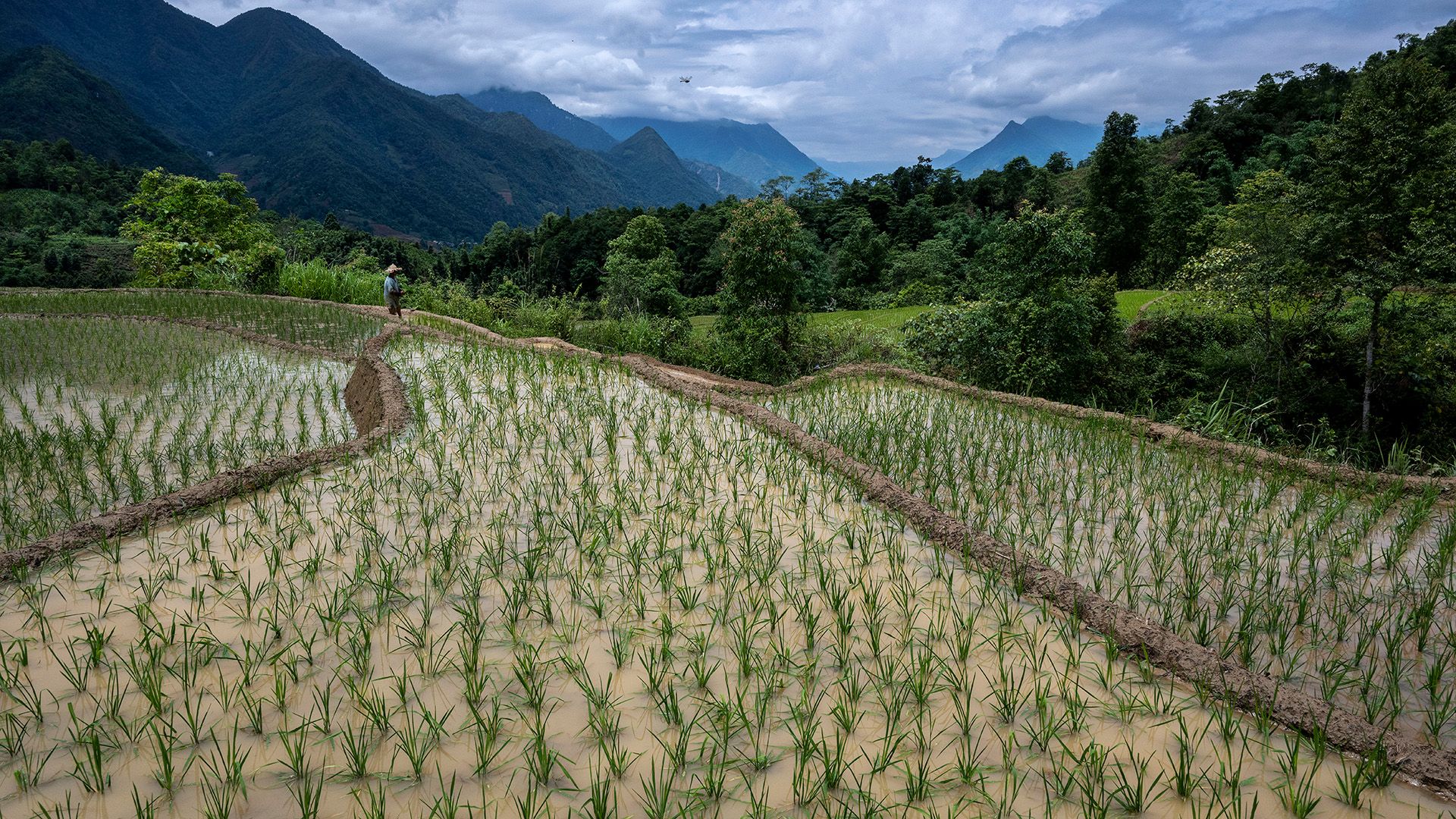
The reporting makes clear that temperature is not the only stressor. Rice is a water-intensive crop, so changing wet and dry seasons can be as disruptive as higher heat. Sea-level rise adds another threat where low-lying paddies are exposed to saltwater intrusion, which can damage or kill the crop.
These overlapping pressures matter because they reduce the value of simple adaptation narratives. A farming system that might survive higher temperatures through different planting times or improved seed varieties could still struggle if water availability becomes less predictable or salinity rises. Climate risk is not arriving in a single form.
That complexity is especially important for rice because so much production is concentrated in regions already exposed to warming. The article notes that some rice-growing areas are already experiencing severe heat that is affecting yields. In that sense, the study is not only about distant projections. It is also about ongoing strain that may intensify as warming continues.
Why pace matters
The most striking claim in the source material is the mismatch in speed. Crops can be bred. Farming practices can shift. People can move production zones. But all of those responses take time, money, infrastructure, and political stability. If the climate is changing thousands of times faster than the evolutionary adjustment that shaped rice over millennia, adaptation becomes a race against accumulating damage.
This is one reason the study’s conclusion matters beyond agriculture specialists. It reframes climate change as a force that can push staple food systems into conditions with little historical precedent. When a crop has been central to human societies for 9,000 years, leaving its past climate envelope is not a trivial fluctuation. It signals that the environmental baseline supporting long-standing food systems is shifting rapidly.
The consequences are likely to be uneven. Some regions may be able to invest in breeding, irrigation, or shifting production. Others may face tighter constraints. The source material specifically points to the billion people who depend on rice cultivation for their livelihoods, indicating that the issue is not just consumption but employment and rural economic stability.

What adaptation can and cannot do
The reporting does not present adaptation as impossible. Breeding more heat-resistant strains remains one pathway, and moving rice cultivation into new regions may offer another. But the study appears intended as a warning against assuming those tools will be sufficient everywhere or soon enough.
That distinction is important. Crop adaptation often enters public discussion as an abstract reassurance: agriculture has always changed, so it will change again. The research summarized here argues for a more constrained view. Adaptation is real, but it is occurring in a system that may already be approaching practical limits in some places.
For policymakers, the implication is that climate resilience cannot be reduced to seed innovation alone. Water management, land planning, coastal protection, and emissions policy all shape how much room rice systems have to adjust. For markets, the warning is that staple crops may face more abrupt disruption than historical production trends suggest.
The report’s core message is stark because the stakes are large. Rice has endured across centuries of environmental variation, but the present rate of warming appears to be pushing beyond the tempo to which the crop and the societies around it have historically adapted. If that trajectory continues, the challenge will not be proving that rice can survive somewhere. It will be preserving stable cultivation across the places and communities that currently depend on it most.
This article is based on reporting by Live Science. Read the original article.
Originally published on livescience.com