A Cosmic Fire Hose
An international team of astronomers has captured direct evidence of a precessing jet from an active galactic nucleus (AGN) driving massive gas outflows from a disk galaxy, providing one of the clearest demonstrations yet of how supermassive black holes at galactic centers can fundamentally reshape the galaxies they inhabit. The findings, published in the journal Science, reveal the mechanism by which energy from a black hole's immediate environment is transferred to the broader galactic ecosystem.
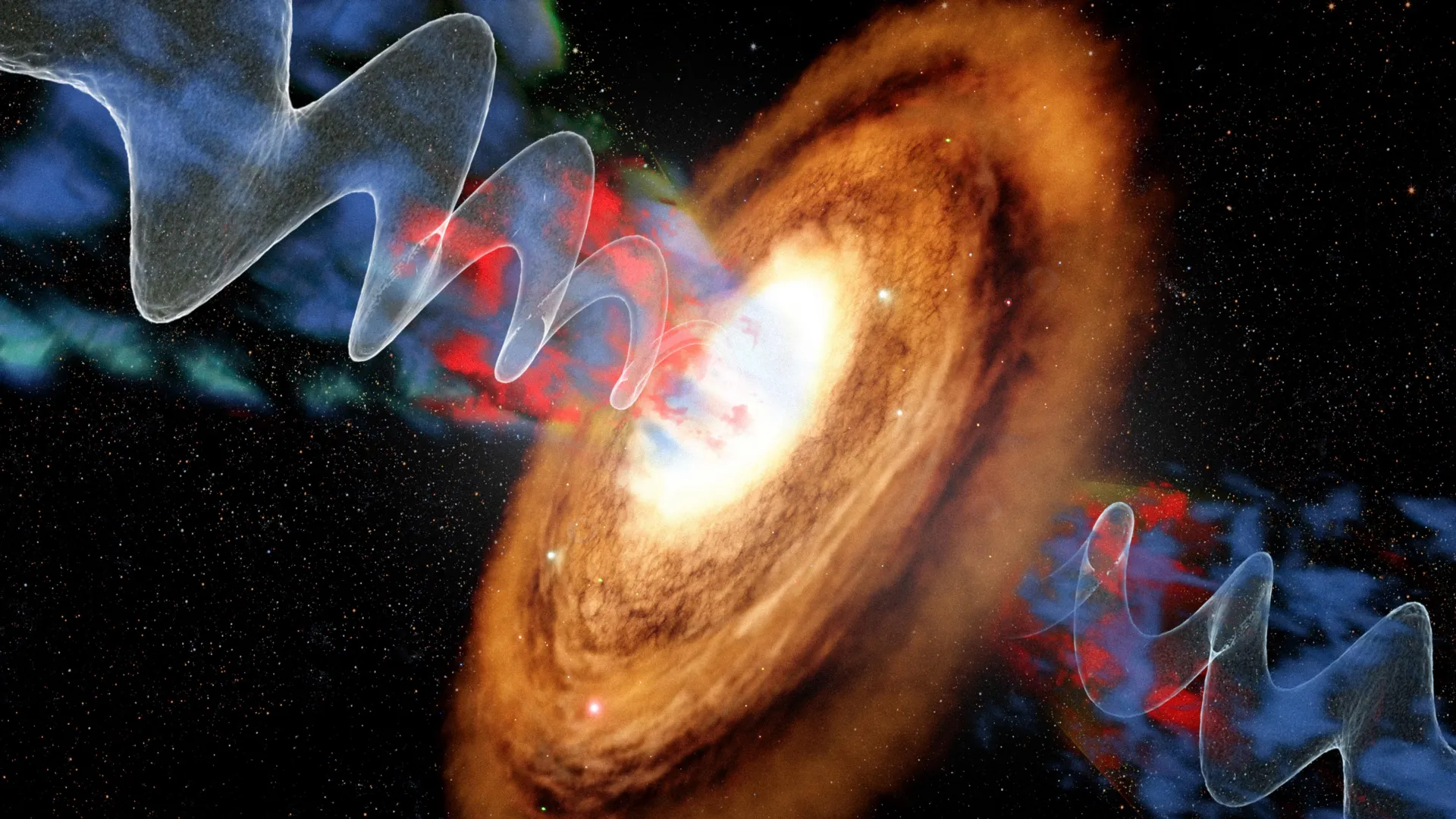
The jet, a narrow beam of relativistic particles launched from the vicinity of the supermassive black hole, wobbles like a slow-motion spinning top as it sweeps through the galaxy's gas reserves. This precessing motion — the same physical phenomenon that causes a gyroscope's axis to trace circles — allows the jet to affect a much larger volume of gas than a stationary jet would, effectively clearing material from a wide cone-shaped region of the galaxy.
How Precessing Jets Work
Jets from active galactic nuclei are among the most powerful phenomena in the universe, capable of accelerating particles to near the speed of light and extending hundreds of thousands of light-years beyond their host galaxies. They are produced when matter spiraling into a supermassive black hole generates intense magnetic fields that collimate and launch twin beams of plasma along the black hole's rotational axis.
Precession occurs when the black hole's spin axis is misaligned with the axis of the accretion disk that feeds it. This misalignment causes the jet direction to slowly change over time, sweeping through space like a lighthouse beam. The precession period can range from thousands to millions of years, depending on the specific conditions of the black hole-accretion disk system.
In the galaxy studied by the research team, the precessing jet is actively plowing through the disk of gas that constitutes the galaxy's interstellar medium. As the jet sweeps through this material, it heats and accelerates the gas, driving it outward at velocities that can exceed the galaxy's escape velocity. Gas that is ejected in this way is effectively removed from the galaxy, depriving it of the raw material needed to form new stars.

Observations and Evidence
The research team used a combination of radio, optical, and infrared observations to map the jet's trajectory and the resulting gas outflows in unprecedented detail. Radio observations revealed the jet's current direction and its historical path through the galaxy, while optical and infrared spectroscopy allowed the team to measure the velocity and composition of the outflowing gas.
The data showed that the outflow is not symmetric or confined to a narrow channel, as would be expected from a stationary jet. Instead, the outflowing gas is distributed across a broad cone that matches the expected sweep pattern of a precessing jet. This geometric signature provided compelling evidence that precession, rather than other mechanisms, is responsible for the observed gas removal.
The mass outflow rate is substantial, with the jet driving several solar masses of gas out of the galaxy each year. At this rate, the jet could significantly deplete the galaxy's gas reserves over timescales of tens to hundreds of millions of years, fundamentally altering the galaxy's ability to form new stars and grow.
AGN Feedback in Action
The observations provide direct evidence of a process that cosmologists call AGN feedback — the mechanism by which supermassive black holes regulate the growth of their host galaxies. Theoretical models have long predicted that energy output from AGN should heat and expel gas from galaxies, preventing runaway star formation and explaining why the most massive galaxies in the universe contain far fewer stars than simple models of gravitational collapse would predict.
While indirect evidence for AGN feedback has accumulated over the past two decades, direct observations of the specific physical processes involved have been rare. The precessing jet study provides an unusually clear and detailed look at one particular feedback channel: mechanical energy from a relativistic jet being converted into bulk motion of galactic gas.
Understanding AGN feedback is critical for cosmological models that attempt to explain the observed properties of galaxies across cosmic time. Without feedback mechanisms that regulate gas cooling and star formation, simulations produce galaxies that are far too massive, too bright, and too numerous compared to what telescopes actually observe.

Broader Significance
The discovery that jet precession can dramatically enhance the efficiency of gas removal has implications for understanding galaxy evolution more broadly. Precession allows a single jet to affect a much larger volume of its host galaxy than a fixed jet, meaning that even relatively modest jets could have outsized impacts on galactic gas content if they precess over sufficient timescales.
This finding may help resolve a long-standing puzzle in galaxy evolution studies: how AGN feedback operates effectively in galaxies where the jet power appears insufficient to drive the large-scale outflows that are observed. Precession provides a natural amplification mechanism that bridges this gap, distributing the jet's energy over a much larger solid angle than its instantaneous opening width would suggest.
This article is based on reporting by Science (AAAS). Read the original article.
Originally published on science.org