An Iconic Launchpad Enters Its Next Chapter
Launch Complex 39A at NASA's Kennedy Space Center has witnessed some of humanity's most consequential departures from Earth. From the Saturn V missions that carried Apollo astronauts to the Moon in the late 1960s and 1970s, to three decades of Space Shuttle flights, to the modern era of commercial crew launches aboard SpaceX's Dragon capsules, Pad 39A has been perpetually reinventing itself. This week, it underwent yet another transformation.
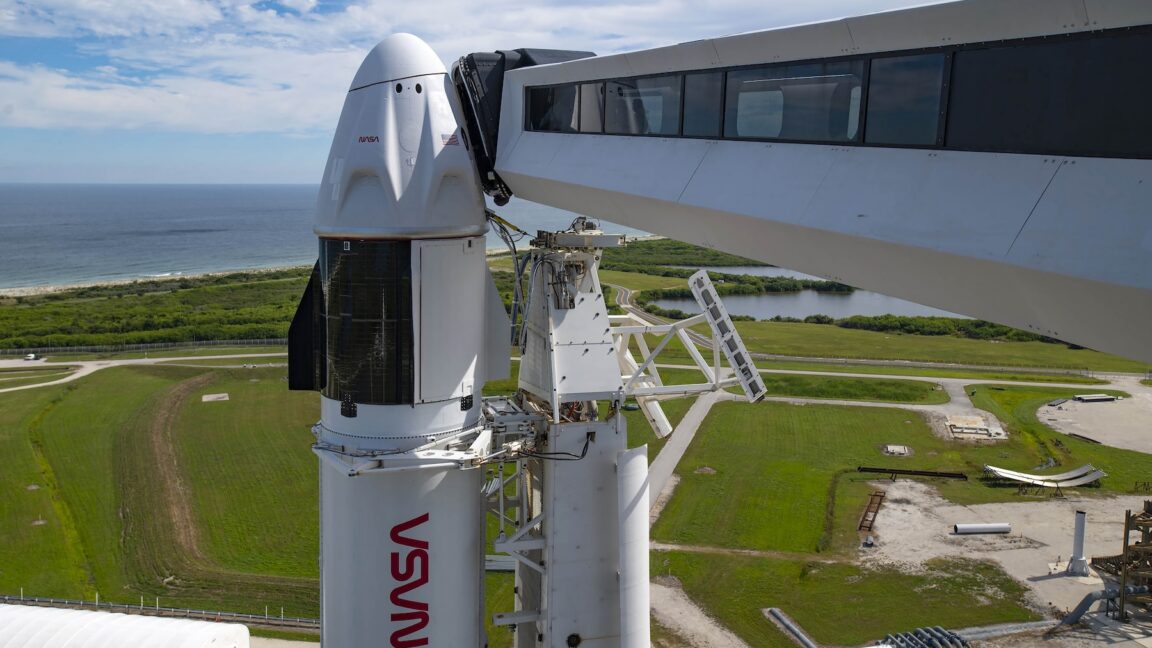
On Wednesday, SpaceX removed the Crew Access Arm (CAA) from the pad's Fixed Service Structure -- the enclosed walkway, suspended more than 200 feet above the concrete surface, that astronauts have used to board Dragon capsules since 2020. Workers had positioned a massive Liebherr LR13000 crane at the site earlier in the week and secured support structures before lifting the arm from the tower. It was the latest unmistakable signal that Pad 39A's future belongs to Starship, not Falcon 9.
All Dragon Flights Move to SLC-40
The removal formalizes a shift that has been underway for months. No Falcon 9 rocket has launched from 39A since December 2025. Going forward, every Dragon mission -- crewed and cargo alike -- will depart from Space Launch Complex 40 (SLC-40) at the adjacent Cape Canaveral Space Force Station, roughly four miles south.
SpaceX's Lee Echerd explained the rationale for the move: the company plans to concentrate all Falcon 9 launches at SLC-40, including Dragon flights, freeing the Cape team to focus Pad 39A on Falcon Heavy missions and, crucially, the first Florida-based Starship launches anticipated later this year. SLC-40 has been capable of supporting crewed missions since modifications were completed in 2024, and it hosted its first astronaut launch -- the Crew-9 mission -- in September of that year.

Making Room for Starship
The Crew Access Arm's departure is one piece of a much larger infrastructure overhaul. The Federal Aviation Administration has approved up to 44 annual Starship-Super Heavy launches from LC-39A, an operational tempo that demands massive new ground systems. SpaceX's plans call for roughly 800,000 square feet of additional infrastructure at the complex, including new launch mounts, integration towers, and propellant storage facilities capable of handling the colossal volumes required by the methane-fueled Super Heavy booster and Starship upper stage. The company estimates it will consume approximately 297 million gallons of water annually to operate the launch site's deluge and sound-suppression systems.
The exact timing of Starship's first Florida launch remains uncertain, though it could come as early as the second half of 2026. Until then, SpaceX will continue flying Starship from its Starbase facility in Boca Chica, Texas, where the vehicle has undergone an intensive test campaign.
Why It Matters
Pad 39A's evolution from a government-owned Apollo infrastructure asset to a commercially operated, multi-vehicle launch site is a microcosm of the broader transformation in American spaceflight over the past two decades. The removal of the Dragon crew arm -- itself only installed in 2018 to replace the aging shuttle-era walkway -- underscores how rapidly the industry is moving. SpaceX is no longer merely iterating on its existing Falcon fleet; it is actively reconfiguring its most storied facilities to accommodate the fully reusable rocket system it believes will define the next era of launch.
For NASA, the transition is seamless. Crew-12, the latest rotation mission to the International Space Station, was already scheduled to launch from SLC-40. The agency's astronauts will simply board their Dragon capsules at a different address. But for the launch pad itself, the change marks the end of one chapter and the start of another -- one measured not in incremental upgrades, but in the sheer scale of what comes next.
This article is based on reporting by Ars Technica. Read the original article.

Originally published on arstechnica.com