Lasers at Sea Are No Longer Science Fiction
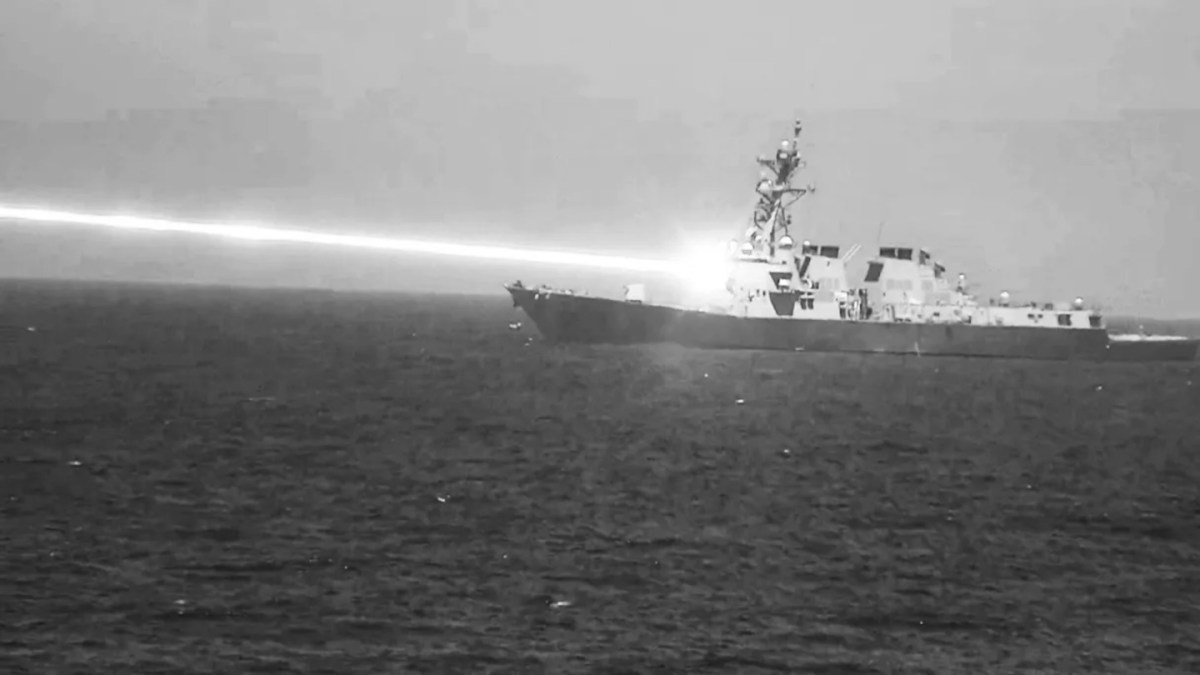
The guided-missile destroyer USS Preble has demonstrated a new layer of close-in defense by using its HELIOS shipboard laser to neutralize four uncrewed aerial vehicles during an at-sea counter-UAS exercise. The trial, publicly disclosed in early February 2026, marks the first confirmed use of a ship-mounted laser weapon to engage multiple airborne targets during an operational demonstration by the U.S. Navy.
HELIOS, formally designated Mk 5 Mod 0, is a 60-kilowatt-class directed-energy weapon that operates within the Aegis combat system. The laser has been installed on the Preble since 2022, making it one of the most powerful laser weapons actively deployed on a U.S. Navy surface combatant. The successful engagement of four drones in a single exercise demonstrates that the system has progressed from experimental curiosity to operational capability.
The Economics of Directed Energy
The strategic rationale for shipboard lasers is fundamentally economic. A single RIM-116 Rolling Airframe Missile, one of the Navy's primary close-in defense weapons, costs approximately one million dollars. A Standard Missile-2 costs even more. When adversaries can field cheap drones costing a few hundred dollars each, defending against swarms with conventional missiles becomes financially unsustainable.
Lasers offer what Navy leaders increasingly describe as an effectively unlimited magazine, constrained mainly by the ship's power generation and cooling capacity rather than a fixed number of interceptors. Each shot costs roughly the electricity required to power it, which is measured in single-digit dollars. For a destroyer that might face dozens of drone threats in a single engagement, the cost differential between missiles and lasers is transformative.
How HELIOS Works
The HELIOS system uses a fiber-optic laser to project a concentrated beam of energy onto a target, heating it until structural failure occurs. Against small drones, which are typically built from lightweight plastics and carbon fiber, a 60-kilowatt beam can cause structural damage or ignite components within seconds of sustained contact. The system also includes an optical dazzler mode that can blind or confuse drone sensors at ranges beyond the destructive beam's effective distance.
Limitations and Honest Assessments
The Navy has been careful not to oversell the HELIOS system, and for good reason. Directed-energy weapons face real physical limitations. Lasers are single-target weapons that can engage only one threat at a time. Atmospheric conditions, including rain, fog, dust, and salt spray, all degrade beam effectiveness. Range is limited compared to missile systems. And the power required to operate high-energy lasers places significant demands on a ship's electrical generation capacity.
The Navy has not disclosed specific engagement ranges or the time required to neutralize each drone during the Preble's test. These details matter enormously for assessing the system's practical utility. A laser that requires 10 seconds of sustained contact to destroy a drone can engage only six targets per minute, which may be insufficient against a coordinated swarm attack.
Power Generation Challenges
Current naval vessels were not designed with high-energy lasers in mind. The Arleigh Burke-class destroyers that form the backbone of the Navy's surface fleet have limited surplus electrical capacity. Operating HELIOS at full power likely requires diverting power from other systems, creating operational trade-offs. The Navy's next-generation DDG(X) destroyer is being designed with significantly greater power generation capacity, suggesting that directed-energy weapons will be integral to future surface combatant design rather than retrofitted additions.
A Complementary Layer, Not a Replacement
Navy officials have emphasized that HELIOS is intended to complement existing missile defenses rather than replace them. The envisioned layered defense begins with long-range missiles engaging threats at distance, transitions to shorter-range systems as targets close in, and uses directed-energy weapons as the final layer of protection for the ship itself.
This layered approach addresses each weapon system's limitations while exploiting its strengths. Missiles offer long range and high lethality but are expensive and finite. Lasers are cheap and effectively unlimited but are range-limited and weather-dependent. Together, they create a defense that is both deeper and more sustainable than either system alone.
What Comes Next
The successful four-drone engagement on the Preble validates years of development investment and moves HELIOS closer to full operational deployment across the fleet. The Navy is expected to install directed-energy weapons on additional surface combatants as production scales and reliability data accumulates. For the drone swarm threat that has emerged as the defining naval challenge of the 2020s, the Preble's laser offers the first convincing answer that does not require a missile for every target.
This article is based on reporting by The War Zone. Read the original article.
Originally published on twz.com