Ground robots are becoming a frontline necessity
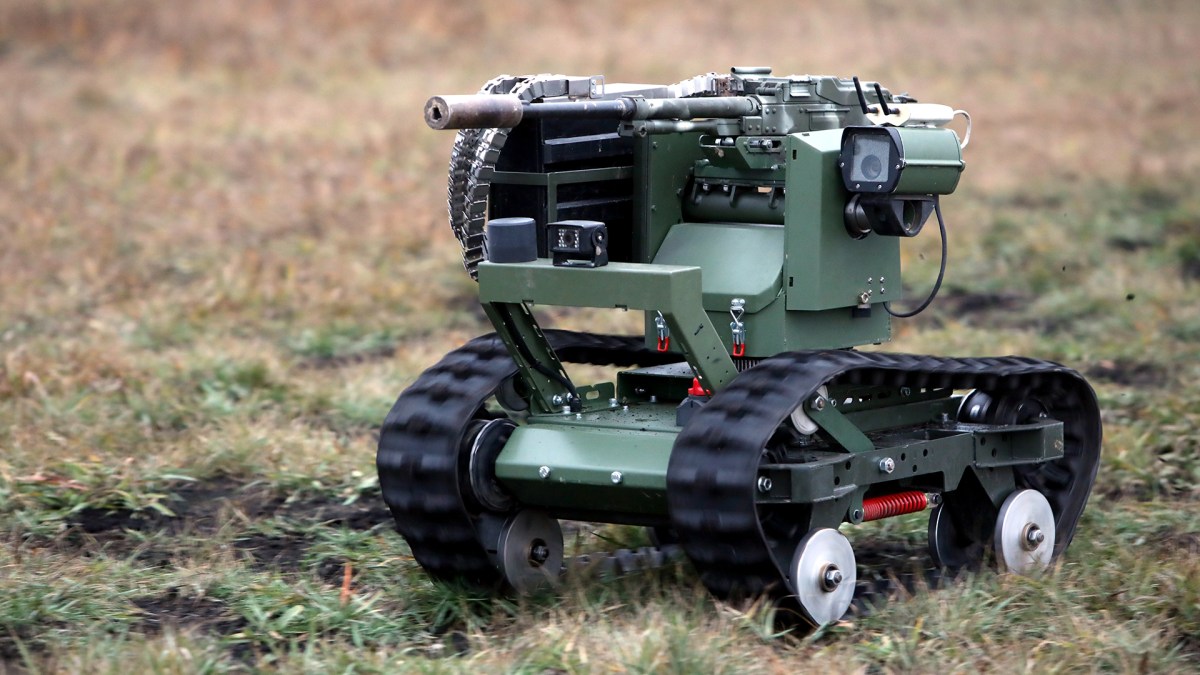
Ukraine’s war has already transformed expectations around aerial drones. Now the same process is unfolding on the ground. According to Brave1 CEO Andrii Hrytseniuk, Ukraine is on track to produce tens of thousands of unmanned ground vehicles this year, part of an effort to meet what officials describe as one of the country’s most urgent battlefield needs.
The shift reflects the realities of a battlefield saturated with lethal aerial drones. Traditional ground maneuver has become so dangerous that even routine tasks can carry disproportionate risk. In that environment, uncrewed ground vehicles are increasingly being used to move supplies, evacuate wounded troops, lay mines, counter drones, and even directly support combat operations.
From niche systems to mass demand
The supplied interview makes clear that demand is no longer marginal. President Volodymyr Zelensky set a target of producing 50,000 UGVs this year, and Hrytseniuk said the effort is moving according to plan. He described the goal as ambitious but said the armed forces are expected to receive many times more drones than in previous years.
That matters because scale is a strategic variable in its own right. A few advanced robotic systems can demonstrate concept value. Tens of thousands can begin to change operational design. If Ukraine reaches anything close to the declared target, UGVs would no longer be experimental adjuncts. They would become a standing element of how the force sustains, protects, and projects itself along dangerous sections of the front.
Why UGVs fit this war
Uncrewed ground vehicles address a specific battlefield problem: exposure. Any mission that reduces the need to send a soldier into a drone-watched, artillery-threatened corridor has obvious value. Logistics runs, casualty evacuation, and explosive tasks are especially suitable because they often require movement through contested space without the need for large-scale human presence.
What stands out in the source material is the breadth of roles already being assigned. These are not being framed as single-purpose machines. They are part of an expanding toolkit that can handle support, protection, and direct operational tasks depending on configuration and need.
Ukraine’s industrial advantage may be speed
The interview also highlights why foreign militaries are watching closely. After years of adaptation under wartime pressure, Ukraine has become a global leader in ground drone technology, deploying systems at a pace and scale that even many advanced militaries have not matched. That is less a statement about theoretical sophistication than about iteration under fire.
Wars can accelerate development when failure is immediate and incentives are sharp. In Ukraine’s case, the result appears to be an ecosystem that can identify a battlefield requirement, field a workable design, and expand production quickly enough to matter. Hrytseniuk also stressed the importance of artificial intelligence in improving the efficiency of these systems, pointing toward increasing autonomy and better task execution.
A signal for other militaries
Ukraine’s experience is likely to shape procurement debates well beyond the conflict itself. Many militaries have discussed robotic ground systems for years, but actual deployment has often remained limited, expensive, or doctrinally uncertain. Ukraine is creating an evidence base under wartime conditions. If UGVs can routinely handle supply movement, rescue, or combat-support functions in one of the world’s most heavily contested drone environments, the argument for broader adoption strengthens considerably.
That does not mean every lesson will transfer directly. Industrial capacity, doctrine, terrain, and command structures differ. But one point is already clear: uncrewed ground systems are moving closer to the core of land warfare, especially where aerial surveillance makes human movement conspicuous and costly.
The next phase is about reliability at scale
The real test now is not whether Ukraine can build interesting robots. It is whether it can keep contracting, supplying, and integrating them at the volume the battlefield demands. Zelensky’s own remarks, cited in the source text, emphasize that production and supply must keep pace with need and that contracting volumes must be significantly higher.
If that happens, Ukraine’s ground-robot arsenal could become one of the clearest examples of rapid wartime military innovation in this conflict. Not because robots replace soldiers outright, but because they increasingly take on the dangerous tasks soldiers should no longer have to do in person if machines can do them first.
This article is based on reporting by twz.com. Read the original article.
Originally published on twz.com