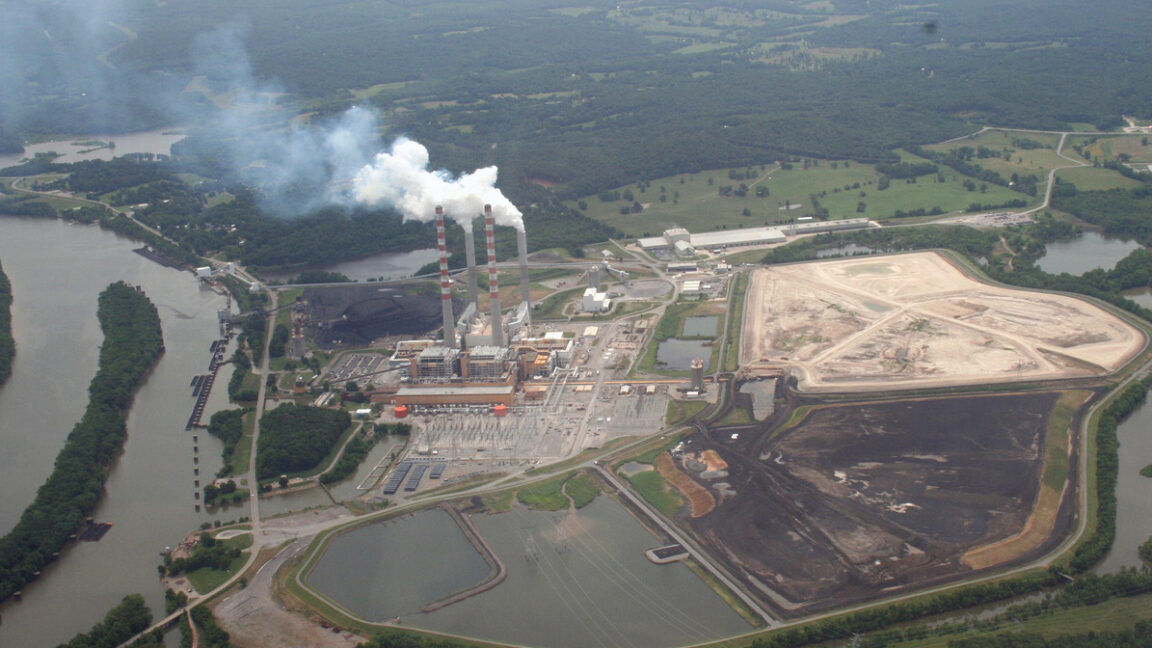
Federal coal support reaches plants with past environmental violations
The Trump administration’s new push to keep older coal stations running is directing federal support to plants with long records of environmental violations, according to the supplied source material. The article centers on a Department of Energy grant program designed to extend the life of coal facilities that might otherwise be retired, and it argues that at least some of the beneficiaries have repeatedly been cited under the Clean Air Act, the Clean Water Act, or both.
That matters because the policy debate is not only about grid reliability or fuel diversity. It is also about whether public funds should be used to prolong operations at plants that regulators have already scrutinized for years over pollution-control failures, wastewater releases, or other compliance problems. In the supplied reporting, one Tennessee plant serves as the clearest example of that tension.
Cumberland became a symbol of the policy reversal
The Tennessee Valley Authority’s Cumberland Fossil Plant had previously been on a retirement track. The source text says the coal-fired facility was slated to close within the decade after years marked by pollution concerns, equipment failures, and health complaints. It also notes that the plant was part of a multibillion-dollar settlement in 2011 tied to TVA’s failure to install pollution-control technology earlier, and that regulators cited the plant again for air-pollution violations in 2017 and 2023.
TVA had said it would retire Cumberland’s units in 2026 and 2028. The supplied article says that changed after the Trump administration replaced four TVA board members, with the agency reversing course on the retirement plan in February. Cumberland has now received a federal pledge of $46 million to help extend its operating life.
That funding is presented as part of a broader national campaign to preserve older coal generation. Rather than allowing retirements to proceed, the administration is using federal backing to keep selected plants online longer. Supporters may frame that as a reliability measure, but critics in the source material describe it as a direct setback for pollution reduction and energy transition efforts.
More than one recipient has a history of citations
The source text says Cumberland is one of at least three of the 12 grant recipients that have been repeatedly cited for violations over the past decade. The other two named plants are the Grand River Energy Center in Oklahoma and the Roxboro Steam Electric Plant in North Carolina. The cited issues include excess pollutants in wastewater and other environmental compliance problems.
Even from the limited set of details provided, the significance is clear. This is not a case where every supported facility is described as a relatively clean or newly modernized plant being preserved for a narrow emergency purpose. Instead, the reporting indicates that multiple recipients carry substantial regulatory baggage, raising questions about the standards used to decide where federal money goes.
That in turn complicates the administration’s message. If the argument is that extending coal plants is necessary for the public good, opponents can point to the violation histories and ask why cleaner or less contentious solutions are not receiving the same emphasis.
Critics say the grants reward outdated generation
Environmental advocates quoted in the source describe the grants as a reversal of the direction many utilities had already begun taking. For local organizer Angie Mummaw, who lives near the Cumberland plant, the funding was described as a “slap in the face.” Her objection, as presented in the source material, is that public investment should be moving toward clean energy and newer technologies rather than preserving fossil-fuel infrastructure.
Another critic cited in the article, Southern Alliance for Clean Energy research director Maggie Shober, argues that retiring coal plants is one of the most direct ways to reduce pollution, limit climate damage, and avoid associated health harms. In that view, extending the life of aging coal stations does not merely delay decarbonization on paper. It prolongs real-world exposure to emissions and locks in additional climate risk.
The source also notes that multiple studies have linked coal-plant air pollution to early death, with effects reaching well beyond the communities immediately adjacent to a facility. That is an important point in this debate. The costs of continued coal operation are not necessarily confined to a single county or state, especially when airborne pollutants travel across broad regions.
The practical question is what problem Washington is trying to solve
Based on the supplied text, the administration’s answer is straightforward: preserve older coal plants instead of allowing retirement schedules to shrink the fleet. But the article’s underlying challenge is whether that response is appropriately targeted. If a plant has a lengthy record of environmental problems, then a grant to keep it running longer can look less like a strategic bridge and more like a subsidy for unresolved risk.
There is also a governance angle. Cumberland’s path changed after board replacements at TVA and a subsequent reversal of its retirement plan. That sequence suggests the outcome was not just about plant economics or engineering constraints. It was also about political control over public power institutions and the priorities those institutions are expected to serve.
For utilities, regulators, and communities, that creates a more uncertain planning environment. Retirement timelines that once looked settled may now become contingent on federal politics. Plants nearing closure could receive new life if they fit the administration’s broader energy posture, even when environmental groups and some local residents argue the opposite.

Why this story matters beyond one plant
The supplied reporting points to a wider national test over the role of coal in the current US power mix. The immediate issue is a set of federal grants. The larger issue is whether Washington is prepared to spend public money to preserve older fossil infrastructure despite documented compliance concerns and a long-running push to retire the dirtiest units first.
That choice carries consequences across several fronts:
- Energy policy, because it favors extending existing coal assets over accelerating replacement.
- Environmental enforcement, because recipients with past violations may still receive substantial support.
- Public health, because coal pollution has been linked to harms that extend far beyond plant boundaries.
- Institutional governance, because leadership changes can alter retirement decisions at major utilities.
Within the scope of the supplied source, the most defensible conclusion is narrow but significant: federal coal support is reaching facilities with repeated violation histories, and that fact is becoming a focal point in the fight over whether the US should be prolonging the life of aging coal plants at all.
As this policy develops, the central dispute is unlikely to fade. One side will argue that existing coal generation remains worth preserving. The other will argue that extending such plants, particularly those with documented environmental problems, pushes the power sector in the wrong direction. The grants described here have already turned that abstract disagreement into a concrete test of where federal energy priorities now lie.
This article is based on reporting by Ars Technica. Read the original article.
Originally published on arstechnica.com