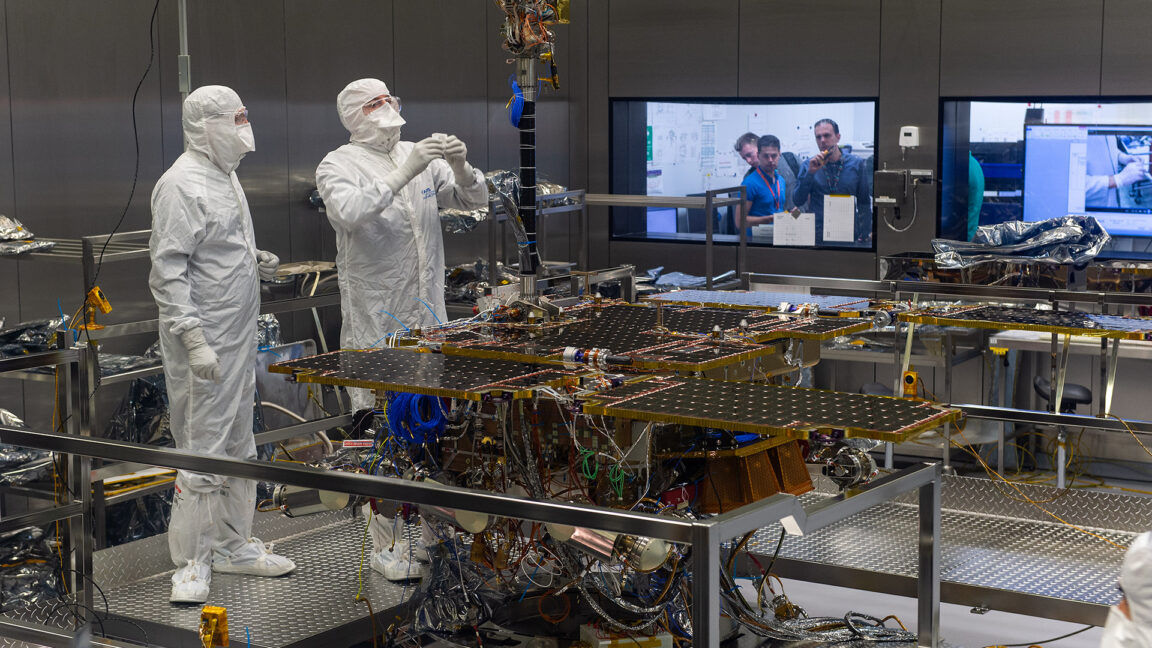
Europe’s long-delayed Mars rover has a new path to space
NASA has confirmed that SpaceX will launch the European Space Agency’s Rosalind Franklin rover on a Falcon Heavy rocket from Kennedy Space Center, with launch possible as soon as late 2028. The decision gives Europe’s flagship rover mission something it has lacked for much of its history: a firm ride to Mars.
That milestone matters because Rosalind Franklin has become one of the clearest examples of how ambitious planetary missions can be reshaped by budget pressure, shifting alliances and international conflict. The rover, developed as Europe’s first mission of its kind to the Martian surface, has survived repeated redesigns and multiple launch plans over nearly a quarter-century.
The current plan places the mission on its fourth rocket. Earlier versions of the program were tied at different times to a Russian Soyuz, then to United Launch Alliance Atlas V rockets under a NASA-ESA partnership, and later to a Russian Proton as the mission structure changed again. The Falcon Heavy assignment is the latest turn in that long sequence, but it is the first one in years to arrive with clear institutional backing after the mission’s most serious disruption.
A mission shaped by broken partnerships and funding shocks
The roots of Rosalind Franklin trace back to the early 2000s, when ESA set out to send a European rover to Mars under a program called Aurora. The original launch target was 2009. That schedule did not hold. Delays accumulated, plans changed and the rover project evolved into ExoMars, a broader Mars exploration effort.
In 2009, ESA and NASA signed an agreement to pursue Mars exploration together. Under that arrangement, the European rover would have traveled alongside a similarly sized US rover in 2018, while a European orbiter would launch in 2016 to study methane in the Martian atmosphere. NASA was to provide Atlas V launches for both missions and contribute key landing-system elements.
That framework unraveled in 2012, when the Obama administration cut most of NASA’s participation in ExoMars, citing budget constraints, including pressure from James Webb Space Telescope cost overruns. ESA did not have the funding to replace the lost US contributions on its own. To keep the mission alive, the agency turned to Russia, which became a major partner for both launches.
That arrangement also collapsed, this time because of geopolitics rather than budgets. Russia’s invasion of Ukraine forced a break in cooperation and left the rover without the launch and mission infrastructure it had been counting on. The result was another major delay and a new search for support.

Why the rover still matters
The endurance of Rosalind Franklin reflects the mission’s scientific value. The rover is designed to search for evidence related to extraterrestrial life, a goal that has made it central to Europe’s Mars ambitions for years. Its importance is not only scientific but institutional: it represents ESA’s long effort to field an independent rover mission after decades of robotic exploration led largely by the United States.
That is one reason the launch assignment is more than a transportation detail. It signals that the mission has moved from recovery mode back toward execution. For a project that has repeatedly had to start over with new partners and new timelines, a confirmed launcher is a decisive operational step.
NASA’s role in confirming a SpaceX launch for a European flagship mission also highlights how interdependent planetary exploration remains. Even when agencies seek autonomy, deep-space missions often depend on international arrangements for rockets, landing systems, scientific instruments and political support. Rosalind Franklin’s history makes that reality unusually visible.
Falcon Heavy gives the mission a stable near-term anchor
Falcon Heavy has emerged as a practical answer to a problem that repeatedly derailed the rover. The vehicle offers established heavy-lift capability from US soil and fits a broader pattern in which SpaceX has become a major launch provider for government and international missions. For ESA, securing Falcon Heavy removes one of the most obvious remaining uncertainties around the mission.
It does not erase the mission’s complexity. Mars exploration still demands a synchronized chain of launch, cruise, entry, descent and landing, any of which can threaten schedule and budget. Rosalind Franklin also carries the burden of long delay: hardware prepared years ago must still align with a mission architecture that has changed repeatedly. But the Falcon Heavy decision narrows the list of open questions.
The late-2028 target is also notable because it repositions the rover within the next wave of Mars planning rather than leaving it stranded as a legacy program from earlier decades. That shift could help restore momentum around a mission that has often been discussed more for its setbacks than for its science.

What this means for Europe’s Mars ambitions
If Rosalind Franklin launches on schedule, it will mark a significant moment for Europe’s role in planetary exploration. After years of dependence on external partners and repeated interruptions, ESA would finally send its rover toward Mars under a rebuilt mission framework. That would not erase the delays, but it would turn a long-running saga into an operational success story.
The rover’s path also offers a broader lesson for space policy. Large missions rarely fail for a single reason. Instead, they are stressed by the interaction of science goals, political cycles, industrial capacity, international cooperation and world events. Rosalind Franklin has experienced all of those pressures in one program.
For now, the immediate takeaway is straightforward: Europe’s first Mars rover finally has a launch vehicle again, and the mission is back on a concrete timeline. After years of broken promises and forced reinventions, that is real progress.
This article is based on reporting by Ars Technica. Read the original article.
Originally published on arstechnica.com


