A Different Take on Portable Input
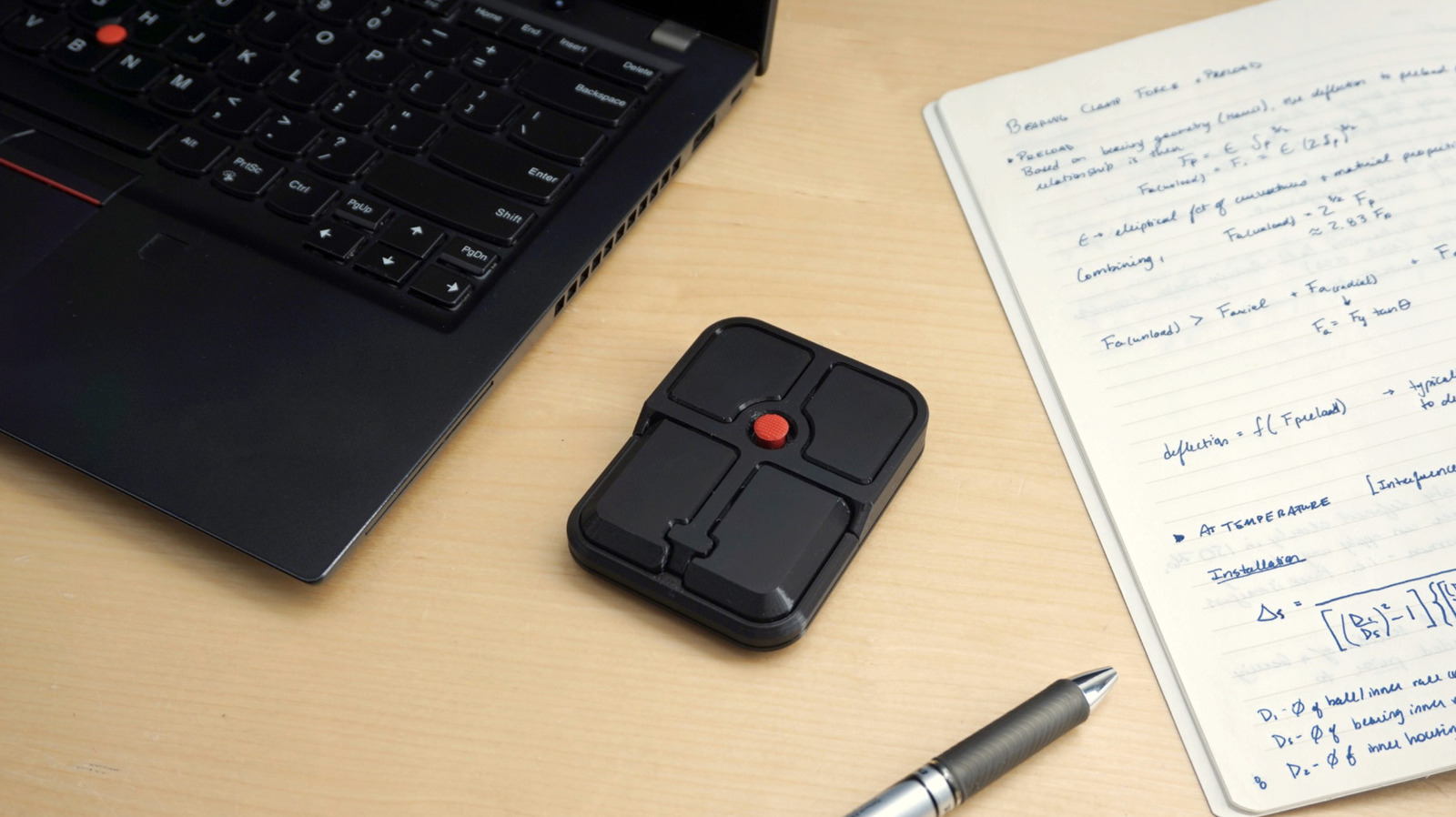
Ploopy has introduced a new compact pointing device called the Bean, aimed at travelers and mobile workers who need something smaller and less movement-dependent than a conventional mouse. On the surface it resembles a travel mouse, but its core input method is closer to a stationary trackpad or the pointing stick long associated with older laptop keyboards.
At the center of the device is a red control nub that handles cursor movement. Instead of sliding the whole device around a desk, users manipulate that nub directly. The concept targets an obvious problem in mobile work: cramped desks, narrow hotel tables, and temporary workspaces where a standard mouse is awkward to use.
Built for Tight Spaces
The Bean’s value proposition is less about novelty than about constraints. Traditional mice work best when users have enough room for lateral motion. Even many compact mice still need a clear surface and a familiar wrist posture. Ploopy’s design reduces that requirement by letting the hardware stay in place while the control nub registers movement input.
That makes the device particularly relevant for people working in transit-heavy environments. In practice, a stationary pointer can be easier to manage on a cluttered desk or in a temporary office setup. The device is explicitly framed for heavy travelers trying to stay productive in limited space, and that is where its unusual control scheme could find the most receptive audience.

High-Sensitivity Sensing
Ploopy says the Bean uses magnetic sensors from Texas Instruments and can detect movements as small as 3 microns. The nub can move up to 11 millimeters in all directions. Those figures are meant to distinguish it from the laptop pointing sticks that inspired the design, which are familiar but not always loved for precision work.
The company’s pitch is that this nub is much more sensitive than the ones commonly built into keyboards. If that translates well in real use, the Bean could appeal to users who like the concept of a stationary pointer but have always found legacy implementations too imprecise or fatiguing.
Custom Controls and Repairability
Surrounding the nub are four buttons, and Ploopy says they are fully customizable through the company’s firmware. That opens the door to macros and single-press combinations of keyboard inputs, giving the Bean some appeal beyond travel alone. Users who value programmable peripherals may see it as a compact productivity tool rather than just a novelty pointer.
The device also reflects a more maker-friendly design philosophy than most mainstream computer accessories. Ploopy says many components have been designed so users with a 3D printer can create their own replacements. That is a small but notable contrast with sealed consumer peripherals, which are often treated as disposable when parts fail or wear out.

The Tradeoffs Are Clear
The Bean is not wireless. It requires a USB-C connection, which immediately narrows its appeal for some laptop and tablet users. Wireless convenience is often a basic expectation in travel gear, and a cable adds friction in exactly the kinds of temporary setups the device is supposed to simplify.
There is also the question of lead time. Ploopy says the Bean is available to order now, but shipments could take up to 20 weeks. For a niche hardware product that may be acceptable, yet it puts the launch squarely in enthusiast territory rather than mass-market rollout.
Price is another factor. At about $51, the Bean is not prohibitively expensive, but it is also not an impulse buy for an unfamiliar input method. Buyers are being asked to pay for a distinct workflow, not just a cheaper mouse.
A Niche Device With a Real Use Case
The Bean is unlikely to redefine computing peripherals at large. It does not seem designed to. Instead, it represents a specific branch of hardware experimentation: building around user frustration that large accessory makers mostly ignore. That includes travel ergonomics, custom firmware, and maintainability.
What makes the launch notable is that it combines those priorities into a product that feels intentional rather than merely odd. The Bean may remain a specialist device, but it addresses a genuine problem with a design that is at least technically differentiated. In a peripheral market crowded with slight variations on the same mouse template, that alone gives it a reason to exist.
This article is based on reporting by Engadget. Read the original article.
Originally published on engadget.com