NASA’s most famous recent Earth image just became more interesting
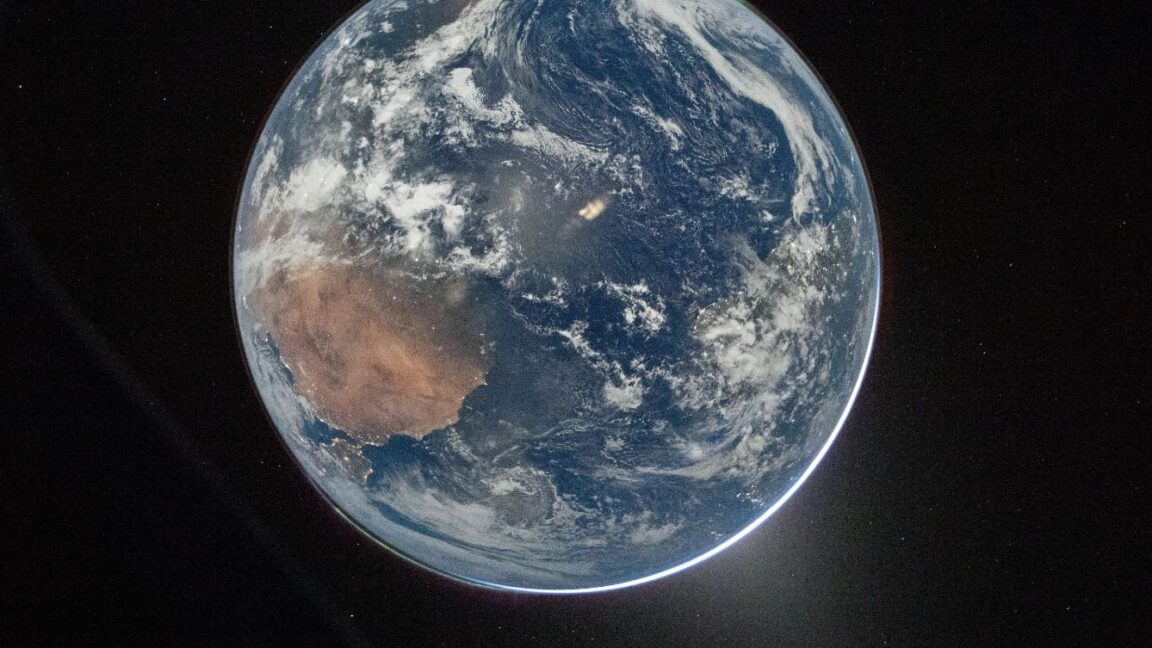
One of the standout images from the Artemis II mission was the “Hello, world” photograph taken by mission commander Reid Wiseman as Orion departed Earth for the Moon. Now a newly processed animation built from NASA’s recently released full photo archive has turned that already striking image into a richer and more puzzling visual record.
After last month’s flight, NASA released a curated selection of pictures from Artemis II. But only over the weekend did the agency publish the full trove of more than 12,000 images through the Gateway to Astronaut Photography. Buried inside that larger archive was a sequence of stills from the “Hello, world” moment, giving image processor Andy Saunders the material to build an animated composite.
The sequence covers just 80 seconds, but reveals much more
Saunders said he worked with 17 separate photos from the sequence, choosing the best consecutive set after excluding frames with different exposures or where Earth had drifted partly out of shot. He adjusted color and contrast in each frame and then animated the series.
The result is a view sped up by a factor of 30, covering one minute and 20 seconds of real time. In motion, details emerge that were not obvious in the original still image. Saunders said the animation reveals lightning storms, dancing aurora and satellites.

The satellite detail may be real, but not straightforward
The apparent satellites are among the most intriguing parts of the sequence. Ars Technica notes that the solar arrays on those objects seem visible, which would be surprising given the scale of the image. If taken literally, the panels would have to be on the order of a kilometer wide, which is not the case.
That means the most eye-catching detail in the animation may also be the least settled. The report suggests the solar-array appearance could be an optical effect caused by Orion’s window rather than a direct rendering of the structures themselves.
Even with that uncertainty, the sequence remains compelling. It does not need every visual feature to be fully explained in order to expand the value of the original image. Motion alone adds context that a single frame could not provide.
A bigger archive changes the story of the mission
The full release of more than 12,000 Artemis II images matters in its own right. Missions often become publicly legible through a small group of iconic photographs, but a complete archive can reveal overlooked moments, alternate angles and new scientific or visual interest long after the headline images have circulated.
Artemis II astronauts used three different cameras on the mission: a Nikon D5, a Nikon Z9 and an iPhone 17s. The archive includes hits, misses and unexpected gems, according to Ars Technica, and the “Hello, world” sequence appears to be one of those late discoveries that gains power when revisited with fresh processing.
Why this matters beyond aesthetics
The new animation is not just a better version of a popular photo. It is a reminder that space missions increasingly generate visual datasets that can be reinterpreted after the fact. Public archives are no longer static repositories. They are raw material for new analysis, restoration and storytelling.
In this case, a sequence that originally delivered a single iconic Earth view now also offers evidence of weather, auroral activity and at least the appearance of nearby human-made hardware. Whether some of the smallest details turn out to be optical artifacts or not, the broader effect is the same: the image now feels less like a postcard and more like a moving record of Earth and its orbital environment seen from a spacecraft on its way outward.
That is a fitting evolution for the “Hello, world” image. It began as a symbolic first look back at Earth from Orion. With the full archive finally released, it has become something more layered: a scene with motion, atmosphere, mystery and a stronger sense of just how much was in the frame all along.
This article is based on reporting by Ars Technica. Read the original article.
Originally published on arstechnica.com