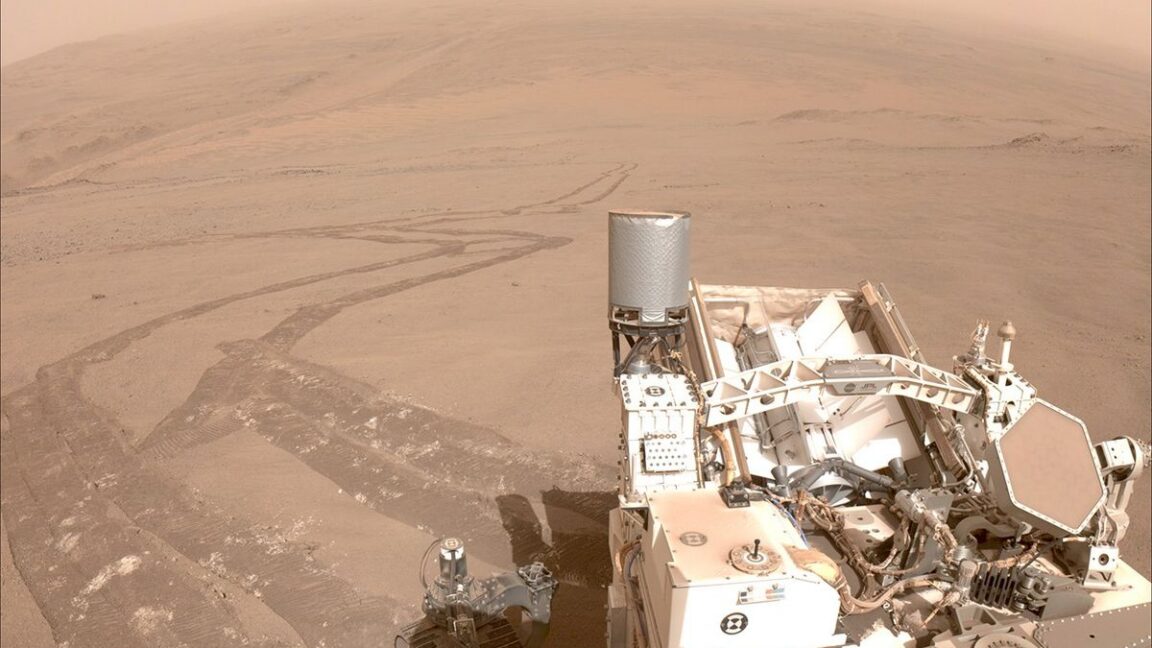
NASA’s Mars rover is about to reset the distance record
Sometime in the coming week, NASA’s Perseverance rover is expected to surpass 45.16 kilometers, or 28.06 miles, driven on Mars and become the longest-traveling vehicle on another world. The milestone would move it past Opportunity, the veteran rover that ended communications with NASA in 2018 after a career that helped define modern Mars exploration.
The raw distance matters, but the bigger story is how Perseverance got there so quickly. The rover landed on Mars in February 2021, meaning it is approaching the record in roughly a third of the time it took Opportunity. The key difference is not speed in the everyday sense. Perseverance remains a slow machine by terrestrial standards. The decisive upgrade is autonomy.
According to NASA’s Perseverance project manager Steven Lee, the rover’s auto-navigation system has been the enabling technology. Using onboard cameras and software, Perseverance can image the terrain around it, process those images locally, and calculate a safe route while continuing to move. That ability has transformed rover driving from a stop-and-think exercise into something closer to continuous motion.
A rover that can think while its wheels are turning
Self-driving systems on Earth usually rely on clearly marked roads, highly detailed maps, and traffic rules. Mars offers none of those conveniences. Instead, the rover has to deal with rocks, sandy slopes, uncertain traction, and a landscape where every route is effectively off-road. That makes autonomous mobility both harder and more consequential.
Perseverance’s advantage comes from a more capable onboard computing setup called the Vision Compute Element. Lee contrasted it with the older computer architecture on Curiosity, the rover that launched nine years earlier and remains active on Mars today. Curiosity had related imaging and navigation algorithms, but its hardware was far less capable. Some of its chipset dated back to the 1990s, which limited how much autonomous driving it could do in practice.
The result is a dramatic operational split. Only about 10 percent of Curiosity’s driving has been autonomous because its processing is too slow to support extensive real-time route planning. Perseverance, by contrast, has driven about 90 percent of its distance autonomously. That does not make it fast in a human sense. Its maximum wheel speed is only around 150 meters per hour. What it does make it is efficient. The rover no longer has to spend nearly as much time stopping to evaluate terrain before moving again.
That change is easy to miss if one focuses only on peak speed. On Mars, average progress matters more than top speed. A rover that can move steadily and safely over long stretches can cover much more ground over months and years than a rover that pauses frequently for navigation decisions. Perseverance’s looming record is therefore as much a software achievement as a mechanical one.

Why mobility changes the science
Distance on Mars is not a vanity metric. Every additional kilometer expands the range of scientific targets a rover can reach and the geological story it can reconstruct. Perseverance landed in Jezero Crater, a site selected because it preserves signs of an ancient river-delta system. The rover’s mission includes studying those rocks, collecting samples, and helping scientists understand whether the region once offered conditions suitable for microbial life.
That mission benefits directly from better autonomous driving. Mars science is constrained by time, power, terrain, and communication windows with Earth. If more of a rover’s operational budget is consumed by cautious movement, less is available for reaching outcrops, climbing slopes, and positioning instruments where they are most useful. By allowing the rover to handle more of the pathfinding itself, autonomy increases the practical radius of exploration.
The milestone also illustrates a broader truth about planetary exploration: computation is now part of the mobility system. Wheels, suspension, and motors still matter, but they no longer determine performance on their own. The ability to sense terrain, interpret hazards, and make route decisions locally has become equally central. In that sense, Perseverance’s record is not just about a rover outdriving its predecessors. It is about a shift in how robotic explorers are designed.
That shift could shape future missions well beyond Mars. As destinations become more distant or more operationally complex, the communication delay between Earth and spacecraft becomes an even stronger argument for onboard decision-making. A robot that can navigate, prioritize, and adapt without waiting for continuous human instruction can use scarce mission time far more effectively.
From Mars rover to proving ground for field autonomy
Perseverance’s success also highlights an aspect of autonomy that matters on Earth: the value of systems that work in unstructured environments. Self-driving cars in cities are one class of problem. Autonomous machines in mines, farms, disaster zones, military logistics corridors, or planetary surfaces are another. In those settings, there may be no lane lines, no polished maps, and no predictable traffic flow. The machine has to interpret a rough environment and keep moving safely.
Mars is the ultimate stress test for that kind of engineering. There is no possibility of roadside assistance, no quick repair, and no margin for careless risk-taking. Every drive combines caution with the need to make scientific progress. That balance helps explain why NASA’s autonomous navigation work draws attention far beyond the space sector. It is a concentrated demonstration of what practical robotics looks like when reliability matters more than spectacle.
Opportunity’s long career will remain one of the great achievements in exploration robotics, and Curiosity continues to deliver science. But Perseverance’s impending record signals a new phase. The rover is not merely lasting a long time; it is operating with a level of self-directed mobility that materially changes mission tempo.
If it passes Opportunity’s total in the next several days as expected, the headline will be a new record on another world. The deeper takeaway is that NASA has shown how a robot can keep making progress when it is trusted to see, decide, and drive for itself. On Mars, that capability is no longer experimental. It is now the reason the record book is being rewritten.
This article is based on reporting by Ars Technica. Read the original article.

Originally published on arstechnica.com