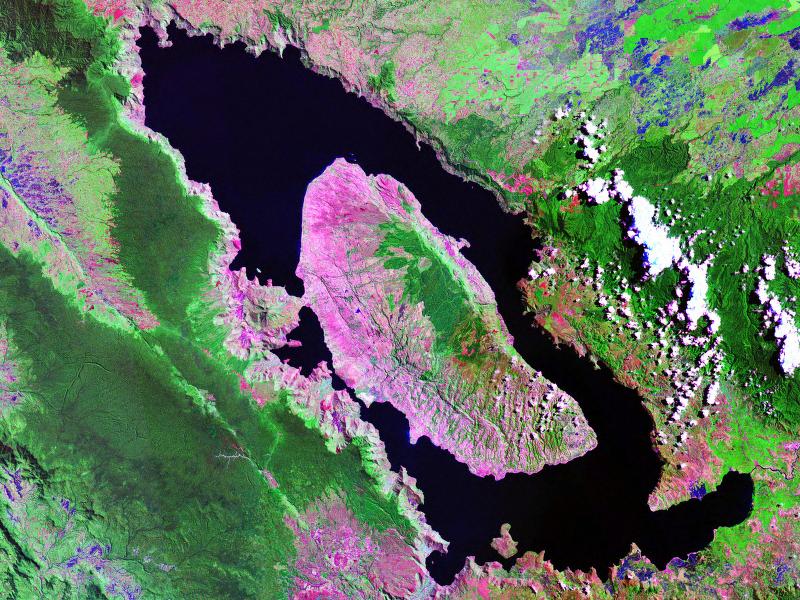
Ancient super-eruption, smaller climate shock
Mount Toba’s eruption around 74,000 years ago has long held a dramatic place in discussions of human prehistory. It was the largest volcanic eruption of the last 2.6 million years, emptying thousands of cubic kilometers of magma from a caldera in what is now Sumatra over roughly two weeks. Because of that scale, some researchers had argued that the event may have triggered a severe volcanic winter, cooled the planet sharply, and pushed early human populations toward collapse.
New research described by Ars Technica points in a much less catastrophic direction. A team led by geoscientist Jinheum Park of Johannes Gutenberg University Mainz examined mud from the bottom of a small crater lake on the Kenya-Tanzania border and found evidence that the eruption’s climate effects were shorter and weaker than some earlier scenarios suggested. Instead of years of extreme cooling, the researchers concluded that the impact lasted under two years and amounted to perhaps half a degree of cooling.
If that interpretation holds up, it would substantially weaken one of the most sweeping claims attached to the Toba event: that it nearly wiped out our species. The eruption remains extraordinary in geological terms. But extraordinary eruptions do not automatically produce civilization-ending or species-threatening climate effects.
Why Toba became a near-extinction candidate
The logic behind the older hypothesis was straightforward. Volcanic eruptions inject sulfur dioxide into the stratosphere, where it forms a haze of droplets that reflects incoming sunlight back into space. In general, more sulfur dioxide means more cooling. Toba was so large that it seemed plausible to treat it as an extreme case of that process, one capable of lowering temperatures enough to devastate ecosystems and early human populations.
But the new work emphasizes that the relationship is not endlessly linear. According to Park, once eruptions exceed a certain magnitude, the sulfate particles can become larger and settle more quickly because they are heavier. That means the atmosphere may clear faster than simple “bigger eruption, bigger cooling” models assume. In that view, the scale of the blast does not guarantee a proportionally larger or longer-lived climatic effect.
That point matters because estimates of Toba’s sulfur output have varied widely. Depending on which values researchers used, climate models could produce radically different outcomes, from a near-extinction event to something far milder. The debate has therefore turned on how to anchor those models to physical evidence rather than assumptions.

A better clock in the mud
One difficulty in reconstructing volcanic winters is timing. Scientists often look for ash layers or climate signals preserved in seafloor or lake sediments, but abrupt events can be blurred in those records. As sediment accumulates at the bottom of lakes and oceans, material from different years can mix. Even when cores are cut into thin slices, those slices can still combine signals from multiple years. That makes short, intense episodes difficult to resolve cleanly.
For long-term climate history, that limitation is manageable. Researchers can often track changes over decades. For volcanic cooling, which may last only one to three years, it becomes a central problem. A short-lived climatic shock can effectively disappear into the averaging effect of the sediment record.
The crater lake record used in the new study appears to have offered a sharper view. Rather than finding evidence for prolonged severe cooling, the team saw a more modest disturbance. That result suggests the eruption’s aftereffects were real but brief, and that the event may not support the strongest versions of the human bottleneck story built around it.
What this changes, and what it does not
The study does not make Toba unimportant. It remains one of the most powerful eruptions known in the geologic record, and even a cooling episode of less than two years could have mattered locally or regionally. What changes is the scale of the biological and climatic consequence being inferred from it.
The most important takeaway is methodological as much as historical. Grand narratives about ancient disasters often depend on sparse evidence, uncertain dating, and model assumptions that can amplify one another. Here, a more tightly constrained sediment record appears to cut against the largest claims. That does not mean the debate is over, but it does raise the standard for arguing that Toba drove humanity to the edge.
It also illustrates a broader lesson in Earth system science: massive physical events do not always translate neatly into equally massive long-term environmental outcomes. Atmospheric chemistry, particle size, settling rates, and local record quality all shape what a giant eruption actually does to the climate system.

Why the result matters now
Ancient eruptions draw attention because they are natural experiments in rapid climate forcing. Researchers use them to test how the atmosphere responds to sudden injections of material and how ecosystems absorb shocks. Toba is especially important because its size made it a boundary case. If even Toba’s climatic punch was limited in duration and moderate in magnitude, that changes how scientists think about the upper bound of volcanic cooling.
For human prehistory, the implications are equally significant. Claims that a single catastrophe nearly erased early humans are compelling, but they need evidence strong enough to separate dramatic possibility from durable explanation. This new reconstruction shifts the burden back toward caution. A bottleneck in human populations, if one occurred, cannot be assumed to follow directly from Toba’s eruption without stronger proof of extreme climatic stress.
In that sense, the study does not diminish the volcano. It makes the story more precise. Mount Toba may still have darkened skies and cooled temperatures, but the available evidence described here points to a shorter, milder disturbance than the near-apocalyptic version that became popular. For one of prehistory’s biggest eruptions, that is a consequential downgrade.
This article is based on reporting by Ars Technica. Read the original article.
Originally published on arstechnica.com